
Join us on a literary world trip!
Add this book to bookshelf
Grey
Write a new comment Default profile 50px
Grey
Subscribe to read the full book or read the first pages for free!
All characters reduced
The Man Who Laughs - cover

The Man Who Laughs

Victor Hugo

Publisher: Phoemixx Classics Ebooks

  • 0
  • 0
  • 0

Summary

The Man Who Laughs Victor Hugo - The Man Who Laughs is a romantic masterpiece of a man whose face has been disfigured into a laughing mask in childhood, the loyal blind girl who gives him her heart, and the cruelty of the privileged aristocracy whose laughing-stock and saviour he becomes.
Available since: 11/15/2021.
Print length: 555 pages.
Other books that might interest you

  • Everyday Leadership - Taking Charge in the Real World - cover

    Everyday Leadership - Taking...

    M.D. Ahron Friedberg, Sandra...

    • 0
    • 0
    • 0
    Everyday Leadership examines how individuals in everyday, relatively small settings can succeed in leadership positions. 


    The book provides tools for tackling the unique psychological and external challenges that everyday leaders face, and offers principles that they can adapt to their own situations. Dr. Ahron Friedberg, who regularly advises leaders and would-be leaders, emphasizes the social aspect of leadership, and explores how those who are new to leadership—and those in established positions—can leverage their support networks and thrive in their roles. The book follows the experience of real people who have faced leadership challenges and learned from them, demonstrating how listeners can learn from these examples and apply them to their own circumstances. Guided by a practical leadership roadmap, chapters examine concepts such as vision, determination, flexibility, planning, organization, and responsibility using extensive case studies, with reflective questions and key takeaways that help the listener consider how to apply these principles to their own leadership challenges. 


    This book is a must-listen for HR professionals, executive coaches, management consultants, leadership trainers, and organizational psychologists as well as those facing leadership challenges in their profession.
    Show book
  • Culinary Jailbreak - The Remarkable Tale of Freedom Won with an Unexpected Concoction - cover

    Culinary Jailbreak - The...

    John Harpoon

    • 0
    • 0
    • 0
    In the depths of confinement, where the walls are more than just bricks and mortar but a constant reminder of lost opportunities, an unexpected force emerged: food. This story is not just about escape in the traditional sense, but about breaking free from the psychological and emotional prisons that can often be more suffocating than physical ones. It is a testament to the unyielding human spirit, its capacity for creativity and resilience even in the most stifling of conditions. 
    Incarceration is a test of endurance. Every day is marked by repetition, isolation, and the stripping away of autonomy. It’s easy to feel like hope is a distant dream, slipping further away with each passing hour. But in the midst of despair, something remarkable happened—a plan was forged in the most unlikely of places: the prison kitchen. It was here, in a space designed to merely nourish the body, that a group of individuals came to realize the power of food as a vehicle for something greater: freedom. 
    The idea didn’t start as a grand blueprint or a well-thought-out escape plan. It began with the simple, shared joy of creating something from limited ingredients, turning mundane meals into small acts of rebellion. The kitchen, a place that was simultaneously a site of routine and surveillance, became a sanctuary for ingenuity. It was a space where culinary skills, often honed outside the confines of prison walls, found new purpose in the service of something far more important than sustenance—it became the key to unlocking doors that seemed forever closed.
    Show book
  • Today's Authors Series: Author and Entrepreneur Bo Peabody - Today's Authors Series - cover

    Today's Authors Series: Author...

    Bo Peabody

    • 0
    • 0
    • 0
    Listen as Bo Peabody, author of "Lucky or Smart?" and entrepreneur extraordinaire, discuss the businesses he started, how he was able to make them successful, and the place that intelligence, hard work and a little bit of good fortune have in the process. As Bo explains: “My formula for getting lucky in business is reasonably simple: Start a company that fundamentally innovative, morally compelling, and philosophically positive. Create and aura of authenticity around your start-up by carefully crafting your mission and communicating it with charisma and passion. Our company will quickly attract smart, inspired people who will work very hard. Treat all these people fairly. Provide them with a clear action plan and give them the latitude to exercise their creativity. The result: serendipity, luck, success, and, ultimately, money. And the only smart thing about this formula is that I understand that on a day-to-day basis my brain has very little to do with any of it.”
    Show book
  • Diary of a Man in Despair - cover

    Diary of a Man in Despair

    Friedrich Reck, Richard J. Evans

    • 0
    • 0
    • 0
    Hailed as one of the most important works on the Hitler period, this is an "astonishing, compelling, and unnerving" portrait of life in Nazi Germany between 1936 and 1944—from a man who nearly shot Hitler himself (The New Yorker). 


    Friedrich Reck might seem an unlikely rebel against Nazism. Not just a conservative but a rock-ribbed reactionary, he played the part of a landed gentleman, deplored democracy, and rejected the modern world outright. To Reck, the Nazis were ruthless revolutionaries in Gothic drag, and helpless as he was to counter the spell they had cast on the German people, he felt compelled to record the corruptions of their rule. 


    The result is less a diary than a sequence of stark and astonishing snapshots of life in Germany between 1936 and 1944. We see the Nazis at the peak of power, and the murderous panic with which they respond to approaching defeat; their travesty of traditional folkways in the name of the Volk; and the author's own missed opportunity to shoot Hitler. This riveting book is not only, as Hannah Arendt proclaimed it, "one of the most important documents of the Hitler period," but a moving testament of a decent man struggling to do the right thing in a depraved world.
    Show book
  • The Relevance of Emotion Regulation - cover

    The Relevance of Emotion Regulation

    Jim Colajuta

    • 0
    • 0
    • 0
    Daily, we all experience emotions, both happy and negative. Most of us learn how to control, express, and cope with our emotions healthy as youngsters. Emotion regulation is more challenging for some people, sometimes due to terrible childhood events like abuse or trauma, sometimes due to a biological vulnerability to emotional sensitivity, and sometimes due to not being shown or taught how to manage challenging emotions.We can learn to modify what feeling we experience, how intense it is when we have it, and how we react to it since emotions are not absolute and everlasting. Emotion regulation promotes psychological well-being and aids in the management of bad life events and stress.There are various advantages to having better emotion regulation strategies to handle your emotions. Individuals who exercise emotional regulation are more robust and manage better with life's stresses. They have more effective coping mechanisms and are more tolerant of stress. Emotion regulation is a protective factor against anxiety and depressive symptoms. Furthermore, children who can control their emotions have greater flexibility in their thinking and higher focus, impulse control, and problem-solving abilities. These advantages cascade, resulting in more self-assurance, emotional well-being, and general satisfaction.
    Show book
  • St Kilda: My Island Home - Christina MacDonald MacQueen - cover

    St Kilda: My Island Home -...

    Miles Kerr-Peterson, Michelle H...

    • 0
    • 0
    • 0
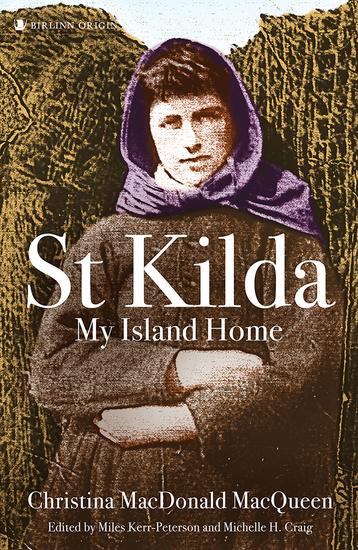
    Christina MacDonald MacQueen (1884–1959) was born on St Kilda and grew up there at the close of the 19th century. Yearning for the bright modern world beyond the island, she was the first woman to leave of her own accord in 1909, settling in Glasgow. During the crisis that led to the islands' evacuations in 1929-30, she wrote a series of passionate articles about her childhood and the history of the islands. These writings about St Kilda offer a personal and uniquely female perspective on the island's story and its imminent abandonment.
    This book includes all seventeen of her articles, which tell the full history of the island as she understood it, and sets their publication against the dates of the evacuation. These are complemented by a historical introduction and commentary. Despite extensive literature on the story of St Kilda, Christina's contributions have been largely overlooked by historians, though they offer valuable insights into the island's history and the evacuation's impact. To compliment the articles written by Christina, this volume includes a collection of photographs taken by her husband, Robert Chalmers, in 1930.
    Show book