
Rejoignez-nous pour un voyage dans le monde des livres!
Ajouter ce livre à l'électronique
Grey
Ecrivez un nouveau commentaire Default profile 50px
Grey
Abonnez-vous pour lire le livre complet ou lisez les premières pages gratuitement!
All characters reduced
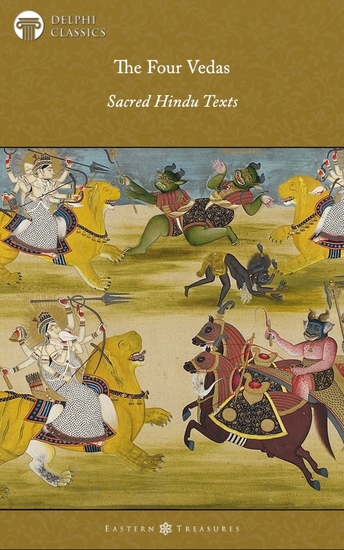
The Four Vedas - Sacred Hindu Texts Illustrated - cover

The Four Vedas - Sacred Hindu Texts Illustrated

The Four Vedas

Maison d'édition: Delphi Publishing Ltd

  • 0
  • 0
  • 0

Synopsis

The Four Vedas, the ‘Rigveda’, ‘Yajurveda’, ‘Samaveda’ and the ‘Atharvaveda’ are the primary texts of Hinduism. They comprise vast collections of poems and hymns, composed in archaic Sanskrit by Indo-European-speaking peoples that flourished in northwest India during the 2nd millennium BC. These sacred works celebrate a wide pantheon of gods, including natural and cosmic phenomena, as well as abstract qualities. The ‘Rigveda’, the foremost of the Vedas, is among the oldest extant texts of world literature. Noted for their beautiful language and metrical brilliance, these hymns reveal philosophical depth and great spiritual understanding. Delphi’s Eastern Treasures Series provides eReaders with rare and precious texts of Asian literature, featuring prominent works of history, fiction, religion and philosophy, complemented with the original texts.  This eBook presents the complete four Vedas, with illustrations, informative introductions and the usual Delphi bonus material. (Version 1)

 
* Beautifully illustrated with images relating to Vedas and their composition* Features the complete translations of the four Vedas of ancient India* Translations by Ralph T. H. Griffith and Arthur Berriedale Keith* Both the Black and White ‘Yajurveda’* Also includes the complete Sanskrit text of the ‘Rigveda’* Concise introduction to the Vedas* Excellent formatting of the texts* Easily locate the hymns you want to read with individual contents tables* Provides a special dual English and Sanskrit text of the ‘Rigveda’, allowing readers to compare the texts hymn by hymn — ideal for students* Features a bonus resource — discover Macdonell’s seminal study ‘A History of Sanskrit Literature’

 
CONTENTS:

 
The TranslationsRigvedaYajurveda (Black)Yajurveda (White)SamavedaAtharvaveda

 
The Original TextRigveda (Sanskrit Text)

 
The Dual TextRigveda (Sanskrit and English Text)

 
The ResourceA History of Sanskrit Literature (1900) by Arthur Anthony Macdonell
Disponible depuis: 30/03/2025.
Longueur d'impression: 8243 pages.

D'autres livres qui pourraient vous intéresser

  • Umbilical Cord - cover

    Umbilical Cord

    Hasan Namir

    • 0
    • 0
    • 0
    Dear Child
    Once upon a time
    Your baba fell in love with your dad
    
    We got married and dreamt of having a baby
    
    A roller coaster of emotions and feelings
    
    We were always hopeful
    Lambda Literary and Stonewall Book Award-winner Hasan Namir shares a joyful collection about parenting, fatherhood and hope. These warm free-verse poems document the journey that he and his husband took to have a child. Between love letters to their young son, Namir shares insight into his love story with his husband, the complexities of the IVF surrogacy process and the first year as a family of three. Umbilical Cord is a heartfelt book for parents or would-be parents, with a universal message of hope.
    Voir livre
  • Lycidas - Much shorter poem from the famed author of Paradise Lost - cover

    Lycidas - Much shorter poem from...

    John Milton

    • 0
    • 0
    • 0
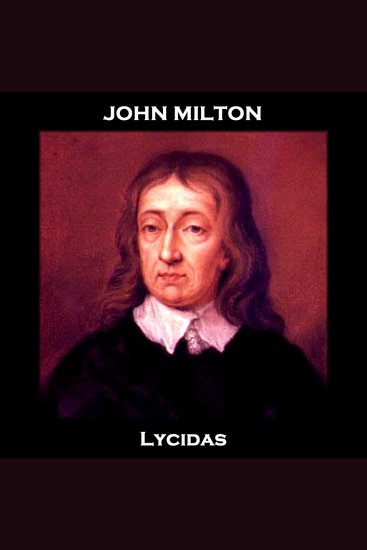
    John Milton was born in Bread Street, London, on December 9th, 1608.  His early years were privately tutored before gaining a place at St Paul’s School and in 1625 he matriculated at Christ's College, Cambridge, earning a BA in 1629 and an MA in 1632. At Cambridge he had developed a reputation for poetic skill but also experienced alienation from his peers and university life as a whole.  
    The next 6 years were spent in private study. He read both ancient and modern works of theology, philosophy, history, politics, literature and science, in preparation for a poetical career.  Milton mastered Latin, Greek, Hebrew, French, Spanish, and Italian. To these he would add Old English (whilst researching his History of Britain) and also acquired more than a passing acquaintance in Dutch.  
    Although he was studying, some of his poetry from this time is remarkable; L’Allegro and Il Penseroso in 1631 and Lycidias in 1638. 
    In May 1638, Milton embarked upon a 15 month tour of France and Italy. These travels added a new and direct experience of artistic and religious traditions, especially Roman Catholicism.  He cut the journey short to return home during the summer of 1639 because of what he claimed were "sad tidings of civil war in England."  
    Once home, Milton wrote prose tracts against episcopacy, in the service of the Puritan and Parliamentary cause.  
    He married 16-year-old Mary Powell in June 1643 but she left him after only a few months during which he wrote and published several writings on divorce. Mary did return after 3 years and their life thereafter seemed harmonious.  Milton received a hostile response to the divorce tracts and drove him to write Areopagitica, his celebrated attack on pre-printing censorship.  
    With the parliamentary victory in the Civil War, Milton wrote The Tenure of Kings and Magistrates (1649) which defended popular government and implicitly sanctioned the regicide which led to his appointment as Secretary for Foreign Tongues by the Council of State.  
    On 24 February 1652 Milton published his Latin defense of the English People, Defensio Pro Populo Anglicano, also known as the First Defense. Milton's Latin prose and intellectual sweep, quickly gained him a European reputation.  
    Tragically his first wife, Mary, died on May 5th, 1652 following the birth of their fourth child.   The following year Milton had become totally blind, probably due to glaucoma.  He then had to dictate his verse and prose to helpers, one of whom was the poet Andrew Marvell.  
    He married again to Katherine Woodcock but she died in February 1658, less than four months after giving birth to a daughter, who also tragically died.  
    Though Cromwell’s death in 1658 caused the English Republic to collapse Milton stubbornly clung to his beliefs and in 1659 he published A Treatise of Civil Power, attacking the concept of a state-dominated church. Upon the Restoration in May 1660, Milton went into hiding for his life. An arrest warrant was issued and his writings burnt. He re-emerged after a general pardon was issued, but was nevertheless arrested and briefly imprisoned before influential friends, such as Marvell, now an MP, intervened 
    His third marriage was to Elizabeth Mynshull. Despite a 31-year age gap, the marriage seemed happy and Milton spent the remaining decade of his life living quietly in London, apart from a short spell in Chalfont St. Giles, during the Great Plague of London.  
    Milton was to now publish his greatest works, which had been gestating for many years.  Paradise Lost, perhaps the classic English Epic poem was originally published in 10 books in 1667.  This was followed by Paradise Regained and Samson Agonistes in 1671.  Because of his anti-monarchy views their reception was muted but over the centuries since Milton has established himself as second only to Shakespeare.  He died of kidney failure on November 8th, 1674 and was buried in the church of St Giles Cripplegate.
    Voir livre
  • Dying To End It - cover

    Dying To End It

    Joey Sanchez

    • 0
    • 0
    • 0
    When Frank’s wife of many years is killed in a car accident and he is left badly injured, he quickly grows tired of life. No longer wishing to be a burden on his daughters who are missing out on their own lives by having to care for him, he hatches a plan. 
    Heading off out onto the mean streets of New York, the city he grew up in, Frank decides that he will find a way to end his life there without resorting to the sin of taking it himself. 
    However, his plans are thrown into confusion when he bumps into an old friend, Carlo. In years gone by Frank had helped Carlo, who was part of the Mafia, with fraudulent insurance claims but had turned his back on a life of crime, leading to Carlo being demoted by his bosses. 
    Now, the two old friends catch up on past times as Frank’s plans for his final hours slowly draw closer. But Carlo has a dark secret that he has kept from Frank. The resentment he had been carrying after being betrayed by his friend had been allowed to fester and boil to the surface, and now he is about to reveal the full shocking truth of his actions to him. 
    How will Frank react? Will he still be able to find a way to end his life on his terms? Or is that nagging feeling at the back of his mind about to show him something terrifying?
    Voir livre
  • James V: Katherine - cover

    James V: Katherine

    Rona Munro

    • 0
    • 0
    • 0
    'If a young woman made you smile, you wouldnae want to see her set on fire, would you?'
    Katherine Hamilton is a nineteen-year-old woman facing arrest and trial in the King's court, with only her quick wit as defence against execution.
    James V: Katherine is a dramatic interpretation of key events during a turbulent time in Scotland's history, events that changed the nation forever. It is also a play filled with hidden histories, deft comedy and a secret love story between two young women.
    Rona Munro's renowned James Plays are a breathtaking series of plays set during the reigns of Scotland's generations of Stewart kings. Each play stands alone as a thrilling depiction of a moment in Scottish history, full of playful wit and boisterous theatricality; taken together, the cycle is a uniquely compelling narrative of a nation tussling with its past and future.
    James V: Katherine was first staged at Capital Theatres' The Studio, in April 2024, directed by Orla O'Loughlin, before embarking on a Scottish tour. It was a co-production between Raw Material and Capital Theatres, who previously produced James IV: Queen of the Fight.
    Rona Munro is a writer who has written extensively for stage, radio, film and television. Earlier works in the James Plays cycle (I–III) have been performed at the National Theatre in London, across the UK and internationally, and have won Evening Standard and Writers' Guild of Great Britain Awards.
    Voir livre
  • The Lake Poets - Three of the titans of English poetry muse in one of Englands finest landscapes - cover

    The Lake Poets - Three of the...

    William Wordsworth

    • 0
    • 0
    • 0
    Strictly speaking The Lake Poets were not a movement or school of poetry they were only so named as such by The Edinburgh Review so that they could be disparaged. 
    It was a spectacular backfire! 
    The three main figures would be rightly seen as among the most monumental figures in English poetry - William Wordsworth, Samuel Taylor Coleridge and the under rated but immense Robert Southey, himself a thirty year poet laureate. 
    The profound majesty of the Lake District, an area of almost unequalled beauty, of mythical landscapes and beguiling charm influenced and acted as muse to their burgeoning talents. 
    Their creations have ennobled this poetry as an art form that is intense, lyrical, moving and above all deliciously satisfying. 
    This volume comes to you from Portable Poetry, a specialized imprint from Deadtree Publishing.  Our range is large and growing and covers single poets, themes, and many compilations.
    Voir livre
  • A Rhyme A Dozen ― The Stars - 12 Poets 12 Poems 1 Topic - cover

    A Rhyme A Dozen ― The Stars - 12...

    John Keats, A E Housman, James...

    • 0
    • 0
    • 0
    ‘A dime a dozen’ as known in America, is perhaps equal to the English ‘cheap as chips’ but whatever the lingua franca of your choice in this series we hereby submit ‘A Rhyme a Dozen’ as 12 poems on many given subjects that are a well-rounded gathering, maybe even an essential guide, from the knowing pens of classic poets and their beautifully spoken verse to the comfort of your ears. 
    1 - A Rhyme A Dozen - 12 Poems, 12 Poets, 1 Topic - The Stars - An Introduction 
    2 - Bright Star by John Keats 
    3 - Sonnet 14 - Not From the Stars Do I My Judgement Pluck by William Shakespeare 
    4 - Falling Stars by Rainer Maria Rilke 
    5 - Stars by A E Housman 
    6 - Evening Star by Edgar Allan Poe 
    7 - From Sunset to Star Rise by Christina Georgina Rossetti 
    8 - Stars by Sara Teasdale 
    9 - The Light of Stars by Henry Wadsworth Longfellow 
    10 - Places Among the Stars by Stephen Crane 
    11 - Star of Ethiopia by Lucian B Watkins 
    12 - When the Shy Star Goes Forth in Heaven by James Joyce 
    13 - Hymn To The North Star by William Cullen Bryant
    Voir livre