
Join us on a literary world trip!
Add this book to bookshelf
Grey
Write a new comment Default profile 50px
Grey
Subscribe to read the full book or read the first pages for free!
All characters reduced
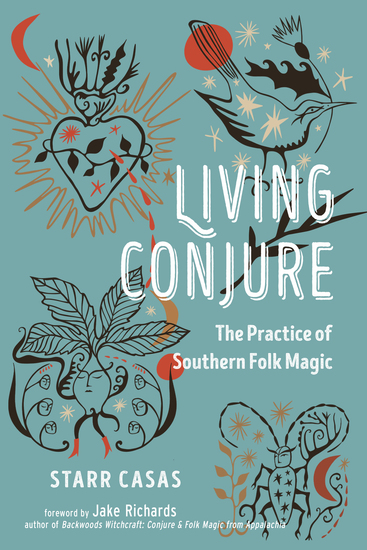
Living Conjure - The Practice of Southern Folk Magic - cover

Living Conjure - The Practice of Southern Folk Magic

Starr Casas

Publisher: Weiser Books

  • 0
  • 0
  • 0

Summary

A guide to Conjure as it has been practiced in the Deep South and passed down through the generations.  “If you’ve always dreamt of sitting at the feet of a backwoods grandma as she teaches you the ways of folk magic, your wishes have been heard. Mama Starr is a true, living encyclopedia of down-home rootwork, and reading Living Conjure is like sitting down at the kitchen table with her as she explains the old ways that were handed down to her. If you’ve been curious about Conjure or mystified by magic, this book will gently take you by the hand and give you the tools, rituals, and remedies to take control of your life on your terms.” —Madame Pamita, author of The Book of Candle Magic  “A fantastic resource for anyone interested in Southern Conjure or folk magic. Casas’s expertise and deep connection to this mystical world shine through every page of her book, making it both informative and enchanting. Starr Casas does it again, delivering another masterpiece of Southern folk magic.” —Mystic Dylan, author of Throwing Bones, Crystals, Stones, and Curios   A beginner-friendly guide to Conjure written by an authentic Conjure woman with over four decades of working experience, Living Conjure contains tips and tricks for the seasoned practitioner. Starr Casas learned Conjure the old-fashioned way: at home, from her relatives and ancestors—she is now sharing that knowledge with a new generation of practitioners. With this book, you can learn from a master.   In this foundational book, Mama Starr leads readers step-by-step toward establishing their own practice, from setting up altars to finding the right tools and creating baths, washes, and powders. Included in the book are venerations to the ancestors who passed down this knowledge and introductions to the culture and customs that brought these workings to light.
Available since: 08/05/2024.
Print length: 208 pages.


Other books that might interest you

  • Kiawah Island - A History - cover

    Kiawah Island - A History

    Ashton Cobb

    • 0
    • 0
    • 0
    Hurricane Michael may have taken away some of the landmarks, but this book reveals the history of Florida's Mexico Beach, once known as the "Unforgettable Coast." 


    As French interests in the Americas dwindled, records indicate very little activity around Mexico Beach until rumors of buried riches and sunken ships brought treasure hunters to the coast. In the early 1900s, businessman Felix du Pont purchased the land known today as Mexico Beach. Resin to make turpentine was harvested from the native pine trees, and fishermen could not resist the migratory fish passing through the area's waters. By the 1930s, United States Highway 98 was completed, and visitors could finally reach the sugar-soft sand beaches of the "Unforgettable Coast." By 1941, Tyndall Field was constructed and became a training site for Air Force pilots. In 1946, a group of farsighted businessmen, led by Gordan Parker, W.T. McGowan, and J.W. Wainwright, purchased 1,850 acres along the beach for $65,000. Parker's son Charlie moved to the area in 1949 with his wife, Inky, and their family. He soon took over development responsibilities for the Mexico Beach Corporation and laid the groundwork for the beach town known and loved today. Charlie went on to become the city's first mayor and a lifelong advocate of the family-friendly community.
    Show book
  • Oathsworn Brothers Divided - Ch21-40 of The Romance Of the Three Kingdoms (三国演义 Sānguó Yanyì) - cover

    Oathsworn Brothers Divided -...

    Luo Guanzhong, CH...

    • 0
    • 0
    • 0
    The oath is broken. The brothers are scattered. As the Han Dynasty's final embers die, the fires of all-out war ignite. 
    The explosive saga continues in Oathsworn Brothers Divided (Chapters 21-40), where alliances shatter and legends are tempered in betrayal. Liú Bèi, the virtuous claimant to the throne, becomes a fugitive, hunted by former allies. The god of war, Guān Yǔ, faces an impossible choice: break his oath or die for his honor, leading to his legendary submission to the ambitious Cáo Cāo. And the tempestuous Zhāng Fēi, drowning in shame and rage, must forge a broken army from the wilderness. 
    Meanwhile, Cáo Cāo’s ruthless genius reaches its zenith. He crushes rivals, consolidates power, and sets his sights on total domination of the north. But a new star rises to challenge him: the young, brilliant strategist Zhūgě Liàng (Crouching Dragon), who emerges from his thatched cottage to weave miracles of tactics and deception. His master plan sets the stage for the most legendary naval battle in history. 
    Navigate the Epic with ease with essential faction overviews, character breakdowns, and chapter summaries that illuminate the complex web of shifting loyalties. Hanyu Pinyin pronunciation (like Zhūgě Liàng, Sūn Quán, Zhōu Yú) deepens your immersion into this foundational tale. 
    The chessboard of China is set. The pieces are in motion. All paths lead to the Yangtze River, where the flames of Red Cliffs await to consume the hopes of empires.
    Show book
  • Modernising Irish Government - The Politics of Administrative Reform - cover

    Modernising Irish Government -...

    Neil Collins, Terry Cradden

    • 0
    • 0
    • 0
    Modernising Irish Government presents the major historical turning points in the development of Irish public services with a particular focus on the civil service, covering the mid-nineteenth-century reforms, the foundations of the State and the Lemass-Whittaker economic initiative. It introduces the Strategic Management Initiative, its origins and its impact, discussed in terms of efficiency, responsibility and democracy.
    Authors Neil Collins, Terry Cradden and Patrick Butler examine the current, key issues within the Civil Service, including the contentious issue of decentralisation. Providing reviews of the institutional framework for regulating monopolies in such sectors as telecommunications, aviation and retail competition, they present a critique of the new kinds of relationships between government and the people by reviewing Social Partnership, the Citizen Charters of government departments and other similar instruments.
    This textbook at once examines the scale, scope and structure of the delivery of services to the public and their relationship to the civil service, government departments, commercial semi-state companies and other public bodies, while identifying a number of significant failures in service delivery in detail and offering an analysis for their reasons.
    Show book
  • Logical Diversions and Misdirections - Tactics That Distract from the Truth (2 in 1) - cover

    Logical Diversions and...

    William Rands

    • 0
    • 0
    • 0
    This book consists of the following two titles: 
    - The Red Herring Fallacy: The Red Herring Fallacy is a common and effective tool for diverting attention from the main issue in an argument. It occurs when irrelevant information or topics are introduced into a discussion, leading the audience away from the core subject. The name "red herring" originates from an old English practice of using smoked fish to distract hunting dogs from a scent trail. In the context of logical reasoning, the concept is metaphorical, describing tactics that mislead or confuse. At its heart, the Red Herring Fallacy exploits our natural tendencies to become sidetracked by emotionally charged, intriguing, or seemingly relevant details. The distraction can take many forms: an unrelated anecdote, a tangential issue, or even an outright falsehood designed to provoke. These diversions can be deliberate, crafted to manipulate the audience, or unintentional, stemming from poor argumentation or misunderstanding. Regardless of intent, the result is the same—a shift in focus away from the actual matter at hand. 
    - The Straw Man Fallacy: The Straw Man Fallacy is one of the most pervasive forms of logical misrepresentation, often employed to simplify complex arguments for easier refutation. At its core, this fallacy involves constructing a distorted or exaggerated version of an opponent's position, subsequently attacking this weakened argument instead of addressing the original point. The technique, though logically flawed, can be compelling, as it plays on cognitive biases and simplifies discourse in ways that resonate with audiences.
    Show book
  • Boost Your Productivity: Unleash Hidden Secrets - "Elevate your productivity! Dive into transformative audio lessons that unlock hidden secrets for success" - cover

    Boost Your Productivity: Unleash...

    Cyrus Marwood

    • 0
    • 0
    • 0
    Boost Your Productivity: Unleash Hidden Secrets  
    ⭐⭐ Simplified Guide & Explanations Included ⭐⭐   
    Are you eager to advance in your career and solidify your knowledge for greater success and achievement?   
    Are you searching for a comprehensive guide that encompasses all the essentials for enhancing your mindset?   
    Look no further!   
    This guide is your ultimate companion for deepening your understanding, honing your skills, and engaging in practical exercises. With this resource, you're poised for success.   
    Updated for the latest strategies for success.   
    Key features of this enriched guide: 
    - Profound insights into enhancing your mindset for greater success and achievement   
    - Detailed explanations of techniques to boost productivity   
    - Effective strategies for preparation and execution   
    What sets our guide apart is its thorough coverage, vital for your success. Concepts aren’t just touched upon; they are explored in depth.   
    Please note that this guide is an independent resource and is not affiliated with any official entity.   
    With a clear structure and easily understandable language, our guide ensures seamless transitions between topics. Say goodbye to convoluted jargon and embrace clear, precise, and technically accurate content.   
    So, why hesitate? Click the BUY NOW button, secure your guide, and embark on your journey to enhanced productivity and success!  
    Show book
  • The Rise and Fall of Brazil's Economic Giants - cover

    The Rise and Fall of Brazil's...

    Anya Solace

    • 0
    • 0
    • 0
    Brazil’s industrial foundations were shaped by its colonial past, rich natural resources, and evolving economic policies. The country’s transition from an agrarian economy to an industrial powerhouse was a long and complex process influenced by global trade dynamics, government intervention, and social changes. Understanding these foundations provides insight into the rise and fall of Brazil’s economic giants. 
    The origins of Brazil’s economy date back to the colonial period under Portuguese rule. Initially, the country’s economic activities were centered around agriculture, particularly the production of sugarcane, which became the backbone of Brazil’s early commerce. The Portuguese established large sugar plantations, or engenhos, along the northeastern coast, relying heavily on enslaved labor from Africa. This agricultural-based economy set the stage for Brazil’s role as a key exporter of raw materials, a trend that would persist for centuries. As global demand for sugar declined in the 17th and 18th centuries, Brazil’s economy diversified into gold mining, particularly in the state of Minas Gerais. The discovery of gold and diamonds attracted European settlers and boosted trade, but much of the wealth was extracted by the Portuguese crown, limiting local reinvestment. The reliance on commodity exports, without substantial industrial development, created a pattern that continued into modern times. 
    Brazil’s shift toward industrialization began in the late 19th and early 20th centuries, spurred by the decline of slavery, urbanization, and increasing foreign investment. The abolition of slavery in 1888 led to significant demographic changes, with many freed individuals moving to urban centers in search of work. Around the same time, European immigrants arrived in large numbers, bringing skills that contributed to Brazil’s growing workforce. The coffee boom of the late 19th century played a crucial role in financing Brazil’s early industries.
    Show book