Unisciti a noi in un viaggio nel mondo dei libri!
Aggiungi questo libro allo scaffale
Grey
Scrivi un nuovo commento Default profile 50px
Grey
Iscriviti per leggere l'intero libro o leggi le prime pagine gratuitamente!
All characters reduced
The spider's web - cover

The spider's web

St. George Rathborne

Casa editrice: Good Press

  • 0
  • 0
  • 0

Sinossi

In "The Spider's Web," St. George Rathborne weaves a sophisticated narrative that intricately combines elements of mystery, suspense, and social commentary. Set against a backdrop of early 20th-century urban life, the novel explores the entangled lives of its characters as they navigate moral dilemmas and personal ambitions. Rathborne's literary style is characterized by meticulously crafted prose and vivid imagery, which immerses readers in a world rife with intrigue and hidden dangers that lurk beneath the surface of everyday existence. Through skillful dialogue and rich character development, the author cultivates a sense of tension that propels the narrative forward, making this book a compelling read for lovers of classic detective fiction. St. George Rathborne was an accomplished writer, known for his contributions to the genre of mystery and adventure. Drawing on his experiences and observations of society's complexities during his lifetime, Rathborne's work often reflected a keen awareness of the moral struggles faced by individuals in rapidly changing environments. His fascination with human psychology and moral ambiguity is evident in "The Spider's Web," demonstrating his prowess in capturing the essence of the era while exploring universal themes. This novel comes highly recommended for those who appreciate a well-crafted plot and rich character studies. Rathborne's adept storytelling and thoughtful engagement with the human condition makes "The Spider's Web" not only an entertaining read but also a profound exploration of the intricacies of human relationships. Delve into this remarkable narrative and uncover the secrets that lie within the web.
Disponibile da: 02/03/2025.
Lunghezza di stampa: 230 pagine.
Altri libri che potrebbero interessarti

  • The Beggar - cover

    The Beggar

    Anton Chekhov

    • 0
    • 0
    • 0
    The Beggar is a short story written by Anton Chekhov. The story revolves around the life of a blind beggar named Lushkov, who is trying to earn a living by begging on the streets. The story highlights the struggles of the poor and the difficulties they face in their daily lives.
    .
    Mostra libro
  • A Mystery - cover

    A Mystery

    Anton Pavlovich Chekhov

    • 0
    • 0
    • 0
    Classic short story about a mysterious signature that puzzled everybody around.
    Mostra libro
  • Mansfield Park - cover

    Mansfield Park

    Jane Austen

    • 0
    • 0
    • 0
    Taken from the poverty of her parent's home in Portsmouth, Fanny Price is brought up with her rich cousins at Mansfield Park, acutely aware of her humble rank and with her cousin Edmund as her sole ally. During her uncle's absence in Antigua, the Crawfords arrive in the neighborhood bringing with them the glamour of London life and a reckless taste for flirtation. Mansfield Park is considered Jane Austen's first mature work, with its quiet subtle examination of social position and moral integrity. 
     
    Jane Austen was an English novelist known primarily for her six major novels, which interpreted, critiqued, and commented upon the British landed gentry at the end of the 18th century. Austen's plots often explore the dependence of women on marriage in the pursuit of favorable social standing and economic security.
    Mostra libro
  • Is There a People? (Unabridged) - cover

    Is There a People? (Unabridged)

    H. G. Wells

    • 0
    • 0
    • 0
    Herbert George Wells (21 September 1866 - 13 August 1946) was an English writer. Prolific in many genres, he wrote dozens of novels, short stories, and works of social commentary, history, satire, biography and autobiography. His work also included two books on recreational war games. Wells is now best remembered for his science fiction novels and is often called the "father of science fiction", along with Jules Verne and the publisher Hugo Gernsback.
    IS THERE A PEOPLE?: Of all the great personifications that have dominated the mind of man, the greatest, the most marvellous, the most impossible and the most incredible, is surely the People, that impalpable monster to which the world has consecrated its political institutions for the last hundred years.
    Mostra libro
  • The Seed of McCoy - cover

    The Seed of McCoy

    Jack London

    • 0
    • 0
    • 0
    “The Seed of McCoy” written by Jack London: The Pyrenees, her iron sides pressed low in the water by her cargo of wheat, rolled sluggishly, and made it easy for the man who was climbing aboard from out a tiny outrigger canoe. As his eyes came level with the rail, so that he could see inboard, it seemed to him that he saw a dim, almost indiscernible haze. It was more like an illusion, like a blurring film that had spread abruptly over his eyes. He felt an inclination to brush it away, and the same instant he thought that he was growing old and that it was time to send to San Francisco for a pair of spectacles.
    Mostra libro
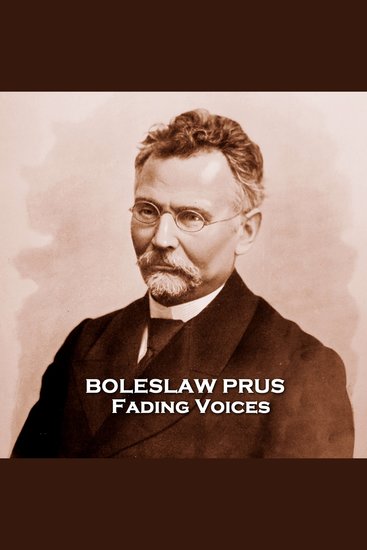
  • Fading Voices - From their pens to your ears genius in every story - cover

    Fading Voices - From their pens...

    Boleslaw Prus

    • 0
    • 0
    • 0
    Aleksander Głowacki who wrote under the nom de plume Boleslaw Prus was born on 20th August 1847 at Hrubieszów in the Kingdom of Poland, at that time, controlled by the Russian Empire. 
    At three his mother died and then at nine his father.  Female relatives helped raise him but at 15 he joined the Polish uprising against the might of Imperial Russia.  Wounded on the battlefield, arrested and imprisoned, he was later released into the care of a relative and resumed secondary school and then Warsaw University but poverty forced him to leave after two years.  At some point he developed agoraphobia which often caused problems. 
    In 1869, he enrolled in the Forestry Department at Puławy but was soon sacked and so he began a system of self-education that led to work as a newspaper columnist on a wide-ranging series of topics that eventually became the ‘Weekly Chronicles’ and spanned 40 years. 
    With his finances now stabilized he married and then adopted his late brother-in-law’s son.  
    It seems he had doubts as to the scale of his talents and early on adopted the name ‘Boleslaw Prus’ for both his journalistic and literary offerings. 
    His work as a short-story writer met with much acclaim. He wrote several dozen of them, originally published in newspapers and ranging in length from micro-story to novella. His keen observation of everyday life and sense of humor are evident in them.  
    During his career he also wrote novels. After ‘Pharoah’, in 1895, he embarked on a four-month journey taking in Berlin, Dresden, Nuremberg, Rapperswil in Switzerland, where he stayed for two months, and his final destination, Paris.  Here his agoraphobia was so bad he couldn’t cross the Seine.  
    However, his writing continued and in 1911 his novel ‘Changes’, though uncompleted, began to be serialised.  It was never finished. 
    Boleslaw Prus died on 19th May 1912, at his Warsaw apartment.  He was 64.  A National Hero, thousands attended both his funeral service and interment.
    Mostra libro