Unisciti a noi in un viaggio nel mondo dei libri!
Aggiungi questo libro allo scaffale
Grey
Scrivi un nuovo commento Default profile 50px
Grey
Iscriviti per leggere l'intero libro o leggi le prime pagine gratuitamente!
All characters reduced
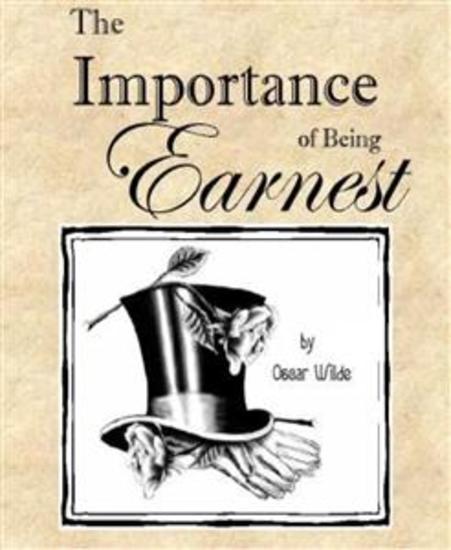
The Importance of Being Earnest - cover

The Importance of Being Earnest

Oscar Wilde

Casa editrice: BookRix

  • 0
  • 0
  • 0

Sinossi

The Importance of Being Earnest is a play by Oscar Wilde.  it is a farcical comedy in which the protagonists maintain fictitious personae in order to escape burdensome social obligations. Working within the social conventions of late Victorian London, the play's major themes are the triviality with which it treats institutions as serious as marriage, and the resulting satire of Victorian ways. Contemporary reviews all praised the play's humor, though some were cautious about its explicit lack of social messages, while others foresaw the modern consensus that it was the culmination of Wilde's artistic career so far. Its high farce and witty dialogue have helped make The Importance of Being Earnest Wilde's most enduringly popular play.

The successful opening night marked the climax of Wilde's career but also heralded his downfall. The Marquess of Queensberry, whose son Lord Alfred Douglas was Wilde's lover, planned to present the writer with a bouquet of rotten vegetables and disrupt the show. Wilde was tipped off and Queensberry was refused admission. Soon afterwards their feud came to a climax in court, where Wilde's homosexual double life was revealed to the Victorian public and he was eventually sentenced to imprisonment. His notoriety caused the play, despite its early success, to be closed after 86 performances. After his release, he published the play from exile in Paris, but he wrote no further comic or dramatic work.
Disponibile da: 19/12/2023.
Lunghezza di stampa: 84 pagine.

Altri libri che potrebbero interessarti

  • Shadows In the Moonlight - Poems and Short Stories - cover

    Shadows In the Moonlight - Poems...

    Rachel Lawson

    • 0
    • 0
    • 0
    This is a mixture of other short stories and poems , dark, romantic and light themed read by the author and the Mortal Coil players 
    Good quotes from Stand and Deliver: In The Moonlight- 
    "Stand and deliver, your money or your life!" shouted the highwayman. 
    "I hear that you met a real highwayman the other day I wish I had been with you. They are so thrilling and romantic!" 
    "Hand over your loot! Either give it to me now or I will take it from your body!" Terrence the Terror said. 
    "I said give it back, Terry!" said Sir Justin. 
    "Tom your friend is a nut!" Mary said. 
    "What did he do murder the driver so he could drive the coach?" asked Sir Thomas. 
    "I bailed up the Terror and took your sister's stuff back as she was under my care!" said Sir Justin. 
    "New to this are you lad!" said one of them. 
    "Terry I think you killed him!" said one of the others he was the black-clad highwayman named the Ghost for his sudden appearances and disappearances. 
    "I just found her here, I was on my way to see you." 
    "I have never seen anything so beautiful! I could forget everything and live in this moment forever"
    Mostra libro
  • More American - cover

    More American

    Sharon Hashimoto

    • 0
    • 0
    • 0
    Poetry. Asian & Asian American Studies. Winner of the 2021 Off the Grid Poetry Prize. In MORE AMERICAN, poet Sharon Hashimoto reconstructs a collective memory, conjuring the voices of grandparents, children, soldiers, and "those left to tell." In moving detail, these poems convey the realities of assimilation, service, and internment as experienced by Japanese Americans during, and in the decades following, the Second World War. In this stunning second collection, Hashimoto reckons with the limitations of language, and by extension, notions of citizenship. She deftly sounds the dissonances in the language of loyalty and allegiance.
    Mostra libro
  • Sunset at the Villa Thalia - cover

    Sunset at the Villa Thalia

    Alexi Kaye Campbell

    • 0
    • 0
    • 0
    A funny and passionate play from the author of The Pride and The Faith Machine.
    April 1967. Greece is in political turmoil. Charlotte and Theo have retreated to a small island in search of peace and inspiration. But when they meet a charismatic American couple at the port they are seduced into making choices with devastating consequences.
    Alexi Kaye Campbell's play Sunset at the Villa Thalia spans a decade as it explores the impact of foreign influence, planned and unintentional, on a nation and its people.
    It premiered at the National Theatre, London, in 2016, in a production directed by Simon Godwin.
    Mostra libro
  • The Poetry of Weddings - cover

    The Poetry of Weddings

    W B Yeats, Kahlil Gibran,...

    • 0
    • 0
    • 0
    Whilst those of us old enough to remember the sixties might have thought weddings would become obsolete for all but the faithful, they still seem for the majority of us to be the benchmark, the gold standard of a relationship. 
     
    This symbol of love, commitment and sacrifice between two people, albeit for most, no longer mirroring the union between God and His Church, endures.  Others have found other words with which to celebrate, share and state their love, their spiritual and emotional commitment in front of family, friends and the wider world. 
     
    This wide-ranging and inclusive volume contains some of the most beautiful verses ever created in the English language from some of its greatest classic poetical voices including Shakespeare, John Donne, John Keats, Edna St Vincent Millay and Sara Teasdale.   
     
    Whether conventional, convenient or gimmicky, love is the theme and the feeling and used to offer the vows without focusing on the religious but still providing the personal and universal of that very mysterious emotion, love.
    Mostra libro
  • Ten Bridges I've Burnt - A Memoir in Verse - cover

    Ten Bridges I've Burnt - A...

    Brontez Purnell

    • 0
    • 0
    • 0
    In Ten Bridges I've Burnt, Brontez Purnell—the bard of the underloved and overlooked—turns his gaze inward. A storyteller with a musical eye for the absurdity of his own existence, he is peerless in his ability to find the levity within the stormiest of crises. Here, in his first collection of genre-defying verse, Purnell reflects on his peripatetic life, whose ups and downs have nothing on the turmoil within. "The most high-risk homosexual behavior I engage in," Purnell writes, "is simply existing." 


    The thirty-eight autobiographical pieces pulsing in Ten Bridges I've Burnt find Purnell at his no-holds-barred best. He remembers a vicious brawl he participated in at a poetry conference and reckons with packaging his trauma for TV writers' rooms; wrestles with the curses, and gifts, passed down from generations of family members; and chronicles, with breathless verve, a list of hell-raising misadventures and sexcapades. Through it all, he muses on everything from love and loneliness to capitalism and Blackness to jogging and the ethics of art, always with unpredictable clarity and movement. 


    With the same balance of wit and wisdom that made 100 Boyfriends a sensation, Purnell unleashes another collection of boundary-pushing writing with Ten Bridges I've Burnt, a book as original and thrilling as the author himself.
    Mostra libro
  • The Poetry of Thomas Chatterton - Despite tragically committing suicide at only 17 Chattertons influence would stretch far beyond his years being a huge spark to poets such as Shelley Keats Wordsworth and Coleridge - cover

    The Poetry of Thomas Chatterton...

    Thomas Chatterton

    • 0
    • 0
    • 0
    Thomas Chatterton was born in Bristol on 20th November 1752 some 15 weeks after the death of his father. For a time he was admitted to Edward Colston's Bristol charity school, on a limited curriculum of reading, writing, arithmetic and the catechism. 
      
    Although fascinated by the church of St Mary Redcliffe where his uncle was sexton, he was liable to fits of abstraction, sitting for hours in a trance or crying for no reason. When Chatterton was 8 he was so eager for books that he would read and write all day long and by 11 he had become a contributor to Felix Farley's Bristol Journal. He lived in thought with his 15th-century heroes and heroines. 
      
    The first of his literary mysteries, the dialogue of "Elinoure and Juga," was written before he was 12, and he showed it to the usher at the boarding school Colston's Hospital where he was a pupil, pretending it was the work of a 15th-century poet. Chatterton remained a boarder at Colston's Hospital for more than six years. His little pocket-money was spent borrowing books from a circulating library and always attempting to ingratiate himself with book collectors. 
      
    His holidays were mostly spent at his mother's house, and much of that in the attic study living for the most part in an ideal world of his own, centered on his mid-15th century imaginary world. 
      
    Chatterton soon conceived the romance of Thomas Rowley, an imaginary monk of the 15th century, and adopted for himself the pseudonym Thomas Rowley for poetry and history. He imagined he would become a famous poet who by his talents would be able to rescue his mother from poverty. 
      
    Chatterton needed a patron. Many were not interested. Horace Walpole was but discovering that the poems were most probably fake and Chatterton himself only 16 scornfully sent him away. 


    Badly hurt by Walpole's snub, Chatterton wrote very little for a summer. Then he turned his attention to periodical literature and politics, and the London periodicals. He was frequently published but received little reward for his startling efforts. 
      
    Chatterton wrote at Easter 1770, ‘‘Last Will and Testament,’’ a satirical mix in jest and seriousness. The will was possibly prepared so that John Lambert, the attorney to whom he was apprenticed, cancelled his indentures. His friends and acquaintances, having donated money, Chatterton proceeded to London. 
      
    He continued to write and publish in various styles and was paid little for his efforts. He wrote hopefully to his mother and sister, and spent his first earnings in buying gifts for them. 
      
    In June 1770, after nine weeks in London, he moved from a shared room in Shoreditch to an attic in Brook Street, Holborn. He now enjoyed uninterrupted solitude and now could write all night. The romance of his earlier years revived, and he transcribed from an imaginary parchment of the old priest Rowley his "Excelente Balade of Charitie." This poem, disguised in archaic language, he sent to the editor of the Town and Country Magazine, where it was rejected. 
      
    A neighbouring apothecary, repeatedly invited him to come for dinner or supper; but he refused. His landlady also, suspecting his necessity, pressed him to share her dinner, but in vain. "She knew," as she afterwards said, "that he had not eaten anything for two or three days." But he assured her that he was not hungry. 
      
    In August 1770, while walking in St Pancras Churchyard, Chatterton was much absorbed in thought, and did not notice a newly dug open grave in his path, and subsequently tumbled into it. His walking companion helped Chatterton out of the grave, and told him that he was happy in assisting at the resurrection of a genius. Chatterton replied, "My dear friend, I have been at war with the grave for some time now." 
     
    On 24th August 1770, Thomas Ch
    Mostra libro