
Join us on a literary world trip!
Add this book to bookshelf
Grey
Write a new comment Default profile 50px
Grey
Subscribe to read the full book or read the first pages for free!
All characters reduced
A Spelling-Book for Advanced Classes - cover

A Spelling-Book for Advanced Classes

Oliver Optic

Publisher: DigiCat

  • 0
  • 0
  • 0

Summary

In "A Spelling-Book for Advanced Classes," Oliver Optic presents an innovative approach to language education, targeting the evolving needs of advanced learners. The book is characterized by its systematic structure, merging traditional spelling exercises with contemporary usage and vocabulary. Written in a clear, accessible style, it draws upon rich pedagogical insights, reflecting the educational reforms of the late 19th century. This work serves as a vital resource, catering to the linguistic skill development essential for students preparing for more complex literary and academic challenges. Oliver Optic, the pen name of William Taylor Adams, was an influential American author and educator renowned for his engaging children's literature. His background as a teacher and his belief in the transformative power of education profoundly shaped his literary pursuits. The urgency of providing practical educational resources during a time of societal change motivated Adams to produce this work, which emphasizes clarity, engagement, and intellectual growth in young learners. "A Spelling-Book for Advanced Classes" is highly recommended for educators, parents, and students seeking to enrich their vocabulary and spelling comprehension. Its thoughtful design aids in fostering linguistic proficiency, making it an indispensable addition to any educational library.
Available since: 09/16/2022.
Print length: 38 pages.

Other books that might interest you

  • Instant Zen - Waking Up in the Present - cover

    Instant Zen - Waking Up in the...

    Thomas Cleary

    • 0
    • 0
    • 0
    Find yourself and tune in: such is the message of Zen. Instant Zen presents the teachings of Foyan, a twelfth-century Chinese Zen master recognized as one of the greatest masters of the Song dynasty Zen renaissance in China. These simple exercises by Foyan lead you to the awakening of insight into the real nature of self and emphasize independence and autonomy, two qualities vital to seeing and acting clearly. Newcomers will find this a useful and sophisticated introduction to authentic inner Zen practices without cultural exoticism or religious cultism. Experienced practitioners will benefit from this guide from an impeccable source and experience a return to the uncomplicated genuineness of the original Zen masters.
    Show book
  • Queen Amanirenas - cover

    Queen Amanirenas

    History Nerds

    • 0
    • 0
    • 0
    In the heart of ancient Africa, a formidable queen emerged to defend her people and her kingdom against the encroaching Roman Empire. "Queen Amanirenas" is a gripping short book that unveils the captivating story of one of history's most remarkable and fearless female leaders. 
    Amanirenas, the queen of the Kingdom of Kush in the 1st century BCE, was not your typical monarch. In an era dominated by powerful male rulers, she rose to prominence as a brilliant strategist and an indomitable warrior. This book takes you on a journey through the shifting sands of the Nubian desert, where Amanirenas led her people in a fierce battle for survival against the might of Rome. 
    Discover the incredible life and legacy of Queen Amanirenas, whose resolute spirit and unwavering determination have left an indelible mark on the annals of history. From her early days as a princess to her pivotal role in the Meroitic War, this book explores the highs and lows of her reign, painting a vivid portrait of a woman who refused to be conquered. 
    "Queen Amanirenas" offers a window into a forgotten chapter of African history, celebrating the strength and courage of a queen who defied the odds and defended her people against a relentless adversary. Whether you're a history enthusiast or simply curious about the extraordinary lives of powerful women in the past, this short book will leave you inspired and awestruck by the extraordinary legacy of Queen Amanirenas.
    Show book
  • Wisdom and Destiny - cover

    Wisdom and Destiny

    Maurice Maeterlinck

    • 0
    • 0
    • 0
    In "Wisdom and Destiny," Maurice Maeterlinck explores the intricate interplay between human consciousness and the cosmic order. Through profound reflections on fate, free will, and the mysteries of existence, Maeterlinck delves into the essence of wisdom. With eloquent prose, he contemplates the timeless questions that shape the human experience, offering a philosophical journey into the heart of destiny. Read in English, unabridged.
    Show book
  • Experiment A: What should a God want? - What should a God want? - cover

    Experiment A: What should a God...

    Hooman

    • 0
    • 0
    • 0
    If there is a Singularity- the creator of everything and everyone, what should it want for us, humans. 
    What if you were subjected to the same choices that the Creator made prior to the creation of humans and beyond. 
    To the best of our natural imagination.
    Show book
  • Polyvagal Prompts - Finding Connection and Joy through Guided Explorations - cover

    Polyvagal Prompts - Finding...

    LCSW Deb Dana, LCPC Courtney Rolfe

    • 0
    • 0
    • 0
    Discover the remarkable ways your nervous system works in service of your safety and well-being. 


    Polyvagal Theory, developed by researcher and scientist Dr. Stephen Porges and popularized by therapist Deb Dana, has impacted countless lives. It has changed the way therapists work with their clients and provided a pathway toward healing for those who have experienced hardship or trauma. In Polyvagal Prompts, Deb Dana and Courtney Rolfe invite listeners to explore their nervous systems through Polyvagal Theory with engaging questions and exercises. Listeners are guided in noticing their systems, listening with curiosity, and reflecting on what they learn. The prompts can be used as a daily practice or to explore specific topics at the listener's own pace and are also ideal for helping clients track and reflect upon their polyvagal-informed therapies. No matter how listeners decide to explore, Polyvagal Prompts offers an invaluable opportunity to begin the life-changing journey of befriending one's nervous system.
    Show book
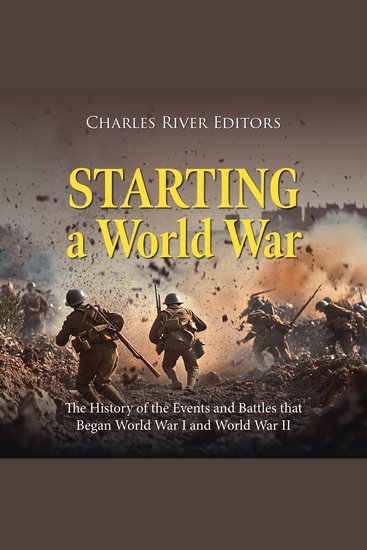
  • Starting a World War: The History of the Events and Battles that Began World War I and World War II - cover

    Starting a World War: The...

    Editors Charles River

    • 0
    • 0
    • 0
    By the 20th century, warfare was nothing new to the European powers, especially when it came to fighting each other. Conflicts had been a mainstay on the European continent for over two millennia. Even after the Napoleonic wars had enveloped Europe in large scale war for nearly 20 years in the 19th century, the Europeans’ imperialism continued unabated. It would take the devastation of World War I to shock Europe and jolt the world’s superpowers out of their imperialistic tendencies.  
    	With Europe anticipating a potential war, all that was missing was a conflagration. That would start in 1908, when Austria-Hungary annexed Bosnia-Herzegovina in the Balkan Peninsula, drawing it into dispute with Russia. Moreover, this upset neighboring Serbia, which was an independent nation. From 1912-1913, a conflict was fought in the Balkans between the Balkan League and the Ottoman Empire, resulting in the weakening of the Ottoman Turks. After the First Balkan War, a second was fought months later between members of the Balkan League itself. The final straw came June 28, 1914, when a Serbian assassinated Archduke Franz Ferdinand, the heir to the throne of Austria-Hungary, in Sarajevo, Bosnia.   
    The Munich Agreement is widely reviled today and is held up as the epitome of appeasement, but historians still debate its effects on the Second World War, as well as Neville Chamberlain's character and motivations. Some believe the attempted appeasement of Nazi Germany hastened, or even caused, the mayhem occupying the next seven years. Others believe that the pact merely failed to alter war's inevitable arrival in either direction.  
    Of course, as most people now know, the invasion of Poland was merely the preface to the Nazi blitzkrieg of most of Western Europe, which would include Denmark, Belgium, and France by the summer of 1940
    Show book