Join us on a literary world trip!
Add this book to bookshelf
Grey
Write a new comment Default profile 50px
Grey
Subscribe to read the full book or read the first pages for free!
All characters reduced
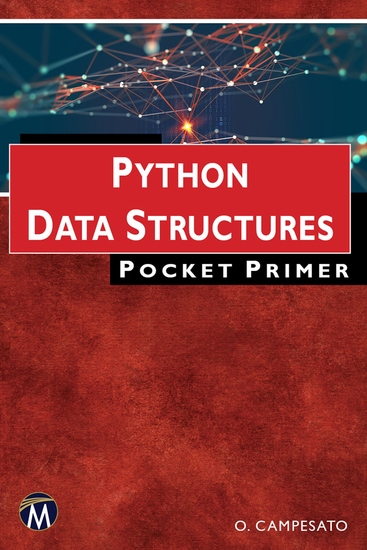
Python Data Structures Pocket Primer - A concise guide to Python data structures to enhance your skills - cover

Python Data Structures Pocket Primer - A concise guide to Python data structures to enhance your skills

Mercury Learning and Information, Oswald Campesato

Publisher: Packt Publishing

  • 0
  • 0
  • 0

Summary

This Pocket Primer book introduces the fundamentals of data structures using Python. It provides a comprehensive yet fast-paced introduction to core Python concepts and data structures, emphasizing their importance in managing large datasets and implementing search and sort algorithms effectively. The course starts with a basic introduction to Python, setting a solid foundation for more complex topics.The journey continues with an exploration of recursion and combinatorics, followed by detailed discussions on strings, arrays, and various search and sort algorithms. Further, the book delves into linked lists, queues, and stacks, illustrating their practical applications with numerous code samples. This structured approach ensures that learners can progressively build their knowledge and skills in data structures, reinforced by hands-on coding examples.With companion files available for download, the book provides additional resources for practice and deeper understanding. This comprehensive guide is ideal for both beginners and those looking to strengthen their grasp of data structures in Python, equipping them with essential tools for managing and manipulating large datasets.
Available since: 08/12/2024.
Print length: 245 pages.
Other books that might interest you

  • The Decision Intelligence Handbook - Practical Steps for Evidence-Based Decisions in a Complex World - cover

    The Decision Intelligence...

    L. Y. Pratt, N.E. Malcolm

    • 0
    • 0
    • 0
    Decision intelligence (DI) has been widely named as a top technology trend for several years, and Gartner reports that more than a third of large organizations are adopting it. Some even say that DI is the next step in the evolution of AI. Many software vendors offer DI solutions today, as they help organizations implement their evidence-based or data-driven decision strategies. 


    But until now, there has been little practical guidance for organizations to formalize decision making and integrate their decisions with data. 


    With this book, authors L. Y. Pratt and N. E. Malcolm fill this gap. They present a step-by-step method for integrating technology into decisions that bridge from actions to desired outcomes, with a focus on systems that act in an advisory, human-in-the-loop capacity to decision makers. 


    This handbook addresses three widespread data-driven decision-making problems: 


    ● How can decision makers use data and technology to ensure desired outcomes? 


    ● How can technology teams communicate effectively with decision makers to maximize the return on their data and technology investments? 


    ● How can organizational decision makers assess and improve their decisions over time?
    Show book
  • Clinical Pharmacokinetics - The Movement of Drugs in the Body - cover

    Clinical Pharmacokinetics - The...

    Ava Westwood

    • 0
    • 0
    • 0
    Pharmacokinetics is a fundamental aspect of clinical medicine, shaping the way drugs are administered, absorbed, distributed, metabolized, and eliminated by the body. It provides a scientific basis for determining appropriate drug dosing, optimizing therapeutic efficacy, and minimizing adverse effects. Understanding pharmacokinetics allows healthcare professionals to make informed decisions tailored to individual patients, ensuring safe and effective drug therapy. 
    One of the most significant applications of pharmacokinetics in clinical practice is dose optimization. Drug concentration within the body must remain within a therapeutic window—high enough to produce the desired effect but not so high that it causes toxicity. By considering factors such as bioavailability, volume of distribution, and clearance, clinicians can determine the appropriate dosing regimen. This is particularly critical for drugs with a narrow therapeutic index, such as warfarin, lithium, and certain chemotherapeutic agents, where even small variations in plasma levels can lead to significant clinical consequences. 
    Pharmacokinetics also plays a crucial role in adjusting drug therapy for specific patient populations. Factors such as age, organ function, and genetic variability can influence how a drug is processed. In neonates and elderly patients, metabolic and renal clearance mechanisms are often reduced, requiring dose modifications to prevent accumulation and toxicity. Similarly, patients with renal or hepatic impairment need adjusted dosing regimens to account for altered drug metabolism and elimination. Advances in pharmacogenomics further refine this approach, allowing for individualized treatment based on genetic variations affecting drug-metabolizing enzymes.
    Show book
  • Atoms Unleashed - Fusion's Promise to Revolutionize Human Existence - cover

    Atoms Unleashed - Fusion's...

    John Harpoon

    • 0
    • 0
    • 0
    Fusion energy, often described as the “holy grail” of power sources, holds the potential to revolutionize how we generate electricity and tackle global energy challenges. At its core, fusion is the process that powers the sun and stars, where two light atomic nuclei combine to form a heavier nucleus, releasing vast amounts of energy in the process. The promise of harnessing this natural phenomenon for human use is one of the most exciting scientific endeavors of our time. 
    The appeal of fusion energy lies in its virtually limitless potential. Unlike conventional energy sources such as fossil fuels, which are finite and contribute to environmental degradation, fusion uses fuels like deuterium and tritium, isotopes of hydrogen that are abundant in water and lithium. These fuels are not only plentiful, but the fusion process produces no greenhouse gases or long-lived radioactive waste, making it an incredibly clean energy source. In theory, fusion could provide an inexhaustible supply of energy, helping to meet the world’s growing demand while reducing the environmental impacts associated with other forms of energy production. 
    In addition to its environmental benefits, fusion energy promises to be a game-changer for energy security. As the global population increases and industrialization expands, the demand for energy will continue to rise. Traditional sources like coal, oil, and natural gas are becoming increasingly insufficient, both in terms of supply and sustainability. Nuclear fission, while capable of generating large amounts of energy, carries significant risks, such as nuclear accidents and the challenge of radioactive waste disposal. Fusion, on the other hand, offers a potentially safer alternative, with no risk of runaway reactions and no long-term waste problems.
    Show book
  • The Accidental Ecosystem - People and Wildlife in American Cities - cover

    The Accidental Ecosystem -...

    Peter S. Alagona

    • 0
    • 0
    • 0
    The Accidental Ecosystem tells the story of how cities across the United States went from having little wildlife to filling, dramatically and unexpectedly, with wild creatures. Today, many of these cities have more wild animals living in them than at any time in at least the past 150 years. Why have so many cities—the most artificial and human-dominated of all Earth's ecosystems—grown rich with wildlife, even as wildlife has declined in most of the rest of the world? And what does this paradox mean for people, wildlife, and nature on our increasingly urban planet? 


    The Accidental Ecosystem is the first book to explain this phenomenon from a deep historical perspective, and its focus includes a broad range of species and cities. Digging into the natural history of cities and unpacking our conception of what it means to be wild, this book provides fascinating context for why animals are thriving more in cities than outside of them. Considering what it means to live in diverse, multispecies communities and exploring how human and non-human members of communities might thrive together, Peter S. Alagona goes beyond the tension between those who embrace the surge in urban wildlife and those who think of animals as invasive or as public safety hazards.
    Show book
  • Enzymology - Enzymes at Work How They Drive Life's Processes - cover

    Enzymology - Enzymes at Work How...

    Mike Crawford

    • 0
    • 0
    • 0
    Enzymes are essential biological molecules that drive the chemical reactions necessary for life. These specialized proteins act as catalysts, accelerating biochemical reactions without being consumed in the process. Without enzymes, many of the reactions that sustain life would occur too slowly to support cellular function, metabolism, and overall biological activity. Their role is fundamental to everything from digestion and energy production to DNA replication and cellular communication. 
    One of the most crucial functions of enzymes is their ability to facilitate metabolic processes. Enzymes lower the activation energy required for reactions, making it possible for cells to convert nutrients into usable energy efficiently. For instance, the enzyme amylase breaks down carbohydrates into simple sugars, while proteases and lipases help digest proteins and fats, respectively. Without these enzymes, organisms would struggle to extract energy from food, leading to a breakdown in normal physiological functions. 
    Beyond metabolism, enzymes play a key role in DNA replication and repair. DNA polymerase, for example, ensures the accurate copying of genetic material during cell division, while ligases and helicases assist in maintaining the stability and integrity of DNA strands. These enzymatic activities are vital for growth, reproduction, and the prevention of genetic mutations that could lead to diseases. Enzymes also regulate gene expression by modifying DNA and histones, controlling which genes are turned on or off in response to environmental or developmental signals.
    Show book
  • A Hundred Reasons Why AI Can Make You Money - English to Spanish - cover

    A Hundred Reasons Why AI Can...

    Science-Based Language Learning Lab

    • 0
    • 0
    • 0
    Introduction to the 100 Somethings Language Learning Series 
     
    Welcome to a fresh, captivating way to learn a new language! The "A Hundred Reasons Why..." series helps you master Spanish through topics that interest you, such as art, science, and history. Each book offers 100 carefully selected reasons that serve as concise knowledge nuggets in both English and Spanish. 
     
    How It Works: 
     
      - Each reason is first presented in Spanish for you to interpret. 
     
    - The next page provides the English translation and then repeats the reason in Spanish to help you understand unfamiliar terms. 
     
    - This format is repetitive to aid memorization and concise, ensuring streamlined learning. 
     
    Benefits: 
     
    - Concise Learning: The brief, one-sentence reasons are easy to remember and relate directly to your interests. 
     
    - Reinforced Learning: Switching between English and Spanish solidifies your vocabulary and grammar naturally. 
     
    - Engaged Learning: Associating new words with topics you're passionate about keeps your learning dynamic and engaging. 
     
    - Dual Knowledge: You not only learn a new language but also deepen your knowledge of the specific subject matter. 
     
    Ideal for those who thrive on clear and targeted information, this series makes learning both educational and enjoyable. Whether you're a beginner or looking to expand your linguistic skills, these books are crafted to enhance your journey effectively. Embrace this innovative approach and let your passions fuel your progress in mastering Spanish!
    Show book