Join us on a literary world trip!
Add this book to bookshelf
Grey
Write a new comment Default profile 50px
Grey
Subscribe to read the full book or read the first pages for free!
All characters reduced
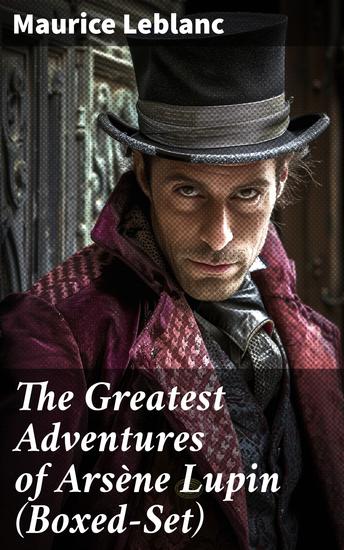
The Greatest Adventures of Arsène Lupin (Boxed-Set) - 8 Novels & 20 Mystery Tales - cover

The Greatest Adventures of Arsène Lupin (Boxed-Set) - 8 Novels & 20 Mystery Tales

Maurice Leblanc

Translator Alexander Teixeira de Mattos, Edgar Jepson

Publisher: Good Press

  • 0
  • 0
  • 0

Summary

Maurice Leblanc's "The Greatest Adventures of Arsène Lupin (Boxed-Set)" compiles a collection of riveting escapades featuring his most famous creation, the suave and cunning gentleman thief, Arsène Lupin. Written in a captivating style that blends wit and intrigue, Leblanc's stories explore themes of identity, morality, and social class, set against the backdrop of early 20th-century France. His clever narrative structure often intertwines Lupin's escapades with those of his adversary, Sherlock Holmes, creating a dynamic interplay between crime and justice, and inviting readers into a world where the lines between hero and villain are artfully blurred. Leblanc, who was deeply influenced by the rapid changes in French society during his lifetime, crafted the character of Lupin as a response to the era's fascination with both criminality and detective fiction. His background as a journalist and novelist allowed him to keenly observe the nuances of human behavior, seamlessly reflecting these observations in Lupin's complex character. The author's experiences also lent a satirical edge to his writing, positioning Lupin as a charming anti-hero who both captivates and critiques the bourgeois society of his time. This boxed set is a must-read for aficionados of mystery and adventure. Readers will delight in the clever plot twists and the rich character development that Leblanc masterfully weaves throughout these tales. Whether you are a longtime fan or new to the genre, this collection serves as an ideal introduction to the enigmatic world of Arsène Lupin, a character who continues to resonate in modern literature.
Available since: 12/14/2023.
Print length: 2222 pages.
Other books that might interest you

  • The Beautiful and Damned - cover

    The Beautiful and Damned

    F. Scott Fitzgerald

    • 0
    • 0
    • 0
    First published in 1922, The Beautiful and the Damned followed Fitzgerald's impeccable debut, This Side of Paradise, thus securing his place in the tradition of great American novelists. Embellished with the author's lyrical prose, here is the story of Harvard-educated, aspiring aesthete Anthony Patch and his beautiful wife, Gloria. As they await the inheritance of his grandfather's fortune, their reckless marriage sways under the influence of alcohol and avarice. A devastating look at the nouveau riche, and the New York nightlife, as well as the ruinous effects of wild ambition, The Beautiful and the Damned achieved stature as one of Fitzgerald's most accomplished novels.
    Show book
  • Home of the Gentlefolk - cover

    Home of the Gentlefolk

    Ivan Turgenev

    • 0
    • 0
    • 0
    "Home of the Gentlefolk" by Ivan Turgenev is a captivating novel that offers a poignant exploration of the lives and struggles of the Russian gentry in the mid-19th century. Set against the backdrop of a changing society, Turgenev weaves a narrative that delves into themes of love, social expectations, and the clash between traditional values and evolving attitudes. "Home of the Gentlefolk" stands out for its keen social observations and the intricate portrayal of human relationships. Turgenev's lyrical prose captures the nuances of the characters' inner lives, their hopes, disappointments, and quiet triumphs. The novel presents a compelling commentary on the limitations of societal expectations and the impact they have on individuals' ability to pursue their true desires. With its evocative descriptions, nuanced characterizations, and timeless exploration of human emotions, "Home of the Gentlefolk" stands as a remarkable work of Russian literature. Turgenev's ability to reflect the complexities of the human condition and the transformative power of love makes this novel a compelling and resonant read, offering a glimpse into the hearts and lives of the Russian gentry during a time of societal change.
    Show book
  • A Responsibility - From their pens to your ears genius in every story - cover

    A Responsibility - From their...

    Henry Harland

    • 0
    • 0
    • 0
    The bookshelves of American literature are incredible collections that have gathered together centuries of very talented authors.  From this continent their fame spread and whilst among their number many are now forgotten or neglected their talents endure.  Among them is Henry Harland.
    Show book
  • The Odyssey - cover

    The Odyssey

    Homer

    • 0
    • 0
    • 0
    The Odyssey is one of two major ancient Greek epic poems attributed to Homer. It is one of the oldest extant works of literature still widely read by modern audiences. As with the Iliad, the poem is divided into 24 books. It follows the Greek hero Odysseus, king of Ithaca, and his journey home after the Trojan War. After the war, which lasted ten years, his journey lasted for ten additional years, during which time he encountered many perils and all his crew mates were killed. In his absence, Odysseus was assumed dead, and his wife Penelope and son Telemachus had to contend with a group of unruly suitors who were competing for Penelope's hand in marriage.The Odyssey was originally composed in Homeric Greek in around the 8th or 7th century BCE and, by the mid-6th century BCE, had become part of the Greek literary canon. In antiquity, Homer's authorship of the poem was not questioned, but contemporary scholarship predominantly assumes that the Iliad and the Odyssey were composed independently and that the stories formed as part of a long oral tradition. Given widespread illiteracy, the poem was performed by an aoidos or rhapsode and was more likely to be heard than read.
    Show book
  • God Sees the Truth But Waits - From their pens to your ears genius in every story - cover

    God Sees the Truth But Waits -...

    Leo Tolstoy

    • 0
    • 0
    • 0
    Leo Tolstoy was born in 1828 in the Russian province of Tula to a wealthy noble family. As a child, he had private tutors but he showed little interest in any formal education. When he went to the University of Kazan in 1843 to study oriental languages and law, he left without completing his courses.  Life now was relaxed and idle but with some writing also taking place.  Gambling debts forced an abrupt change of path and he joined the army to fight in the Crimean War.  He was commended for his bravery and promoted but was appalled at the brutality and loss of life.  He recorded these and other earlier experiences in his diaries which formed the basis of several of his works. 
    In 1852 ‘Childhood’ was published to immediate success and was followed by ‘Boyhood’ and ‘Youth’. 
    His experience in the army and the horrors he witnessed resulted in ‘The Cossacks’ in 1862 and the trilogy ‘Sevastopol Tales’. After the war he travelled around Europe, visiting London and Paris and meeting such luminaries as Victor Hugo and Charles Darwin.  
    It was now that Tolstoy began his masterpiece, ‘War and Peace’. Published in 1869 it was an epic work that changed literature. He quickly followed this with ‘Anna Karenina’.  
    These successes made Tolstoy rich and helped him accomplish many of his dreams but also brought problems as he grappled with his faith and the lot of the oppressed poor. These revolutionary views became so popular that the authorities now kept him under surveillance.  
    He led a life of asceticism and vegetarianism and put his socialist ideals into practice by establishing numerous schools for the poor and food programmes. He also believed in giving away his wealth, which caused much discord with his wife.  
    His writing continued to bring forth classics such as ‘The Death of Ivan Ilyich’ and many brilliant and incisive short stories such as ‘How Much Land Does A Man Need’.  
    In 1901 Tolstoy was excommunicated from the Church and controversially deselected for the Nobel Prize for Literature. 
    Whilst undertaking a pilgrimage by train in October 1910 with his daughter Aleksandra he caught pneumonia in the nearby town of Astapovo.  Leo Tolstoy died on November 9th, 1910, he was 82.
    Show book
  • The Sun Also Rises - cover

    The Sun Also Rises

    Ernest Hemingway

    • 0
    • 2
    • 0
    A World War I veteran journeys from Paris to Pamplona during an era of decadence and despair in this “gripping” classic novel of the Lost Generation (The New York Times).   Physically and emotionally damaged by his service in the Great War, Jake Barnes lives in 1920s France, where he passes time in nightclubs and cafés, yearning for a fellow expatriate, the beautiful English divorcée Lady Brett Ashley. She is a lively and daring woman, desired by many other men. As the pair and their social companions travel to Spain, engage in affairs and fistfights, and wrestle with the aftereffects of a senseless worldwide catastrophe, Jake must struggle mightily to hold on to his soul.   From the Nobel Prize winner and icon of twentieth-century American literature, this novel is “the ideal companion for troubled times: equal parts Continental escape and serious grappling with the question of what it means to be, and feel, lost” (The Wall Street Journal).   “A truly gripping story . . . magnificent writing.” —The New York Times
    Show book