Rejoignez-nous pour un voyage dans le monde des livres!
Ajouter ce livre à l'électronique
Grey
Ecrivez un nouveau commentaire Default profile 50px
Grey
Abonnez-vous pour lire le livre complet ou lisez les premières pages gratuitement!
All characters reduced
The Window at the White Cat - cover

The Window at the White Cat

Mary Roberts Rinehart

Maison d'édition: MysteriousPress.com

  • 0
  • 1
  • 0

Synopsis

A missing person sets off the action in this classic whodunit from the bestselling mystery writer known as the American Agatha Christie.   In The Window at the White Cat, bumbling lawyer Jack Knox agrees to help a beautiful young woman find her missing father. But when the politician is found dead at a backstreet social club serving up beers and illegal favors, and Jack’s aunt disappears, it looks like the daughter’s fiancé may be guilty of more than winning her heart.   A #1 New York Times–bestselling author with ten million books in print, Mary Roberts Rinehart crafted a career out of writing mysteries that set the stage for generations of writers to come.   “[Rinehart’s] literary distinction lies in the combination of love, humor and murder that she wove into her tales. . . . She helped the mystery story grow up.”—The New York Times
Disponible depuis: 21/04/2020.
Longueur d'impression: 129 pages.

D'autres livres qui pourraient vous intéresser

  • Blue & Green - From their pens to your ears genius in every story - cover

    Blue & Green - From their pens...

    Virginia Woolf

    • 0
    • 0
    • 0
    Adeline Virginia Woolf was born on the 25th January 1882 in South Kensington in London. 
    Although lauded as a founder of modernist writing with such classics as ‘Orlando’, ‘Mrs Dalloway’ and ‘To the Lighthouse’ and, of course, many classic short stories, her background is filled with elements of tragedy that she somehow overcame to become such a revered writer.   Her mother died when she was 13, her half-sister Stella two years later and with it her first of several nervous breakdowns.  Appallingly it was later found that three of her half-brothers had sexually abused her so darkness must have seemed ever present.   
    She began writing professionally at age 20 but her father’s death two years later brought a complete mental collapse and she was briefly institutionalised.  Somehow she found within herself a literary career and with it great innovations in writing; she was a pioneer of “stream of consciousness”.    
    Her tight circle of friends were the founders of the Bloomsbury Group, a movement whose legacy still influences across the arts and society in many way to this day.   
    Whilst the dark periods continued to interrupt her emotional state her rate of work never ceased.  Until, on 28th March 1941, Woolf put on her overcoat, filled up its pockets with stones, and walked into the River Ouse, in Lewes, East Sussex and drowned herself.  Her body was not recovered until the 18th April.  She was 59. 
    She left behind a note which read in part “Dearest, I feel certain that I am going mad again.  I feel we can't go through another of those terrible times.  And I shan't recover this time.  I begin to hear voices, and I can't concentrate.  So I am doing what seems the best thing to do”.
    Voir livre
  • The House of Pride - cover

    The House of Pride

    Jack London

    • 0
    • 0
    • 0
    The House of Pride, written by iconic American author Jack London (1876-1916), was first published in December 1910 issue of The Pacific Monthly. Author Jack London wrote The Call of the Wild and many other books. A pioneer in the then-burgeoning world of commercial magazine fiction, he was one of the first Americans to make a lucrative career exclusively from writing. 
    Narrator Patrick Girard Lawlor, a classically trained stage actor, has performed on-stage throughout the United States and Europe. He has appeared in several feature films, as well as on the TV series L.A. Heat. His extensive work as an audio-book narrator has garnered numerous awards, including the Audie Award nomination. 
    (P)2011 Listen & Live Audio, Inc.
    Voir livre
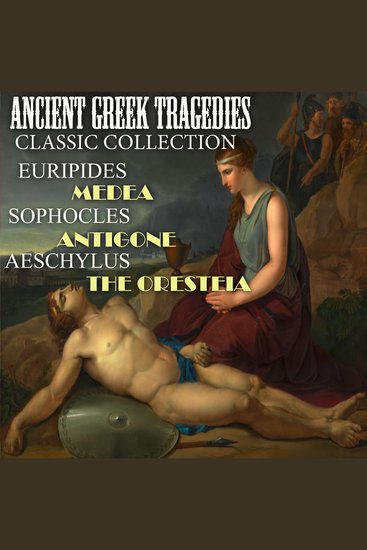
  • Ancient Greek Tragedies Classic collection - Euripides Medea; Sophocles Antigone; Aeschylus The Oresteia - cover

    Ancient Greek Tragedies Classic...

    Euripides, Sophocles, Aeschylus

    • 0
    • 0
    • 0
    This collection presents the works of the three fathers of ancient Greek tragedies: Aeschylus, Sophocles, and Euripides.The reader of this collection will be able to comprehend how the plots and conflicts populating classical tragedy developed.The principle theme of Aeschylus' tragedies is the idea of fate being omnipotent and the futility in struggling against it.The tragedies of Sophocles reflect the era of the Greeks' victorious war against the Persians, which opened up commercial prosperity through trade.Euripides propels his dramas by incorporating conflicts from within the human psyche.Contents:Euripides: MedeaSophocles: AntigoneAeschylus: The OresteiaAgamemnonEumenidesThe Choephori
    Voir livre
  • In the Avu Observatory (Unabridged) - cover

    In the Avu Observatory (Unabridged)

    H. G. Wells

    • 0
    • 0
    • 0
    This early work by H. G. Wells was originally published in 1894. "In the Avu Observatory" is a short story of a man working in an observatory in Borneo who gets attacked by a strange bat-like creature.
    Voir livre
  • The Fortune of the Rougons - cover

    The Fortune of the Rougons

    Émile Zola

    • 0
    • 0
    • 0
    We enter the world of a fictional town of Plassans in Zola's native region of Provence and we are introduced to the eccentric heroine Adelaide Fouque, later known as Tante Dide, who becomes the common ancestor for both the Rougon and Macquart families. Her legitimate son from her short marriage to her late husband, a labourer named Rougon who worked on Dide's land, is forced to grow up alongside two illegitimate children.
    Voir livre
  • Morphine - This story is perhaps the greatest depiction and description in literature of the human psyche going through addiction - cover

    Morphine - This story is perhaps...

    Mikhail Bulgakov

    • 0
    • 0
    • 0
    Mikhail Bulgakov was born on 15th May 1891 in Kiev, in the Kiev Governorate of the Russian Empire, into a Russian family.  He was one of seven children. 
     
    In 1901, Bulgakov attended the First Kiev Gymnasium, and developed a keen interest in Russian and European literature, theatre and opera.  After the death of his father in 1907, his mother assumed responsibility for his education.  After graduating Bulgakov entered the Medical Faculty of Kiev University and then took up a post as physician at the Kiev Military Hospital. 
     
    At the outbreak of the First World War, he volunteered as a doctor and was sent directly to the front, where he was badly injured at least twice.  To suppress chronic pain, especially in the abdomen, he injected morphine.  It took years to wean himself off. 
     
    He now took up medical posts in various towns and in 1919, he was mobilised by the Ukrainian People's Army and assigned to the Northern Caucasus.  There, he became seriously ill with typhus and barely survived.  
     
    After this illness, Bulgakov abandoned his medicine to pursue writing.  He moved to Vladikavkaz and had two plays staged there with great success.  He wrote too for various newspapers and other outlets, but his critics were many.  And growing. 
     
    When a Moscow's theatre director severely criticised Bulgakov, Stalin personally protected him, saying that a writer of Bulgakov's quality was above ‘party words’ like ‘left’ and ‘right’.   Indeed, it is said that Stalin watched ‘The Days of the Turbins’ at least 15 times. 
     
    It was not to last and by March 1929, Bulgakov's career was ruined when Government censorship stopped publication of any of his work and plays. 
     
    In despair, Bulgakov wrote a personal letter to Stalin.  He requested permission to emigrate.  He received a phone call from the Soviet leader, who asked the writer whether he really desired to leave. He replied that a Russian writer cannot live outside of his homeland.  Stalin thus gave him permission to continue working. In May 1930, he re-joined the theater, as stage director's assistant.  
     
    During the last stressful decade of his life, and in poor health, Bulgakov continued to work on ‘The Master and Margarita’, wrote plays, critical works, stories, and continued translations and dramatisations of novels.  Many of them were not published, others were derided by critics.  
     
    On 10th March 1940, Mikhail Afanasyevich Bulgakov died from nephrosclerosis.  He was 48. 
     
    ‘The Master and Margarita’ was not published in any form until the mid-1960’s 
     
    In this story Bulgakov relates the terrifying and hellish descent into addiction that seems so avoidable and yet so chillingly not.
    Voir livre