Join us on a literary world trip!
Add this book to bookshelf
Grey
Write a new comment Default profile 50px
Grey
Subscribe to read the full book or read the first pages for free!
All characters reduced
The Ultimate Western Collection - 175+ Novels & Short Stories - cover

The Ultimate Western Collection - 175+ Novels & Short Stories

Mark Twain, Washington Irving, James Fenimore Cooper, Stephen Crane, O. Henry, Bret Harte, James Oliver Curwood, Frederic Remington, Ann S. Stephens, Will Lillibridge, Emerson Hough, Willa Cather, Zane Grey, Owen Wister, Charles King, Andy Adams, Robert W. Chambers, William MacLeod Raine, Robert E. Howard, Marah Ellis Ryan, Max Brand, Clarence E. Mulford, Charles Alden Seltzer, Frank H. Spearman, J. Allan Dunn, B.M. Bower, R. M. Ballantyne, Grace Livingston Hill, Jackson Gregory, James B. Hendryx, Dane Coolidge, Frederic Homer Balch, Rex Beach, Jack London, Forrestine C. Hooker, William Patterson White, Francis William Sullivan, Charles Siringo, Isabel E. Ostrander, Frederic Logan Paxson

Publisher: e-artnow

  • 0
  • 0
  • 0

Summary

This carefully edited collection of world's most admired westerns will take you on a roller coaster ride through the plains of Wild West, the old trails, gold rush adventures, frontier sagas and more! Introduction The Last American Frontier – History of the 'Far West', of the Pioneers & Trailblazers Story of the Cowboy Story of the Outlaw Novels & Stories Riders of the Purple Sage Saga (Zane Grey) Ohio River Trilogy Dan Barry Series (Max Brand) The Virginian (Owen Wister) Lin McLean Leatherstocking Series (James F. Cooper) Flying U Series (B. M. Bower) Cabin Fever Rimrock Trail (J. Allan Dunn) Bucky O'Connor (William M. Raine) Breckinridge Elkins Series (Robert E. Howard) In a Hollow of the Hills (Bret Harte) Wolf Hunters (James Oliver Curwood) Gold Hunters Last of the Plainsmen Border Legion Smoke Bellew Country Beyond Lone Star Ranger Ronicky Doone Trilogy Riders of the Silences Three Partners Man of the Forest Lure of the Dim Trails Tennessee's Partner Covered Wagon (Emerson Hough) Luck of Roaring Camp Rustlers of Pecos County Pike Bearfield Series Hopalong Cassidy (Clarence E. Mulford) O Pioneers! (Willa Cather) My Ántonia Roughing It (Mark Twain) Outcasts of Poker Flat Call of the Wild (Jack London) Heart of the West (O. Henry) White Fang Log of a Cowboy (Andy Adams) Two-Gun Man (Charles Alden Seltzer) Short Cut (Jackson Gregory) Astoria (Washington Irving) Ungava (R.M. Ballantyne) Valley of Silent Men Black Jack Bull Hunter "Drag" Harlan (Charles Alden Seltzer) Wyoming: A Story of the Outdoor West Sheriff's Son Whispering Smith (Frank H. Spearman) A Texas Cow Boy (Charles Siringo) Boss of the Lazy Y Trail Horde Rider of Golden Bar (William P. White) Buck Peters, Ranchman Tangled Trail Golden Dream (Ballantyne) Gun-Brand (James B. Hendryx) Blue Hotel (Stephen Crane) Long Shadow Girl from Montana (Grace Livingston Hill) Hidden Children (Robert W. Chambers) Where the Trail Divides Iron Trail (Rex Beach) Desert Trail (Dane Coolidge) Bride Comes to Yellow Sky ...
Available since: 12/13/2023.
Print length: 24518 pages.

Other books that might interest you

  • Dwellings of the Damned - 15 Haunted House Stories - cover

    Dwellings of the Damned - 15...

    Robert Arthur, E.F. Benson, A....

    • 0
    • 0
    • 0
    A collection of stories concerning shunned and disreputable houses. 
    Contents: 
    Nobody's House by A. M. Burrage (1927) 
    The history of a haunted house. 
    A Night of Horror by Dick Donovan (1899) 
    A haunted castle in the hills of Wales. 
    The Room in the Tower by E. F. Benson (1912) 
    A recurring nightmare. 
    The House of the Nightmare by Edward Lucas White (1906) 
    A night at a remote country house. 
    The Shunned House by H. P. Lovecraft (1937) 
    An abandoned house in Providence. 
    The Red Lodge by H. Russell Wakefield (1928) 
    A dreadful rental experience. 
    The Specter Priestess of Wrightstone by Herman F. Wright (1925) 
    A legend surrounding an English castle. 
    The Secret of the Vault by J. Wesley Rosenquest (1938) 
    A charnel chamber beneath an old house. 
    Black Was the Night by Laurence Bour, Jr. (1940) 
    An encounter in a crumbling house. 
    Six Flights to Terror by Manly Banister (1946) 
    How do you bury a building? 
    Up Under the Roof by M. W. Wellman (1938) 
    Something stalks the space between the roof-peak and the ceiling. 
    The Believers by Robert Arthur (1941) 
    A radio host broadcasts from a crumbling, haunted mansion. 
    Pigeons from Hell by Robert E. Howard (1938) 
    A deserted plantation mansion haunted by ghostly pigeons. 
    The Ghost of a Hand by Sheridan Le Fanu (1863) 
    A house haunted by a partially visible ghost. 
    Dark Mummery by Thorp McClusky (1944) 
    Beware of 'reputedly' haunted houses.
    Show book
  • Mother of Invention - Mother Teresa and the Franciscan Servants of Jesus - cover

    Mother of Invention - Mother...

    Bridget Gillard

    • 0
    • 0
    • 0
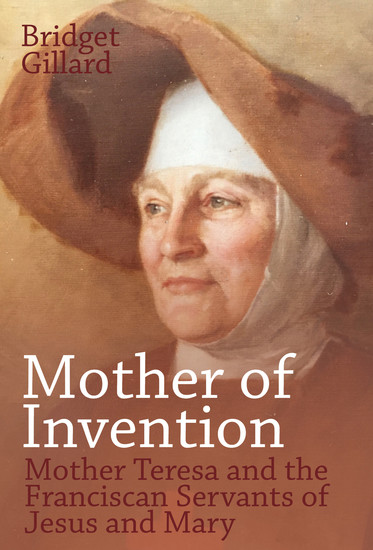
    There is nothing conventional about the life and religious journey of Grace Costin. After a family tragedy caused her to reject God, she began on the long path back to faith through pioneering social work, a solo journey across the United States and a brief interlude as one of the first women police officers. Following a fleeting ministry as Sister Teresa in the Order of St Anne, she met the charismatic priest Bernard Walke, with whom she formed a loving but combative working partnership before experiencing a calling to create a religious Order unlike any that had existed before. Her quest took her from remote parishes in Cornwall to the slums of Paisley, an inner-city parish in 1930s London and the Isle of Wight until finally she found what she was searching for in the personal ads of the Daily Telegraph—a “Typical Thatched Devon farmhouse”.
    
     
    And so in the middle of the Second World War, aged 54 with a heart condition and no money, she set out to transform the run-down house in a remote corner of Devon into the Community she had dreamed of for so long. With the help of a series of remarkable women she had attracted along the way, she created Posbury St Francis—a community, not a convent, with sisters, not nuns, and a Mother, but not a Mother Superior.
    
     
    Mother of Invention is the story of how a woman, the daughter of a bigamous marriage, with no money, connections or academic background, founded her own religious Order which, at its height, was visited by over 2,000 people a year.
    Show book
  • Naturalism - Reality Through the Lens of Science - cover

    Naturalism - Reality Through the...

    Hector Davidson

    • 0
    • 0
    • 0
    Naturalism is a philosophical worldview that asserts that everything that exists, and every phenomenon that occurs, is a product of natural laws and processes. It contends that the universe operates without the need for supernatural explanations or interventions. In essence, naturalism posits that the natural world, as observed through science, is all there is. This perspective has deep roots in both philosophy and science, offering a framework for understanding reality that relies heavily on empirical evidence and reasoned inquiry. 
    At its core, naturalism rejects supernatural forces, divine beings, or metaphysical entities as explanations for natural phenomena. Instead, it emphasizes that everything in the universe, from the smallest particles to the vastness of the cosmos, can be understood in terms of physical, biological, and chemical laws. Naturalism also suggests that humans, as part of the natural world, are subject to the same laws governing the rest of the universe. This view aligns closely with the scientific method, which is built upon observation, experimentation, and the continual refinement of theories based on evidence. 
    In defining naturalism, it is essential to recognize its distinction from other philosophical frameworks. Unlike idealism, which asserts that reality is primarily mental or spiritual, naturalism asserts the primacy of the material world. Similarly, it differs from supernaturalism, which attributes the workings of the universe to forces beyond natural laws, such as gods or spirits. Naturalism’s embrace of the empirical allows it to form the foundation for scientific inquiry, fostering advancements in fields ranging from physics and biology to psychology and medicine.
    Show book
  • A Fight with a Cannon - From their pens to your ears genius in every story - cover

    A Fight with a Cannon - From...

    Víctor Hugo

    • 0
    • 0
    • 0
    Victor Marie Hugo was born on 26th February 1802 in Besançon, France.   
    There can be no doubt that Hugo is ranked as the greatest of French authors and poets. In addition to this he fought against social injustice throughout his life and from his frequent elections to the French Assembly. 
    Hugo published his first novel, Han d’Islande (1823), the year after his marriage and so began an immense canon of fiction and poetry not only for France but to World literature.  
    He was elected to the Académie Française in 1841 and the same year came a peerage and entrance to the Higher Chamber as a pair de France, where he spoke against the death penalty, social injustice and in favour of press freedom.  
    In the years leading up to the Revolution of 1848 Hugo began to lean towards Republicanism and greater freedoms.  With the formation of the Second Republic, he was again elected to the Assembly. 
    When Napoleon III seized power in 1851, and established an anti-parliamentary constitution, Hugo openly declared him a traitor to France. This, of course, meant exile where he remained until 1870.  In exile he published his greatest work ‘Les Misérables’, and further widely honoured collections of poetry. 
    Returning home he was again elected to the National Assembly and the Senate.  It was the time of the Franco-Prussian war and with Paris under siege and food ever more scarce, he wrote in his diary that he was now "eating the unknown". 
    Later he was instrumental in strengthening the rights of artists and copyright, steps which led to the international protections of the Berne Convention.  
    Victor Hugo died on 22nd May 1885, aged 83.
    Show book
  • Upland - A Journey through Time and the Hills - cover

    Upland - A Journey through Time...

    Ian Crofton

    • 0
    • 0
    • 0
    'Fascinating and lyrical . . . A beautifully written celebration of a lifelong passion' – Stephen Venables
    The relationship of people with hills and mountains has been complex, rich and varied – from awe and wonder to fear and loathing, from spiritual longing to peaceful acceptance.
    As he explores our high places, Ian Crofton conjures up those who have been there before: Neolithic axe-makers, mass trespassers, shepherds, quarrymen, botanists, poets and pioneering cragsmen and women among them. At the same time, he is ever attuned to the present moment – a flash of bright moss in a bog, the swoop of an eagle above a skyline, a winter sun sinking into a sea of cloud.
    Following an arc from the gentle Downs of southern England to the wild peaks of Scotland's far north, Upland combines personal experiences with a keen curiosity about the history and nature of mountain landscapes, and the people who once worked and wandered among them. The result is a meditation on the enduring yet ever-changing hills, on the transience of human experience, and on the shifts and twists of time itself.
    Locations included:
    
    - Chilterns (following The Ridgeway)
    
    - Malverns
    
    - Snowdon
    
    - Peak District
    
    - Pennines
    
    - Lake District
    
    - Ben Nevis
    
    - The Cuillin, Skye
    
    - Assynt (Suilven)
    
    - Cairngorms
    Show book
  • Daughters of the North - Jean Gordon and Mary Queen of Scots - cover

    Daughters of the North - Jean...

    Jennifer Morag Henderson

    • 0
    • 0
    • 0
    Mary, Queen of Scots’ marriage to the Earl of Bothwell is notorious. Less known is Bothwell’s first wife, Jean Gordon, who extricated herself from their marriage and survived the intrigue of the Queen’s court. Daughters of the North reframes this turbulent period in history by focusing on Jean, who became Countess of Sutherland, following her from her birth as the daughter of the ‘King of the North’ to her disastrous union with the notorious Earl of Bothwell – and her lasting legacy to the Earldom of Sutherland.
    Show book