Join us on a literary world trip!
Add this book to bookshelf
Grey
Write a new comment Default profile 50px
Grey
Subscribe to read the full book or read the first pages for free!
All characters reduced
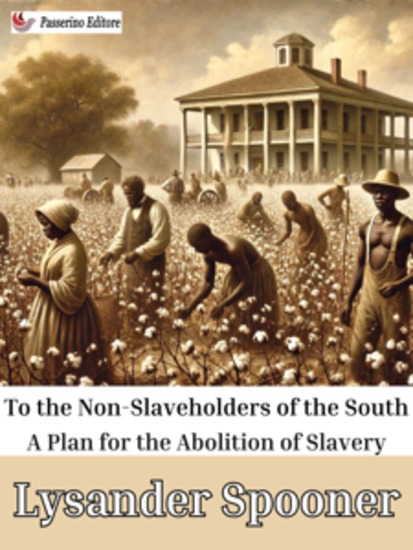
To the Non-Slaveholders of the South - A Plan for the Abolition of Slavery - cover

To the Non-Slaveholders of the South - A Plan for the Abolition of Slavery

Lysander Spooner

Publisher: Passerino

  • 0
  • 0
  • 0

Summary

A Plan for the Abolition of Slavery and To the Non-Slaveholders of the South were two significant anti-slavery pamphlets written by Lysander Spooner. Published in 1858, these works argued passionately against slavery, but with a unique perspective that aimed to reach a specific audience: non-slaveholding white Southerners.

Lysander Spooner (January 19, 1808 — May 14, 1887) was an American abolitionist, entrepreneur, lawyer, essayist, natural rights legal theorist, pamphletist, political philosopher, and writer often associated with the Boston anarchist tradition.
Available since: 11/06/2024.

Other books that might interest you

  • 369 Manifestation Method - Overcome Hidden Blocks & Manifesting Mistakes Unlock Inner Alignment & Abundance Mindset and Transform Your Life with Clarity and Confidence - cover

    369 Manifestation Method -...

    S. C. Rowse

    • 0
    • 0
    • 0
    Unlock the secret to manifesting your dream life, even if you've tried countless Law of Attraction techniques before and saw no results.  
    Are you constantly dreaming about the life you truly desire but feel stuck in your current reality?  
    Have you tried every manifestation technique out there, but still don't see results?  
    Are you tired of self-proclaimed gurus promising quick fixes, but leaving you with shattered dreams?  
    Don't let these struggles dictate your fate!  
    You see, the art of manifesting your dream life doesn’t have to be an uphill battle. It can be quite simple, even if you've tried and failed before. Based on the principles of quantum physics and the revered 369 method, this book is the answer to your dreams.  
    This transformative guide helps you unlock your inner alignment, develop an abundance mindset, and implement proven success strategies for achieving your life goals.  
    Here's just a glimpse of the empowering strategies that you will discover inside this book:  
    ★ Understand the quantum physics behind manifestation, demystifying the art of making your dreams a tangible reality.  
    ★ Explore the obscure origin, theory, and science behind the powerful 369 manifestation method - Nikola Tesla's 'divine code.'  
    ★ Discover the most common manifestation and law of attraction mistakes made by beginners and veterans alike – and how you can avoid them.  
    ★ Uncover your hidden blocks and limiting beliefs that are holding you back from manifesting your desires and replace them with a growth mindset.  
    ★ Develop a foolproof daily manifestation routine using the 369 method that aligns your vibrations with the universe to bring your desires to fruition.  
    If you are ready to embark on a journey that overflows with abundance, success, and fulfillment, don't hesitate! Listen to it now! 
    Download your gift below!
    Show book
  • The Human Calling - Three Thousand Years of Eastern and Western Philosophical History - cover

    The Human Calling - Three...

    Dao Feng He

    • 0
    • 0
    • 0
    A study of the world’s religious movements and what their history says about society today. 
     
    The Human Calling is a vigorously researched and profoundly spiritual narrative history of the world’s religious movements as they relate to society’s collective understanding of the duties they have to fellow people and looks ahead to what lessons from history can be applied as people navigate a technological age. 
     
    Focusing on the rise and fall of spiritual movements in both the East and West, The Human Calling examines what the world’s major religions have historically offered, asks what people are here for outside of pure survival, and makes the persuasive argument for Christianity as the best leader to guide individuals on the path toward better caring for one another—our human calling. The Human Calling takes readers through humanity’s three great thought movements:The first is the Axial Age, the source of the first great human reflection on public spirit and public orderThe second is the twelfth to seventeenths centuries, wrestles with the question of whether people can attain individual rationality in God’s orderThe third delves into the independent reasoning societies of the twentieth and twenty-first centuries and looks forward to what people want their third great reflection on God’s plan to be during their own period of societal flux
    Show book
  • Unwelcome Guests - A History of Access to American Higher Education - cover

    Unwelcome Guests - A History of...

    Steven J. Diner, Harold S. Wechsler

    • 0
    • 0
    • 0
    In Unwelcome Guests, Harold S. Wechsler and Steven J. Diner argue that discrimination in college admissions has a long and troubling history in the US. Institutions of higher learning have vigorously sought to shape their mission and the experiences of their undergraduate students by paying careful attention to race and religion in admissions decisions. Wechsler and Diner explore how American colleges and universities sought to restrict enrollment of students they considered undesirable. How, they ask, did these practices change over time? And how did underrepresented students cope with this discrimination—and with the indifference, bare tolerance, or outright hostility of some of their professors and peers? 


    Tracing the efforts of people from underrepresented racial, ethnic, and religious groups to attend mainstream colleges, Wechsler and Diner also look at how these students fared after graduation, paying particular attention to Black women and men. Unwelcome Guests illuminates a critically important aspect of the history of American colleges and universities but also addresses policy debates about affirmative action and racial/ethnic diversity in colleges today. This profound history of the limits on college access over decades of discrimination helps listeners recognize and understand the role of race in the history of American higher education.
    Show book
  • Franklin Delano Roosevelt: His Finest Hour - The Winning of World War II - cover

    Franklin Delano Roosevelt: His...

    Liam Dale

    • 0
    • 0
    • 0
    The early years of World War II saw Nazi Germany dominate Europe, but by the end of 1941, as Adolf Hitler continued to build his Empire, events in the Pacific took on their own momentum as Imperial Japan and America became locked in battle after the bombing of the US Naval Fleet at Pearl Harbor. 
     
    As the smoke and flames rose from Pearl, America and its President, Franklin D Roosevelt, could no longer remain on the sidelines of the war that had been waging in Europe for over two years, and on December 7th, 1941, the hostilities were transformed into a global conflict. This would mark the beginning of a new chapter in the Second World War where the Americans joined the fight for what Roosevelt had laid out as the Four Freedoms. 
     
    The first was Freedom of Speech, the second, Freedom of Religion and Expression, the third Freedom from Want, and last but by no means least, the fourth was Freedom from Fear. The story of how the nation, which so treasured its neutrality and had gone to such great lengths to avoid fighting on foreign soil, joined the war, will follow in the footsteps of Roosevelt, the man responsible for the American Dream.
    Show book
  • Policing Gun Violence - Strategic Reforms for Controlling Our Most Pressing Crime Problem - cover

    Policing Gun Violence -...

    Anthony A. Braga, Philip J. Cook

    • 0
    • 0
    • 0
    In many US cities, gun violence is the most urgent crime problem. High rates of deadly violence make a city less livable, dragging down quality of life, economic development, and property values. 


    How can police departments find the right balance between over- and under-policing of high-violence areas? What are the best practices for police to preempt and deter gun violence, while engendering support and cooperation from the public? 


    Drawing on fifty years of research and practical experience, Policing Gun Violence argues that it is possible for the police to create greater public safety while respecting the rights of individuals and communities. While gun violence can be attributed to various systemic causes, Anthony A. Braga and Philip J. Cook make the case that violence is itself a root cause of social disparity and future violence. Effective law enforcement is a vital component of a just society. They review and synthesize the evidence in several key areas: enforcement of gun laws, policing hot spots, controlling high-risk groups through focused deterrence, enhancing investigations to increase the arrest and conviction rate, preventing officer-involved shootings, and disrupting underground gun markets. Policing Gun Violence serves as a guide to how the police can better utilize their considerable resources to make cities safer.
    Show book
  • The Myths of the Maya - Cosmic Legends and Sacred Rituals - cover

    The Myths of the Maya - Cosmic...

    Julia Blacksmith

    • 0
    • 0
    • 0
    The Maya civilization, one of the most sophisticated and enduring cultures of Mesoamerica, flourished for thousands of years, leaving behind a rich legacy of myth, ritual, and cosmic understanding. Their world was deeply interconnected with the supernatural, where gods, spirits, and celestial forces played vital roles in everyday life. Through sacred texts, oral traditions, and intricate ceremonial practices, the Maya passed down their myths—stories that explained the origins of the universe, the struggles of gods and heroes, and the sacred cycles of time. These legends were not merely tales; they formed the foundation of their spiritual and societal structures, influencing everything from kingship to agriculture.  
    At the heart of Maya society was a profound connection between myth and ritual. Unlike many cultures that viewed myths as separate from daily life, the Maya saw them as living forces that required constant renewal through ceremonies, sacrifices, and offerings. Bloodletting, a sacred act performed by rulers and priests, was believed to nourish the gods and maintain cosmic balance. Grand pyramids and temple complexes, aligned with celestial events, served as sacred theaters where rituals reenacted the struggles of deities, ensuring harmony between the human and divine realms. The famous Popol Vuh, often regarded as the Maya "Book of Creation," recounts the epic journey of the Hero Twins as they navigate the treacherous underworld, triumphing over the forces of chaos and death. This myth, like many others, reflected the Maya’s deep understanding of duality, rebirth, and the cosmic order.  
    Deciphering Maya mythology has been a long and complex journey, shaped by archaeological discoveries, linguistic breakthroughs, and the resilience of indigenous communities.
    Show book