Junte-se a nós em uma viagem ao mundo dos livros!
Adicionar este livro à prateleira
Grey
Deixe um novo comentário Default profile 50px
Grey
Assine para ler o livro completo ou leia as primeiras páginas de graça!
All characters reduced
Nautilus - A Journey of Reflection and Discovery in 19th Century New England - cover
LER

Nautilus - A Journey of Reflection and Discovery in 19th Century New England

Laura Elizabeth Howe Richards

Editora: Good Press

  • 0
  • 0
  • 0

Sinopse

In "Nautilus," Laura Elizabeth Howe Richards employs a vivid and imaginative narrative that intricately weaves themes of exploration, natural history, and human resilience. Set against a backdrop of marine adventure, Richards uses rich, descriptive language reminiscent of Romantic literature, allowing readers to immerse themselves in the wonders of the ocean and the depths of human emotion. The book stands as a reflection of the late 19th-century fascination with both the natural world and technological innovation, showcasing the interplay between humanity's quest for knowledge and the mysteries of nature. Laura Elizabeth Howe Richards, a prolific author, and poet, was deeply influenced by her familial legacy in literature and her keen interest in science and social reform. The daughter of the prominent writer and social activist, Anna Mary Wells, Richards grew up in an environment ripe for creativity and intellectual exploration. Her diverse background and progressive ideals are palpable throughout "Nautilus," where she channels her passions into a narrative that celebrates both the beauty of the aquatic world and human connection. Readers seeking a blend of captivating storytelling and thoughtful reflection will find "Nautilus" to be an enriching experience. Richards'Äôs masterful prose invites contemplation on human endeavors amidst nature's grandeur, making this book a must-read for those intrigued by literature that bridges the realms of adventure, science, and the human experience.
Disponível desde: 12/08/2023.
Comprimento de impressão: 74 páginas.

Outros livros que poderiam interessá-lo

  • Tales from Edgar Allan Poe - Volume 2 - cover

    Tales from Edgar Allan Poe -...

    Edgar Allan Poe

    • 0
    • 0
    • 0
    Edgar Allan Poe was an American writer, poet, editor and literary critic, considered part of the American Romantic Movement.  Best known for his tales of mystery and the macabre, Poe was one of the earliest American practitioners of the short story and is considered the inventor of the detective-fiction genre.  He is further credited with contributing to the emerging genre of science fiction. Here is a second collection of some of his best stories:  "Masque of the Red Death", "Three Sundays In A Week", "The Sphinx", and "Hop-Frog".
    Don't miss the other volumes in the Tales from Edgar Allan Poe collection.
    ©2011 Listen & Live Audio, Inc. (P)2011 Listen & Live Audio, Inc.
    Ver livro
  • Sorrow - cover

    Sorrow

    Anton Chekhov

    • 0
    • 0
    • 0
    In Sorrow by Anton Chekhov we have the theme of desperation, struggle, guilt, cruelty, hope, loss and self-pity. Taken from his The Complete Short Stories collection the story is narrated in the third person by an unnamed narrator and from the beginning of the story it becomes clear to the reader that Chekhov may be exploring the theme of desperation.
    Ver livro
  • Tarquin of Cheapside - cover

    Tarquin of Cheapside

    F. Scott Fitzgerald

    • 0
    • 0
    • 0
    Tarquin of Cheapside - one of the stories, which entered in a collection of eleven short stories by F. Scott Fitzgerald "Tales of the Jazz Age" (1922). 
    This short story is told in narrative style. As the story opens the invisible narrator and reader are in the home of Wessel Caster. Wessel is reading The Faerie Queen when he is suddenly disturbed by frantic pounding at his front door. When Wessel opens the door he finds a man exhausted and frightened. The man, called "Soft shoes" by the narrator, quickly explains he is running for his life and needs a place to hide. Although Wessel has his concerns he decides to help Soft shoes into hiding and awaits the pursuers... All the while wondering what has caused this man to flee. Once the pursuers are gone the man demands the stranger explain, which he does in written form that Wessel begins to read aloud as the story comes to a close.
    Ver livro
  • Top 10 Short Stories The - The 19th Century - The English - The top ten short stories written from 1800 - 1899 by English authors - cover

    Top 10 Short Stories The - The...

    George Eliot

    • 0
    • 0
    • 0
    Short stories have always been a sort of instant access into an author’s brain, their soul and heart.  A few pages can lift our lives into locations, people and experiences with a sweep of landscape, narration, feelings and emotions that is difficult to achieve elsewhere. 
     
    In this series we try to offer up tried and trusted ‘Top Tens’ across many different themes and authors. But any anthology will immediately throw up the questions – Why that story? Why that author?  
     
    The theme itself will form the boundaries for our stories which range from well-known classics, newly told, to stories that modern times have overlooked but perfectly exemplify the theme.  Throughout the volume our authors whether of instant recognition or new to you are all leviathans of literature. 
     
    Some you may disagree with but they will get you thinking; about our choices and about those you would have made.  If this volume takes you on a path to discover more of these miniature masterpieces then we have all gained something. 
     
    In this Century England assembles more of the world’s territories, people and materials for her own Empire.  The arts also flourish with names in this volume that are bywords for talent beyond the reach of almost all other writers.  An ever hungry audience demands yet more and more. 
     
    1 - The Top 10 - The 19th Century - The English - An Introduction 
    2 - The Lifted Veil - Part 1 by George Eliot 
    3 - The Lifted Veil - Part 2 by George Eliot 
    4 - The Signalman by Charles Dickens 
    5 - The Man Who Would Be King - Part 1 by Rudyard Kipling 
    6 - The Man Who Would Be King - Part 2 by Rudyard Kipling 
    7 - The Magic Shop by H G Wells 
    8 - The Withered Arm by Thomas Hardy 
    9 - The Old Nurse's Story by Elizabeth Gaskell 
    10 - A Little Dinner At Timmin's by William Makepeace Thackeray 
    11 - Father Giles of Ballymoy by Anthony Trollope 
    12 - Lost Hearts by M R James 
    13 - A Terribly Strange Bed by Wilkie Collins
    Ver livro
  • Morphine - This story is perhaps the greatest depiction and description in literature of the human psyche going through addiction - cover

    Morphine - This story is perhaps...

    Mikhail Bulgakov

    • 0
    • 0
    • 0
    Mikhail Bulgakov was born on 15th May 1891 in Kiev, in the Kiev Governorate of the Russian Empire, into a Russian family.  He was one of seven children. 
     
    In 1901, Bulgakov attended the First Kiev Gymnasium, and developed a keen interest in Russian and European literature, theatre and opera.  After the death of his father in 1907, his mother assumed responsibility for his education.  After graduating Bulgakov entered the Medical Faculty of Kiev University and then took up a post as physician at the Kiev Military Hospital. 
     
    At the outbreak of the First World War, he volunteered as a doctor and was sent directly to the front, where he was badly injured at least twice.  To suppress chronic pain, especially in the abdomen, he injected morphine.  It took years to wean himself off. 
     
    He now took up medical posts in various towns and in 1919, he was mobilised by the Ukrainian People's Army and assigned to the Northern Caucasus.  There, he became seriously ill with typhus and barely survived.  
     
    After this illness, Bulgakov abandoned his medicine to pursue writing.  He moved to Vladikavkaz and had two plays staged there with great success.  He wrote too for various newspapers and other outlets, but his critics were many.  And growing. 
     
    When a Moscow's theatre director severely criticised Bulgakov, Stalin personally protected him, saying that a writer of Bulgakov's quality was above ‘party words’ like ‘left’ and ‘right’.   Indeed, it is said that Stalin watched ‘The Days of the Turbins’ at least 15 times. 
     
    It was not to last and by March 1929, Bulgakov's career was ruined when Government censorship stopped publication of any of his work and plays. 
     
    In despair, Bulgakov wrote a personal letter to Stalin.  He requested permission to emigrate.  He received a phone call from the Soviet leader, who asked the writer whether he really desired to leave. He replied that a Russian writer cannot live outside of his homeland.  Stalin thus gave him permission to continue working. In May 1930, he re-joined the theater, as stage director's assistant.  
     
    During the last stressful decade of his life, and in poor health, Bulgakov continued to work on ‘The Master and Margarita’, wrote plays, critical works, stories, and continued translations and dramatisations of novels.  Many of them were not published, others were derided by critics.  
     
    On 10th March 1940, Mikhail Afanasyevich Bulgakov died from nephrosclerosis.  He was 48. 
     
    ‘The Master and Margarita’ was not published in any form until the mid-1960’s 
     
    In this story Bulgakov relates the terrifying and hellish descent into addiction that seems so avoidable and yet so chillingly not.
    Ver livro
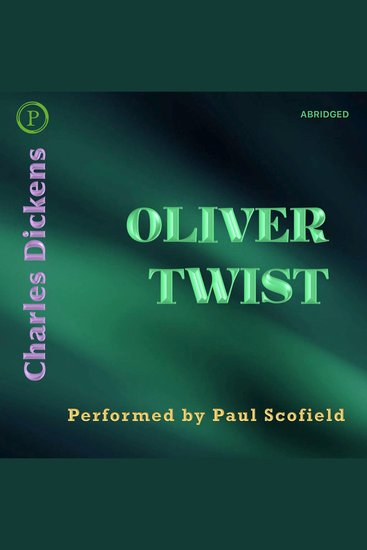
  • Oliver Twist - cover

    Oliver Twist

    Charles Dickens

    • 0
    • 0
    • 0
    A pauper's child reared in a workhouse, young Oliver Twist serves an apprenticeship in a loveless house. Despairing, he runs away and is befriended by a gang of young pickpockets who offer him the only welcome home he has ever known. Falling under the influence of villainous company, the young orphan struggles to escape from a life of poverty and crime, in search of the love he longs for. Oliver Twist is one of Dickens' greatest achievements, a vivid depiction of London's outlaw society with an array of memorable characters.
    Ver livro