¡Acompáñanos a viajar por el mundo de los libros!
Añadir este libro a la estantería
Grey
Escribe un nuevo comentario Default profile 50px
Grey
Suscríbete para leer el libro completo o lee las primeras páginas gratis.
All characters reduced
We Are Not the Enemy: The Practice of Advocacy in Singapore - cover

We Are Not the Enemy: The Practice of Advocacy in Singapore

Cherian George, Kok Hoe Ng, Thirunalan Sasitharan, Carol Yuen, Daryl Yang, Haolie Jiang, Joel Yew, Remy Choo, Kirsten Han, Isaac Neo, Kristian-Marc James Paul, Alfian Sa'at, Walid Jumblatt Abdullah, Irie Aman, Reetaza Chatterjee, Kenneth Paul Tan, Corinna Lim, Alex Au, Suraendher Kumarr

Editorial: Ethos Books

  • 0
  • 0
  • 0

Sinopsis

Advocates and activists in Singapore contribute to policy discussions and positive change through a combination of deft manoeuvres and patient politics. Yet civil society is often unacknowledged, their skill and labour instead frequently misunderstood, even earning them the label of “troublemakers” or “enemies of the state”. 
 
This collection of essays and interviews is a candid reflection on the intentions, beliefs and strategies behind the practice of advocacy across a spectrum of causes. The contributors come from varying backgrounds and include academics, artists, lawyers, journalists, non-profit and advocacy organisations, student and community organisers. They share practical insights into their aims and community-building work, and the tactics they employ to overcome obstacles, shedding light on how to navigate a city-state with shifting socio-political fault lines and out-of-bound markers. 
 
With an introduction, “It is Time to Trim the Banyan Tree”, by Constance Singam, and a conclusion, “Their Struggle is Ours to Continue”, by Suraendher Kumarr.
Disponible desde: 17/03/2024.
Longitud de impresión: 300 páginas.
Otros libros que te pueden interesar

  • My Whirlwind Lives - Navigating Decades of Storms - cover

    My Whirlwind Lives - Navigating...

    Dee Knight

    • 0
    • 0
    • 0
    Our recent storms didn't start in 2020 or 2016. They started decades ago in the 1960s - a whirlwind of threatened nuclear catastrophe, then police dogs and rednecks terrorizing civil rights marchers down south, then Vietnamese children fleeing from napalm flames. Then draft notices to go to Vietnam to "fight commies." 
    A small town boy started by supporting rightist Goldwater against the "peace candidate" Johnson, but rapidly changed in the face of the civil rights and anti-war movements, and started a quest that hasn't ended yet. 
    This book tells Dee Knight's story of "waking up" to the truth about the US war in Vietnam, then refusing the draft and going to Canada where he lived for six years. It relates the years-long campaign for amnesty, in which Knight was a leader. After war resisters won a partial amnesty, Knight continued campaigning against US wars up to the present day. 
    There are chapters on: 
    The political storms of 1968 
    Exile life in Canada 
    The years-long campaign for universal unconditional amnesty 
    Antiwar veterans and active duty soldiers and sailors, including the sanctuary movement 
    Witnessing Portugal's "Carnation Revolution" of 1975 
    Living and working in Sandinista Nicaragua 
    Socialism and the Green New Deal 
    "Messages from the Future" 
    Reflections on the Pandemic 
    The Battle to Expand and Protect Democracy 
    Appendices on Vietnam's victory in 1975, and on the reality of life and politics in China
    Ver libro
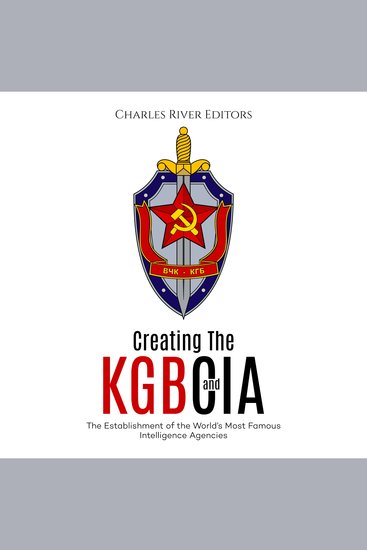
  • Creating the KGB and CIA: The Establishment of the World’s Most Famous Intelligence Agencies - cover

    Creating the KGB and CIA: The...

    Editors Charles River

    • 0
    • 0
    • 0
    The KGB is one of the most famous abbreviations of the 20th century, and it has become synonymous with the shadowy and often violent actions of the Soviet Union’s secret police and internal security agencies. In fact, it is often used to refer to the Soviet state security agencies throughout its history, from the inception of the inception of the Cheka (Extraordinary Commission) in 1917 to the official elimination of the KGB in 1992. Whether it’s associated with the Russian Civil War’s excesses, Stalin’s purges, and even Vladimir Putin, the KGB has long been viewed as the West’s biggest bogeyman during the second half of the 20th century. However, the KGB did not appear out of thin air. Naturally, the earliest Soviet leaders utilized intelligence agencies that collected information both abroad and within the Soviet Union, targeting foreign opponents and domestic opponents alike. Lenin did not imagine the scale of the opposition he would have to face after the revolution, and he quickly came to the conclusion that "a special system of organized violence" must be created to implement the dictatorship of the proletariat. 
    Though it might be hard to believe, the Americans did not have a covert operations organization when they joined World War II, and like the British, it took them some time to realize it could be a powerful tool. As a result, the Office of Strategic Services (OSS) was not established until June 13, 1942, six months after the attack on Pearl Harbor. This would all chart a path for the early days of America’s most famous intelligence agency, the CIA. Although plagued by its own share of problems in its early existence during World War II and the early Cold War years, the agency’s early problems, smoothed over by a string of tenured presidents, paled in comparison to those it would face in the coming decades.
    Ver libro
  • Red White & Blind - The Truth About Disinformation and the Path to Media Consciousness - cover

    Red White & Blind - The Truth...

    Tony Brasunas

    • 0
    • 0
    • 0
    Why were the sordid deeds of Jeffery Epstein concealed for two decades? Why was inquiry into the origin of covid suppressed? Why are social media sites censoring scientists, doctors, journalists, and scholars? 
    Through dozens of absorbing exposés, Red White & Blind reveals the corporate media's deliberate lies, tendentious censorship, and ironic use of the term "disinformation." This deceit has driven faith in corporate news to all-time lows, but it has also birthed an independent media revolution—a New Enlightenment—enabling Americans to see through the walls of "confirmation bias" and perceive the world more directly and accurately than ever before. 
    In this book, you will learn:How the Father of Propaganda convinced Americans to love bananas, World War I, and the color green.Why the notion of "objective, professional journalism" was invented in the early 1900s.How the CIA placed agents in the media and why they likely still do.How to understand family and friends with any set of political views.Why today's social media censorship violates the First Amendment.Why "fact-checking" websites almost always fail.The meaning of "gaslighting," "shadowbanning," and "narrative management."
    Ver libro
  • We Will Be Heard - Women's Struggles for Political Power in the United States - cover

    We Will Be Heard - Women's...

    Jo Freeman

    • 0
    • 0
    • 0
    In We Will Be Heard, noted political scientist Jo Freeman chronicles the struggles of women in the United States for political power. Most of their stories are little-known, but Freeman's compelling portrait of women working for change reminds us that women have never been silent in the political affairs of the nation. From J. Ellen Foster's address to the 1892 Republican Convention to Nancy Pelosi's 2007 election as the first female Speaker of the House, women have worked to influence politics at every level. Well before most could vote, women campaigned for candidates and lobbied to shape public policy. Men welcomed their work, but not their ideas. Even with equal suffrage women faced many barriers to full political participation. The fifteen case studies of women's struggles for political influence in this book provide the historical context for today's political events. Starting with an overview of when and why political women have been studied, the three sections of the book look at different ways in whi
    Ver libro
  • The Anarchist Handbook - cover

    The Anarchist Handbook

    Michael Malice

    • 0
    • 0
    • 0
    Anarchism has been both a vision of a peaceful, cooperative society—and an ideology of revolutionary terror. Since the term itself—anarchism—is a negation, there is a great deal of disagreement on what the positive alternative would look like. The black flag comes in many colors.The Anarchist Handbook is an opportunity for all these many varied voices to speak for themselves, from across the decades. These were human beings who saw things differently from their fellow men. They fought and they loved. They lived and they died. They disagreed on much, but they all shared one vision: Freedom.
    Ver libro
  • The American Supreme Court - Sixth Edition - cover

    The American Supreme Court -...

    Robert G. McCloskey, Sanford...

    • 0
    • 0
    • 0
    For more than fifty years, Robert G. McCloskey’s classic work on the Supreme Court’s role in constructing the US Constitution has introduced generations of students to the workings of our nation’s highest court.
     
    As in prior editions, McCloskey’s original text remains unchanged. In his historical interpretation, he argues that the strength of the Court has always been its sensitivity to the changing political scene, as well as its reluctance to stray too far from the main currents of public sentiment. In this new edition, Sanford Levinson extends McCloskey’s magisterial treatment to address developments since the 2010 election, including the Supreme Court’s decisions regarding the Defense of Marriage Act, the Affordable Care Act, and gay marriage.
     
    The best and most concise account of the Supreme Court and its place in American politics, McCloskey’s wonderfully readable book is an essential guide to the past, present, and future prospects of this institution.
    Ver libro