¡Acompáñanos a viajar por el mundo de los libros!
Añadir este libro a la estantería
Grey
Escribe un nuevo comentario Default profile 50px
Grey
Suscríbete para leer el libro completo o lee las primeras páginas gratis.
All characters reduced
Prisoners of Jan Smuts - Italian Prisoners of War in South Africa in WWII - cover

Prisoners of Jan Smuts - Italian Prisoners of War in South Africa in WWII

Karen Horn

Editorial: Jonathan Ball

  • 0
  • 0
  • 0

Sinopsis

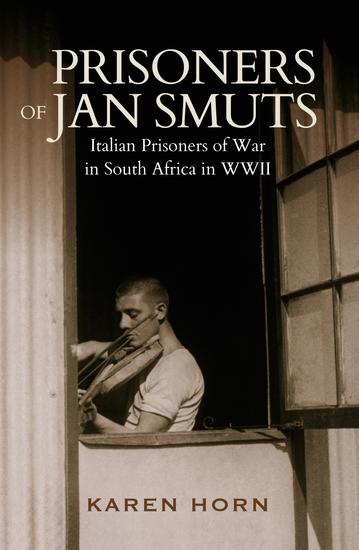
Equally skilled in a variety of trades other than in the art of love, the Italian prisoners of war (POWs) who were incarcerated in South Africa during the Second World War are a source of great fascination to this day. Who were these men? And what made some of them attempt dramatic escapes, while others wanted to stay behind after the war?
The first Italian POWs arrived in the Union of South Africa in early 1941, most of them being held in Zonderwater Camp outside Cullinan or in work camps across the country. The government of Jan Smuts saw them as a source of cheap labour that would contribute to harvesting schemes, road-building projects such as the old Du Toit's Kloof Pass between Paarl and Worcester and even to prickly-pear eradication schemes.
Prisoners of Jan Smuts recounts the stories of survival and shenanigans of the Italian POWs in the Union through the eyes of five prisoners who had documented their experiences in memoirs and letters. While many POWs seemed to appreciate the opportunities to gain new skills, others clung to the Fascist ideas they had grown up with and refused to work
.
Many opted to remain in South Africa once the war had ended, forging quite a legacy. These included sculptor Edoardo Villa, who left an important mark in the local and international art world, and businessman Aurelio Gatti, who built an ice-cream empire whose gelato was to delight generations of South Africans.
Disponible desde: 10/04/2024.
Longitud de impresión: 272 páginas.

Otros libros que te pueden interesar

  • The State and Revolution - cover

    The State and Revolution

    Vladimir Lenin

    • 0
    • 0
    • 0
    The State and Revolution (1917), by Vladimir Lenin, describes the role of the State in society, the necessity of proletarian revolution, and the theoretic inadequacies of social democracy in achieving revolution to establish the dictatorship of the proletariat.
    Lenin began the composition of an early draft of State and Revolution while in exile in Switzerland in 1916, under the title "Marxism on the State".
    "Soviets", legislative bodies of workers and peasants were the de facto governments of Petrograd and many smaller cities. The Russian public was deeply upset with the continuation of Russia's involvement in World War One and the continued economic difficulties that it brought on. On November 7th The Congress of Soviets officially elected a coalition of Bolsheviks, Socialist Revolutionaries and Mensheviks to govern. Through the Red Guards, paramilitary organizations of revolutionary workers, sailors and soldiers; the Soviet government was able to storm The Winter Palace and officially abolishing the Provisional government. The revolution was not uniformly accepted among all Russians, resistance and disruption would occur routinely leading up to The Russian Civil War. A particular issue that Lenin covers in The State and Revolution was the right of nations to secession (The right to self determination); during the composition of this book The Mensheviks of Georgia declared independence soon after The Revolution forming The Democratic Republic of Georgia.
    Among other famous Marxists there were also: Georgi Plekhanov, Joseph Stalin, Leon Trotsky, Karl Marx, Friedrich Engels, Ernst Bloch, Pyotr Kropotkin, Jean-Paul Charles Aymard Sartre, Wilhelm Reich, Perry Anderson.
    Ver libro
  • Roman Legions - The Military Might of an Empire - cover

    Roman Legions - The Military...

    Rogan Fish

    • 0
    • 0
    • 0
    The Roman legions were the backbone of one of the most formidable military forces in history. Before the rise of the professional army, Rome’s early military structure was largely based on citizen soldiers who fought in times of need. This early system was influenced by both the Etruscans and the Greeks, shaping the foundation of what would become the highly disciplined and organized Roman legions. Over time, reforms, particularly those of Gaius Marius, transformed the Roman military into a professional and highly efficient force that would dominate the ancient world. 
    In the early days of Rome, military service was tied to land ownership. The army was made up of citizen militias, with each man providing his own weapons and armor. This system was similar to that of the Greek hoplites, where soldiers fought in close formations with shields and spears. However, as Rome expanded, it became clear that a more structured and permanent military force was needed. The influence of the Etruscans introduced elements of hierarchy and organization, while the Greeks contributed to Rome’s use of phalanx-style formations in battle. Despite these early influences, the Roman army continued to evolve, adapting to new threats and challenges. 
    The real transformation of the Roman military came during the late Republic, when Gaius Marius introduced the Marian Reforms. These changes allowed for the recruitment of landless citizens, shifting the army from a temporary force to a standing professional military. Soldiers were now equipped by the state, ensuring uniformity in weapons and armor. The structure of the army was also refined, replacing the older phalanx formations with the more flexible manipular and cohort systems. This allowed for greater maneuverability on the battlefield, giving the Romans a significant advantage over their enemies.
    Ver libro
  • Frames of Intelligence: Unravel the Hidden Secrets - “Unlock your mind’s potential with transformative audio lessons that unveil the secrets of Frames of Intelligence!” - cover

    Frames of Intelligence: Unravel...

    Kieran Alderwood

    • 0
    • 0
    • 0
    Frames of Intelligence: Unravel the Hidden Secrets 
    ⭐⭐ Simplified Guide & Explanations Included ⭐⭐ 
    Are you eager to advance in your career and deepen your understanding by successfully navigating the 2024-2025 certification exam? 
    Do you need a comprehensive resource that encompasses everything you need to excel in the 2024-2025 certification exam? 
    Your quest ends here! 
    This guide is your ultimate tool for enhancing your comprehension, applying your skills, and engaging in practical exercises. With this resource, you’re set for achievement. 
    Updated for the 2024-2025 Exam Structure. 
    Key features of this enriched guide: 
    - In-depth insights into the 2024-2025 Certification Exam   
    - Comprehensive explanation of unlocking your potential through varied intellectual perspectives   
    - Effective strategies for exam preparation and problem-solving   
    Our guide stands out with its extensive coverage, which is vital for your success in the exam. Concepts are not just briefly discussed; they are explored in depth with clarity. 
    Please keep in mind that this guide is an independent resource and is not affiliated with any official certification organization. 
    Constructed with a clear layout and easily understandable language, our 2024-2025 Exam Guide facilitates smooth transitions between topics. Bid farewell to complex terminology and embrace clear, precise, and technically accurate content. 
    So, why hesitate? Click the BUY NOW button, secure your guide, and embark on your journey towards success in the 2024-2025 certification exam!
    Ver libro
  • Manliness & Civilization - A Cultural History of Gender and Race in the United States 1880–1917 - cover

    Manliness & Civilization - A...

    Gail Bederman

    • 0
    • 0
    • 0
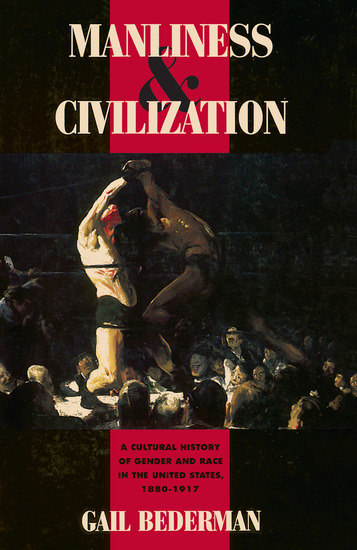
    When former heavyweight champion Jim Jeffries came out of retirement on the fourth of July, 1910 to fight current black heavywight champion Jack Johnson in Reno, Nevada, he boasted that he was doing it "for the sole purpose of proving that a white man is better than a negro." Jeffries, though, was trounced. Whites everywhere rioted. The furor, Gail Bederman demonstrates, was part of two fundamental and volatile national obsessions: manhood and racial dominance. In turn-of-the-century America, cultural ideals of manhood changed profoundly, as Victorian notions of self-restrained, moral manliness were challenged by ideals of an aggressive, overtly sexualized masculinity. Bederman traces this shift in values and shows how it brought together two seemingly contradictory ideals: the unfettered virility of racially "primitive" men and the refined superiority of "civilized" white men. Focusing on the lives and works of four very different Americans—Theodore Roosevelt, educator G. Stanley Hall, Ida B. Wells, and Charlotte Perkins Gilman—she illuminates the ideological, cultural, and social interests these ideals came to serve.
    Ver libro
  • American Family in Nazi Berlin: Love and Fear - "Dive into 'American Family in Nazi Berlin'—compelling audio tales of love and survival" - cover

    American Family in Nazi Berlin:...

    Gareth Wilder

    • 0
    • 0
    • 0
    "American Family in Nazi Berlin: Love and Fear": 
    Are you eager to deepen your understanding of historical resilience and emotional strength during times of extreme adversity? 
    Looking for a comprehensive guide that captures all vital elements of an American family's experiences amidst tyranny? 
    Your journey starts here! 
    This guide is your ultimate resource for gaining profound insights, applying empathy, and exploring the emotional landscape of love and fear. With this, you're prepared for a deep dive into history. 
    Updated to reflect recent research on resilience during oppressive regimes. 
    Key features of this enriched guide: 
    - In-depth exploration of heartfelt resilience in the face of tyranny 
    - Detailed narratives of survival and resistance   
    - Effective strategies for understanding and reflecting on historical events 
    Our guide stands out with its thorough coverage, which is crucial for grasping the complexities of historical narratives. The content is explored with precision and detail. 
    Please note that this guide is an independent resource, not affiliated with any official historical body, created purely for your educational benefit. 
    Crafted with clarity and easy-to-understand language, our guide ensures seamless transitions between topics. Say goodbye to complex jargon and welcome clear, precise, and historically accurate content. 
    So, why wait? Click the BUY NOW button, secure your guide, and embark on your journey into the past and resilience amidst tyranny.
    Ver libro
  • Mind Phenomenon - cover

    Mind Phenomenon

    Uttam Pati

    • 0
    • 0
    • 0
    Does the mind-body entanglement puzzle follow the scientific laws of our time? This book brings forth a revolutionary concept of a subtle crude entity to explain the expression of mind in the biological system. 
    It describes how this entity may link propensities, polarities, and the process of viral invasion to our ever-emerging thought process. The subtle liaison between protozoic, metazoic and unit mind, through a unified command, is proposed to control the biochemical events at the molecular level. The book advances an intuitive rationalization mode of mind to sustain the sentient values against the stationary platform, through reversible order. The role of self-created intuitive reasoning would, silently, propel the reader from chaos in to a sublime, higher order living.
    Ver libro