
Rejoignez-nous pour un voyage dans le monde des livres!
Ajouter ce livre à l'électronique
Grey
Ecrivez un nouveau commentaire Default profile 50px
Grey
Abonnez-vous pour lire le livre complet ou lisez les premières pages gratuitement!
All characters reduced
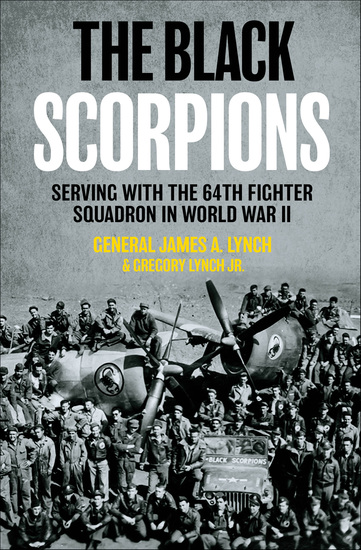
The Black Scorpions - Serving with the 64th Fighter Squadron in World War II - cover

The Black Scorpions - Serving with the 64th Fighter Squadron in World War II

James A. Lynch, Gregory Lynch

Maison d'édition: Casemate

  • 0
  • 0
  • 0

Synopsis

A U.S. Army Air Corps general recounts his service in the Mediterranean during World War II.“This book richly details life in a fighter squadron. Readers will learn new details and gain a better understanding of the daily experience outside of the intense combat environment. It is well worth reading this contribution to World War II oral history.” —The Journal of America's Military PastOn December six, 1941, despite his objections, James Lynch was discharged from the Army for being over age in grade. After the terrible events at Pearl Harbor, James Lynch was recalled to duty. Within a month he was part of the Air Corps, involved in a secret project to send air support to help General Montgomery and the Eighth Army. He joined the nucleus of officers in charge of the 64th Fighter Squadron, 57th Fighter Group. For the next thirty-three months, he fought across the top of Africa and then up through Italy. The 57th Fighter Group arrived in Egypt just in time for the battle at El Alamein. How the United States was able to get the pink-winged P-40s to the battlefield baffled the Germans for many years. The Black Scorpions chased the Afrika Corps across the top of Africa, culminating in the Palm Sunday massacre where the Squadron helped shoot down seventy-four planes in a single engagement. For the Italian campaign, the Black Scorpions switched from P-40s to P-47s, changing from fighters to bombers and disrupting the German and Italian lines up the Italian Peninsula.Through all the battles, including a battle with an erupting Mount Vesuvius, James Lynch kept an unauthorized diary. He also collected daily intelligence reports, newspaper stories, souvenirs, pictures, and letters from home. After the war he reminisced with fellow soldiers about their experiences, and eventually felt it was time to write the story of the Black Scorpions—this book is the result.“One of the most captivating WWII aviation memoirs thus far published.” —ARGunners.com
Disponible depuis: 30/06/2023.
Longueur d'impression: 384 pages.

D'autres livres qui pourraient vous intéresser

  • Presidents of the USA - Martin van Buren James Madison and Ulysses Grant - cover

    Presidents of the USA - Martin...

    Kelly Mass

    • 0
    • 0
    • 0
    This combo contains the following biographies: 
    1 - Martin Van Buren was an American attorney and statesman who acted as the United States' 8th president between 1837 to 1841. He was the ninth ruler of New York, the tenth US Secretary of State, and the 8th Vice President of the United States.He was a creator of the Democratic Party. With the support of well-known leaving President Andrew Jackson and the Democratic Party's organizational strength, he won the 1836 governmental election. 
    2 - James Madison (who lived from March 16, 1751 to June 28th, 1836) was an American statesman, diplomat, expansionist, theorist, and Founding Father who worked as the United States' 4th president from 1809 to 1817. For his essential role in the creation and big promotion of the US Constitution and the US Bill of Rights, he's referred to as the "Father of the Constitution." From 1801 till 1809, he functioned as the 5th Secretary of State of the United States, co-authoring The Federalist Documents and co-founding the Democratic-Republican Party. 
    3 - Ulysses S. Grant was an American army officer and political leader who acted as the United States' 18th president from 1869 to 1877. Grant was an achieved civil liberties executive at the time of his presidency, developing the Justice Department and teaming up with the Radical Republicans to secure African Americans at the time of Restoration. He led the Union Army to success in the American Civil War as Commanding General in the year 1865, and after that briefly functioned as Secretary of War.
    Voir livre
  • Essays: First Series Prudence - cover

    Essays: First Series Prudence

    Ralph Waldo Emerson

    • 0
    • 0
    • 0
    Prudence is not timidity. It is not caution for its own sake. It is the art of knowing when to act and when to wait, when to follow reason and when to trust instinct. In Prudence, Ralph Waldo Emerson reclaims this often-misunderstood virtue, not as mere carefulness but as the wisdom of navigating life with both vision and restraint.
    For Emerson, prudence is not the enemy of boldness but its quiet architect. It does not stifle ambition but shapes it, guiding passion with clarity and purpose. A mind without prudence rushes blindly; a mind ruled by it never moves at all. The balance is where true mastery lies.
    Part of Essays: First Series, Prudence is neither a defense of conservatism nor a rejection of daring. It is an exploration of how thought and action, reason and impulse, can coexist in harmony. To read it is to rethink not just how we act, but how we decide when to act at all.
    Voir livre
  • Augustine the African - cover

    Augustine the African

    Catherine Conybeare

    • 0
    • 0
    • 0
    An extraordinary work of revisionist history that centers Africa in the life of one of our greatest philosophers. 


    Augustine of Hippo (354–430), also known as Saint Augustine, was one of the most influential theologians in history. His writings, including the autobiographical Confessions and The City of God, helped shape the foundations of Christianity and Western philosophy. But for many centuries, Augustine's North African birth and Berber heritage have been simply dismissed. Catherine Conybeare, a world-renowned Augustine scholar, here puts the "African" back in Augustine's story. As she relates, his seminal books were written neither in Rome nor in Milan, but in Africa, where he had returned as a wanderer during a perilous time when the Western Roman Empire was crumbling. Using extant letters and other shards of evidence, Conybeare retraces Augustine's travels, revealing how his groundbreaking works emerge from an exile's perspective within an African context. In its depiction of this Christian saint, Augustine the African upends conventional wisdom and traces core ideas of Christian thought to their origins on the African continent.
    Voir livre
  • The Secret Life of John le Carre - cover

    The Secret Life of John le Carre

    Adam Sisman

    • 0
    • 0
    • 0
    The extraordinary secret life of a great novelist, which his biographer could not publish while le Carré was alive.  
     
    Secrecy came naturally to John le Carré, and there were some secrets that he fought fiercely to keep. Adam Sisman's definitive biography, published in 2015, provided a revealing portrait of this fascinating man; yet some aspects of his subject remained hidden. 
    Nowhere was this more so than in his private life. Apparently content in his marriage, the novelist conducted a string of love affairs over five decades. To these relationships he brought much of the tradecraft that he had learned as a spy - cover stories, cut-outs and dead letter boxes. These clandestine operations brought an element of danger to his life, but they also meant deceiving those closest to him. Small wonder that betrayal became a running theme in his work. 
    In trying to manage his biography, the novelist engaged in a succession of skirmishes with his biographer. While he could control what Sisman wrote about him in his lifetime, he accepted that the truth would eventually become known. Following his death in 2020, what had been withheld can now be revealed. 
    The Secret Life of John le Carré reveals a hitherto-hidden perspective on the life and work of the spy-turned-author and a fascinating meditation on the complex relationship between biographer and subject. “Now that he is dead,” Sisman writes, “we can know him better.”
    Voir livre
  • Casanova Volume 6 - Spanish Passions - cover

    Casanova Volume 6 - Spanish...

    Giacomo Casanova

    • 0
    • 0
    • 0
    "Casanova: Spanish Passions" by Giacomo Casanova delves into the libertine’s fiery encounters and adventures across Spain. From sultry romances to perilous escapades, Casanova immerses himself in the vibrant culture and tempestuous spirit of the region. His charm and audacity lead him into intimate entanglements and clashes with authority, exposing the complexities of love, honor, and desire. Against a backdrop of flamenco, duels, and aristocratic intrigue, Casanova reflects on the intoxicating interplay of passion and power. This volume captures his relentless pursuit of freedom and pleasure, blending personal memoir with rich historical detail. A vivid portrayal of 18th-century Spain, it reveals the timeless allure of human emotions and societal dynamics.
    Voir livre
  • Diary of a Lunatic - From their pens to your ears genius in every story - cover

    Diary of a Lunatic - From their...

    Leo Tolstoy

    • 0
    • 0
    • 0
    Leo Tolstoy was born in 1828 in the Russian province of Tula to a wealthy noble family. As a child, he had private tutors but he showed little interest in any formal education. When he went to the University of Kazan in 1843 to study oriental languages and law, he left without completing his courses.  Life now was relaxed and idle but with some writing also taking place.  Gambling debts forced an abrupt change of path and he joined the army to fight in the Crimean War.  He was commended for his bravery and promoted but was appalled at the brutality and loss of life.  He recorded these and other earlier experiences in his diaries which formed the basis of several of his works. 
    In 1852 ‘Childhood’ was published to immediate success and was followed by ‘Boyhood’ and ‘Youth’. 
    His experience in the army and the horrors he witnessed resulted in ‘The Cossacks’ in 1862 and the trilogy ‘Sevastopol Tales’. After the war he travelled around Europe, visiting London and Paris and meeting such luminaries as Victor Hugo and Charles Darwin.  
    It was now that Tolstoy began his masterpiece, ‘War and Peace’. Published in 1869 it was an epic work that changed literature. He quickly followed this with ‘Anna Karenina’.  
    These successes made Tolstoy rich and helped him accomplish many of his dreams but also brought problems as he grappled with his faith and the lot of the oppressed poor. These revolutionary views became so popular that the authorities now kept him under surveillance.  
    He led a life of asceticism and vegetarianism and put his socialist ideals into practice by establishing numerous schools for the poor and food programmes. He also believed in giving away his wealth, which caused much discord with his wife.  
    His writing continued to bring forth classics such as ‘The Death of Ivan Ilyich’ and many brilliant and incisive short stories such as ‘How Much Land Does A Man Need’.  
    In 1901 Tolstoy was excommunicated from the Church and controversially deselected for the Nobel Prize for Literature. 
    Whilst undertaking a pilgrimage by train in October 1910 with his daughter Aleksandra he caught pneumonia in the nearby town of Astapovo.  Leo Tolstoy died on November 9th, 1910, he was 82.
    Voir livre