
Join us on a literary world trip!
Add this book to bookshelf
Grey
Write a new comment Default profile 50px
Grey
Subscribe to read the full book or read the first pages for free!
All characters reduced
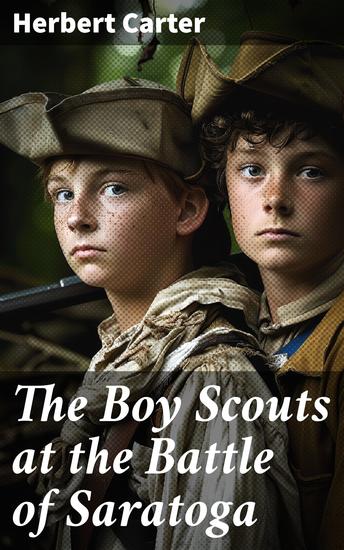
The Boy Scouts at the Battle of Saratoga - The Story of General Burgoyne's Defeat - cover

The Boy Scouts at the Battle of Saratoga - The Story of General Burgoyne's Defeat

Herbert Carter

Publisher: Good Press

  • 0
  • 0
  • 0

Summary

In "The Boy Scouts at the Battle of Saratoga," Herbert Active Carter crafts a gripping narrative that intertwines adventure, historical accuracy, and the spirit of camaraderie as young Boy Scouts engage in a pivotal moment of American history. Set against the backdrop of the Revolutionary War, the story skillfully blends thrilling escapades with an emphasis on the moral virtues espoused by the Boy Scouts'Äîloyalty, resourcefulness, and bravery. Carter's straightforward prose and vivid descriptions immerse readers in the struggles and triumphs of the protagonists, creating a sense of urgency while educating them about the significance of the Battle of Saratoga in shaping the American independence movement. Carter, a noted author active during the early 20th century, was deeply influenced by the burgeoning Boy Scouts movement, which sought to instill leadership and outdoor survival skills in young boys. His experience engaging with youth organizations likely informed his understanding of the values inherent in scouting, which resonate throughout this historical tale. Carter'Äôs focus on detailing events from a youthful perspective invites readers to connect with their historical counterparts, fostering a sense of shared experience across generations. This book is highly recommended for readers seeking an engaging blend of historical fiction and adventure literature. Young readers will find themselves inspired by the courage and camaraderie of the Scouts, while educators can utilize it as a resource to spark interest in American history. "The Boy Scouts at the Battle of Saratoga" is not just a story of war; it'Äôs a celebration of youth, bravery, and the forging of national identity.
Available since: 10/12/2023.
Print length: 136 pages.


Other books that might interest you

  • Feudalism and Its Transition - The Evolution of Feudal Systems and Their Collapse (3 in 1) - cover

    Feudalism and Its Transition -...

    Arlo Holders

    • 0
    • 0
    • 0
    This book contains the following titles: 
      - The Feudal System: Feudalism was a dominant social, economic, and political system in medieval Europe that shaped the lives of millions from the 9th to the 15th centuries. Rooted in the decline of the Roman Empire, it emerged as a response to the need for local defense, stability, and order. With the fall of centralized authority, particularly in the wake of the collapse of Roman imperial power, local leaders, and warriors filled the vacuum, giving rise to a new hierarchical structure that became the backbone of medieval society. 
      - The End of Feudalism: Feudalism was a social, political, and economic system that dominated medieval Europe, particularly from the 9th to the 15th century. Its structure was based on the exchange of land for loyalty, military service, and labor. At its core, feudalism established a hierarchical order in which the king, or monarch, granted land, known as fiefs, to vassals (nobles) in exchange for their service. In turn, these vassals would grant portions of their land to serfs or peasants, who worked the land in return for protection and sustenance. This land-based economy was highly localized, with power concentrated in the hands of a few, and much of daily life revolved around agricultural production.
    Show book
  • The Crisis of the Twelfth Century - Power Lordship and the Origins of European Government - cover

    The Crisis of the Twelfth...

    Thomas N. Bisson

    • 0
    • 0
    • 0
    Medieval civilization came of age in thunderous events like the Norman Conquest and the First Crusade. Power fell into the hands of men who imposed coercive new lordships in quest of nobility. Rethinking a familiar history, Thomas Bisson explores the circumstances that impelled knights, emperors, nobles, and churchmen to infuse lordship with social purpose.Bisson traces the origins of European government to a crisis of lordship and its resolution. King John of England was only the latest and most conspicuous in a gallery of bad lords who dominated the populace instead of ruling it. Yet, it was not so much the oppressed people as their tormentors who were in crisis. The Crisis of the Twelfth Century suggests what these violent people—and the outcries they provoked—contributed to the making of governments in kingdoms, principalities, and towns.
    Show book
  • Crusades in Europe The: The History of the Catholic Crusaders’ Campaigns against the Ottomans and Christians across the Continent - cover

    Crusades in Europe The: The...

    Editors Charles River

    • 0
    • 0
    • 0
    Christianity was not a state religion for its first three centuries, and it was only when Emperor Constantine the Great declared it so in the early 4th century that the Church was faced with the thorny problem of state-sanctioned violence. The first major Christian authority to justify the use of arms in defense of Church and State was Augustine, Bishop of Hippo, who wrote in the 5th century, “They who have waged war in obedience to the divine command or in conformity with His laws, have represented in their persons the public justice or the wisdom of government, and in this capacity have put to death wicked men; such persons have by no means violated the commandment, ‘Thou shalt not kill.’”  
    	This opinion gained increasing influence in Western Christianity, though in the East, the attitude was (and continues to be) more nuanced. War was tolerated as a regrettable necessity in a world wounded by sin but never blessed. Canon law enacted in the Byzantine (Eastern Roman) Empire tended to treat soldiers who had killed as sinners needing to repent, and Bishop Basil of Caesarea (d. c. 330) believed that they needed to abstain from receiving communion for three years after battle. It was not that that the Eastern Roman Empire was a particularly peaceable state–far from it, in fact: it was engaged in almost continuous warfare for its entire existence. However, its conflicts were mostly defensive in character, fighting barbarians, Persians, or Muslims, and the idea of consecrating arms for the cause of Christianity was considered alien to its spirit.  
    At the Council of Clermont in July 1095, Pope Urban II canonized religious war by urging Western Europe's nobility to take up arms in defense of the Byzantine Empire against the Muslims, thus launching the Crusades, and religious military orders such as the Knights of Saint John, the Templars, and the Hospitallers arose.
    Show book
  • Jihad and Genocide - cover

    Jihad and Genocide

    Richard L. Rubenstein

    • 0
    • 0
    • 0
    A study of Islamic fundamentalism, its violent and deadly history, and the questions it raises today. This book examines the relationship between jihad and genocide, past and present. Richard L. Rubenstein takes a close look at the violent interpretations of jihad and how they have played out in the past hundred years, from the Armenian genocide through current threats to Israel. Rubenstein’s unflinching study of the potential for fundamentalist jihad to initiate targeted violence raises pressing questions in a time when questions of religious co-existence, particularly in the Middle East, are discussed urgently each day. Praise for Jihad and Genocide“Provocative, important reading for all interested in Arab-Israeli peace and religious coexistence worldwide. Highly recommended.” —Choice Reviews“Rubenstein’s analysis stands the test of time. Thus, attention must be paid to Rubenstein's new work, Jihad and Genocide, which offers a searing analysis of Islamic thought and bleak predictions of its impact. Even those of us who do not share his pessimism, his sense of the inevitability of the path to genocide and war, or his predilection for the political right, must confront the issues he raises.” —Foreword Reviews
    Show book
  • The Woman's Book of Joy - Listen to Your Heart Live with Gratitude and Find Your Bliss - cover

    The Woman's Book of Joy - Listen...

    Eileen Campbell

    • 1
    • 0
    • 0
    Experience Serenity and Hope Daily“The Woman’s Book of Joy is like a comforting friend supporting us in our struggles.” —Mandy Keast-Southall, therapist and yoga teacherWhen you learn to tap into the deep wellspring of joy that is within you, nothing is impossible.A book of joy. Women have a great many challenges to deal with in their lives. Among the most ubiquitous of those challenges is self-care. Too often, we are focused on caring for others and not ourselves. Low self-esteem, anxiety, and depression are all too common when our lives are less fulfilling than they could be. Yet deep within, women have a tremendous spiritual resource―a capacity for real joy that is not dependent on anything external. It is always available, regardless of circumstances.Find your inner spirituality. Many self-help books can lead people into further self-judgement. Instead, The Woman’s Book of Joy encourages and inspires women to care more deeply for themselves and to face life’s challenges with courage and joy. It’s a practical motivational book for accessing inner wisdom, enhancing self-esteem, overcoming sorrow, and deepening relationships.Thinking deeply. The meditations and affirmations in this book will provide you with the opportunity to contemplate a wide range of topics, including:Developing awarenessLetting goBelieving in your dreamsLiving in the nowFinding your true purposePracticing kindnessBeing optimisticTrusting the universeAppreciating life’s blessingsIf you found joy in meditation books and inspirational books for women like I've Been Thinking…, Journey to the Heart, and Each Day a New Beginning, you’ll be encouraged and uplifted by The Woman's Book of Joy.
    Show book
  • Critical and Modern Movements - Revolutionizing Thought: The Critical Cultural and Political Shifts in Philosophy (12 in 1) - cover

    Critical and Modern Movements -...

    Hector Davidson

    • 0
    • 0
    • 0
    This book contains the following titles and topics: 
    - Deconstructionism  
    - Determinism  
    - Feminist Philosophy  
    - Humanism  
    - Liberalism  
    - Moral Philosophy  
    - Naturalism  
    - Nihilism  
    - Phenomenology  
    - Pragmatism  
    - Structuralism  
    - Utilitarianism 
    Show book