
Junte-se a nós em uma viagem ao mundo dos livros!
Adicionar este livro à prateleira
Grey
Deixe um novo comentário Default profile 50px
Grey
Assine para ler o livro completo ou leia as primeiras páginas de graça!
All characters reduced
Delphi Collected Works of Gottfried Wilhelm Leibniz Illustrated - cover
LER

Delphi Collected Works of Gottfried Wilhelm Leibniz Illustrated

Gottfried Wilhelm Leibniz

Editora: Delphi Publishing Ltd

  • 0
  • 0
  • 0

Sinopse

The German polymath Gottfried Wilhelm Leibniz has been called the “last universal genius” due to his vast expertise across numerous fields. A prominent figure in both the history of philosophy and the world of mathematics, Leibniz produced groundbreaking works on theology, ethics, politics, law, history, physics, music and other studies. As a philosopher, he was a leading representative of seventeenth century rationalism and idealism, being especially noted for his optimism and his famous conclusion that our world is “the best possible world that God could have created”. As a mathematician, he developed the main ideas of calculus and devised the binary number system that is the basis of modern digital computing and communications. This eBook presents Leibniz’ collected works, with numerous illustrations, rare texts, informative introductions and the usual Delphi bonus material. (Version 1)

 
* Beautifully illustrated with images relating to Leibniz’ life and works* Concise introductions to the major texts* Features rare treatises and dialogues* Images of how the texts were first published, giving your eReader a taste of the original texts* Excellent formatting of the texts* Easily locate the sections you want to read with contents tables* Special criticism section, with essays evaluating Leibniz’ contribution to world literature* Features two biographies – discover Leibniz’ incredible life

 
CONTENTS:

 
The WorksSystem of Theology (1686)Discourse on Metaphysics (1686)A Philosopher’s Creed (1673)Extracts from the ‘New Essays on the Understanding’ (1704)Theodicy (1710)Monadology (1714)The Philosophical Works of Leibnitz (1890)Correspondence with Baruch Spinoza

 
The CriticismAn Abstract of a Book Lately Published Entitled a Treatise of Human Nature Etc. (1740) by David HumeLeibnitz (1837) by Georg Wilhelm Friedrich HegelGottfried Wilhelm von Leibnitz (1858) by Frederic Henry HedgeLeibniz Rewritten (1899) by Charles Sanders PeirceLeibniz as a Politician (1911) by Adolphus William Ward

 
The BiographiesLife and Philosophy of Leibnitz (1856) by Alexander Campbell FraserGottfried Wilhelm Leibnitz (1911) by William Ritchie Sorley
Disponível desde: 29/01/2025.
Comprimento de impressão: 1140 páginas.


Outros livros que poderiam interessá-lo

  • Blogging - The Modern Method Of Mass Communication! - cover

    Blogging - The Modern Method Of...

    Owen Jones

    • 0
    • 0
    • 0
    Blogging is the modern cheapest method of mass communication available to everyone everywhere in the world... no matter which language you speak. There are many platforms that allow people to blog for a very low price or even free, or you can establish your own platform in the form of a website, and once you start, you can write about almost anything you like. The aim of this manual is to show you how to get started on the road to becoming a blogger.
    Ver livro
  • Hekate - Goddess of Witches - cover

    Hekate - Goddess of Witches

    Courtney Weber

    • 0
    • 6
    • 0
    Learn the myths and legends behind this beloved goddess plus practices and suggestions for making Hekate part of your spiritual path. Courtney Weber (author of Brigid and The Morrigan) offers an informed, accessible journey through the lore and history of Hekate, the ancient goddess of crossroads, ghosts, and witchcraft, and reflects on Hekate’s relevance today. Tools and techniques for incorporating this goddess into your personal journey round out the book.  Similar to her other works, Weber strikes a balance between the scholarly and the spiritual. Her exploration of Hekate combines solid research with practical, modern applications. The spiritual content is accessible to anyone with an interest in witchcraft, regardless of their faith or background.   Each chapter focuses on a different aspect of Hekate, exploring original mythology, historical context, and contemporary connotations, concluding with spells and personal rituals. The final chapter is a grimoire full of rituals, offerings, and other practices designed to help readers align themselves with this extraordinary goddess. The book also explores magickal ethics, what it means to be a witch in the twenty-first century, and best practices for successful witchcraft.
    Ver livro
  • Off The Map: A Global Atlas of Non-Existent Places - Unrecognized States Disputed Lands & The Places We Cannot Go - cover

    Off The Map: A Global Atlas of...

    Dr. Nick Coman, I. A.I.

    • 0
    • 0
    • 0
    A 24‑lecture audio expedition into the world’s cartographic glitches—unrecognized states, disputed borders, legal voids, and places you can’t enter. We move from café‑tile sovereignty in Baarle, where a front door decides your country, to the 2015 India–Bangladesh enclave exchange, and the 2022 line cut across Hans Island’s ravine; from Ceuta and Melilla’s fences and tax codes to the Danube where hydrology argues with history; from the Bir Tawil/Hala’ib paradox to the Chernobyl Exclusion Zone and America’s twin sacrifice zones, Picher and Centralia.         
    We make the atlas legible: thalweg versus cadastre, uti possidetis and boundary commissions, counter‑enclaves and neutral roads, patrol lines, CBMs, and maritime geodesy. Trace Fergana’s water politics from Golovnoi gates to the Andijan/Kempir‑Abad bargain; India’s Himalayan hinge from Siachen and Galwan to Sugauli; the pastoral circuits and patrol lines that keep the Ilemi Triangle ambiguous; and the nested Nahwa‑in‑Madha‑in‑UAE trick.     
    Markets and politics are treated as geography constraints. Learn to read sovereignty by ferries, fuel receipts, and power bills; to separate romantic claims from operational control; to test what‑ifs—who could claim Bir Tawil, what shifts if Sir Creek moves—and to map chokepoints beyond lines: customs regimes, water releases, patrol logistics, recognition cycles. Then follow the consequences—duty‑free ledgers and bunkering margins, quotas and visas, surveillance and tragedy on the fence. Rigorous, narrative‑driven, and built for the intellectually ambitious, this course is an operator’s guide to the law, logistics, and lived frictions of a planet whose map won’t sit still.  
    Ver livro
  • The Individualization of War - Rights Liability and Accountability in Contemporary Armed Conflict - cover

    The Individualization of War -...

    Dapo Akande, David Rodin,...

    • 0
    • 0
    • 0
    The rights and responsibilities of the individual are at the center of today's armed conflicts in a way that they have never been before. This process of "individualization," which challenges the primacy of the sovereign state, is driven by normative developments related to human rights that have elevated human-centric conceptions of security and created a new class of international crimes, as well as by technological and strategic developments that can both empower individuals as military actors and enable either the targeting or protection of particular individuals. 


    The Individualization of War examines the status of individuals in contemporary armed conflict in three main capacities: as subject to violence but deserving of protection; as liable to harm because of their responsibility for attacks on others; and as agents who can be held accountable for the perpetration of crimes. This book presents a novel conceptualization of the phenomenon of individualization, including how it is both practiced and contested. It then convenes a set of leading thinkers from the fields of moral philosophy, international law, and international relations to further our understanding of not only how individualization is manifest in armed conflict—in theory and in practice—but also how it generates tensions and challenges for today's scholars and practitioners.
    Ver livro
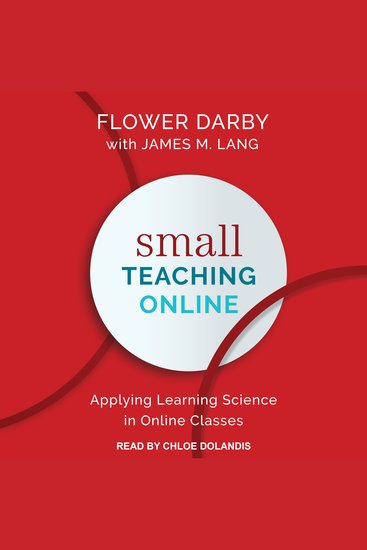
  • Small Teaching Online - Applying Learning Science in Online Classes - cover

    Small Teaching Online - Applying...

    Flower Darby, James M. Lang

    • 0
    • 0
    • 0
    The concept of small teaching is simple: small and strategic changes have enormous power to improve student learning. Instructors face unique and specific challenges when teaching an online course. This book offers small teaching strategies that will positively impact the online classroom. 


    This book outlines practical and feasible applications of theoretical principles to help your online students learn. It includes current best practices around educational technologies, strategies to build community and collaboration, and minor changes you can make in your online teaching practice, small but impactful adjustments that result in significant learning gains. 


    ● Explains how you can support your online students 


    ● Helps your students find success in this non-traditional learning environment 


    ● Covers online and blended learning 


    ● Addresses specific challenges that online instructors face in higher education 


    Small Teaching Online presents research-based teaching techniques from an online instructional design expert and the bestselling author of Small Teaching.
    Ver livro
  • The Gothic Cathedral - Architecture of Faith - cover

    The Gothic Cathedral -...

    Harris Ropes

    • 0
    • 0
    • 0
    The origins of Gothic architecture lie in the transition from the Romanesque style that dominated Europe in the early medieval period. Romanesque churches, with their thick walls, small windows, and rounded arches, provided a sense of solidity but limited natural light and height. By the 12th century, new architectural innovations emerged, driven by a desire for greater verticality, spacious interiors, and an infusion of divine light. These aspirations led to the birth of the Gothic style, first appearing in France before spreading across Europe. 
    One of the key figures in this transition was Abbot Suger of the Abbey of Saint-Denis, near Paris. In the 1130s, he initiated the reconstruction of the abbey church, incorporating pointed arches, ribbed vaults, and extensive stained glass windows. Suger believed that light was a manifestation of the divine, and through these architectural changes, he sought to transform the church into a place of spiritual illumination. His innovations set a precedent for what would become the defining characteristics of Gothic architecture. 
    The pointed arch, a hallmark of the Gothic style, replaced the rounded arch of the Romanesque period. This architectural shift was more than an aesthetic change; it allowed for greater structural efficiency, enabling builders to construct taller and more spacious interiors. The ribbed vault, another significant innovation, helped distribute weight more evenly, allowing for thinner walls and the introduction of expansive stained glass windows. These windows, often adorned with biblical scenes, served both a decorative and didactic function, educating the largely illiterate medieval population about religious narratives.
    Ver livro