Unisciti a noi in un viaggio nel mondo dei libri!
Aggiungi questo libro allo scaffale
Grey
Scrivi un nuovo commento Default profile 50px
Grey
Iscriviti per leggere l'intero libro o leggi le prime pagine gratuitamente!
All characters reduced
Homage to Catalonia - cover

Homage to Catalonia

George Orwell

Casa editrice: E-Kitap Projesi & Cheapest Books

  • 0
  • 0
  • 0

Sinossi

Homage to Catalonia is George Orwell's personal account of his experiences and observations fighting for the POUM militia of the Republican army during the Spanish Civil War. The war was one of the defining events of his political outlook and a significant part of what led him to write in 1946, "Every line of serious work that I have written since 1936 has been written, directly or indirectly, against totalitarianism and for Democratic Socialism, as I understand it."

The first edition was published in the United Kingdom in 1938. The book was not published in the United States until February 1952, when it appeared with an influential preface by Lionel Trilling. The only translation published in Orwell's lifetime was into Italian, in December 1948. A French translation by Yvonne Davet-with whom Orwell corresponded, commenting on her translation and providing explanatory notes-in 1938-39, was not published until five years after Orwell's death.

Book Summary:

Orwell served as a private, a corporal (cabo) and-when the informal command structure of the militia gave way to a conventional hierarchy in May 1937-as a lieutenant, on a provisional basis, in Catalonia and Aragon from December 1936 until June 1937. In June 1937, the leftist political party with whose militia he served (the POUM, the Workers' Party of Marxist Unification, an anti-Stalinist communist party) was declared an illegal organisation, and Orwell was consequently forced to flee.

Having arrived in Barcelona on 26 December 1936, Orwell told John McNair, the Independent Labour Party's (ILP) representative there, that he had "come to Spain to join the militia to fight against Fascism." He also told McNair that "he would like to write about the situation and endeavour to stir working class opinion in Britain and France." McNair took him to the POUM barracks, where Orwell immediately enlisted. "Orwell did not know that two months before he arrived in Spain, the [Soviet law enforcement agency] NKVD's resident in Spain, Aleksandr Orlov, had assured NKVD Headquarters, 'the Trotskyist organisation POUM can easily be liquidated'-by those, the Communists, whom Orwell took to be allies in the fight against Franco."
Disponibile da: 27/11/2023.
Lunghezza di stampa: 300 pagine.

Altri libri che potrebbero interessarti

  • Meet Mr Mulliner - cover

    Meet Mr Mulliner

    P. G. Wodehouse

    • 0
    • 0
    • 0
    In Mr Mulliner, P.G Wodehouse (1881 -1975) has created a conduit for all manner of tall tales. The amiable gentleman happily regales the drinkers in the Angler’s Rest Pub with fascinating stories, usually about his own relatives, which range from the somewhat dubious, to the downright unbelievable.  
    Welcome to this eccentric world inhabited by Curates and Bishops high on health tonic, and a lovesick chap who utilises beauty remedies to win his love. A world where a deceased author’s cottage appears to exert a sentimental influence on all who enter, and where an earthquake can lead to marriage. 
      
    Wodehouse’s most famous creations the implacable “Jeeves” and the archetypal English toff “Bertie Wooster” are only the tip of the author’s considerable output. A master of humorous prose, he published over ninety books, forty plays and two hundred short stories.  
    Head Stories presents " Meet Mr Mulliner" - narrated by Simon Hester
    Mostra libro
  • Lucy Maud Montgomery Short Stories 1907 to 1908 (Unabridged) - cover

    Lucy Maud Montgomery Short...

    L. M. Montgomery

    • 0
    • 0
    • 0
    Beloved Canadian author Lucy Maud Montgomery, famous for the Anne of Green Gables series, was also a prolific writer of short stories, poems, and essays. This collection is part of Montgomery's wider portfolio of 500 stories spanning 20 years. Listeners will be captivated by this richly detailed collection of narratives reflecting on class, sacrifice, family, and romance. Montgomery's heartwarming tales are redolent with her characters' hopes and dreams, as well as her own trademark gentle humor.
    Mostra libro
  • Les Misérables: Volume 5: Jean Valjean - Book 9: Supreme Shadow Supreme Dawn (Unabridged) - cover

    Les Misérables: Volume 5: Jean...

    Victor Hugo

    • 0
    • 0
    • 0
    Victor-Marie Hugo (26 February 1802 - 22 May 1885) was a French poet, novelist, essayist, playwright, and dramatist of the Romantic movement. During a literary career that spanned more than sixty years, he wrote abundantly in an exceptional variety of genres: lyrics, satires, epics, philosophical poems, epigrams, novels, history, critical essays, political speeches, funeral orations, diaries, and letters public and private, as well as dramas in verse and prose.
    BOOK 9: SUPREME SHADOW, SUPREME DAWN: It is a terrible thing to be happy! How content one is! How all-sufficient one finds it! How, being in possession of the false object of life, happiness, one forgets the true object, duty! Let us say, however, that the reader would do wrong were he to blame Marius.
    Mostra libro
  • Hadji Murat - A Gripping Tale of Courage Betrayal and Honor - A Modern Translation - Adapted for the Contemporary Reader - cover

    Hadji Murat - A Gripping Tale of...

    Leo Tolstoy

    • 0
    • 0
    • 0
    How does a warrior survive when caught between two deadly enemies? 
    In Hadji Murat, Leo Tolstoy presents a vivid and unforgettable account of the Caucasian War, drawing from historical events and his own military experience. The novel follows Hadji Murat, a revered Chechen leader who, after falling out with the ruthless Imam Shamil, seeks refuge with the Russian army. However, in the treacherous world of war and diplomacy, no side can be trusted, and Hadji Murat’s fate is sealed by the forces of power, deception, and honor. 
    A gripping story of courage and betrayal, Hadji Murat blends thrilling action with deep philosophical reflection. Tolstoy masterfully examines the futility of war, the complexity of human loyalty, and the inevitable tragedy of those who stand alone against vast empires. 
    What You’ll Discover in This Modern Translation:A Gripping Tale of War and Survival – Experience the life of a fearless warrior caught between two empires.A Masterpiece of Historical Fiction – Witness the brutal reality of 19th-century warfare in the Caucasus.A Story of Betrayal, Honor, and Resistance – Follow Hadji Murat’s desperate struggle for survival in a world where no allegiance is certain.A Modern, Accessible Translation – This adaptation preserves the depth of Tolstoy’s writing while making it engaging for contemporary readers. 
    More than just a war novel, Hadji Murat is a timeless reflection on power, resistance, and the human spirit’s refusal to be broken. 
    Can a man remain honorable in a world of treachery? 
    Get your copy today and experience one of Tolstoy’s most thrilling and thought-provoking works.
    Mostra libro
  • The Dream of a Ridiculous Man - cover

    The Dream of a Ridiculous Man

    Fyodor Dostoyevsky

    • 0
    • 0
    • 0
    While contemplating his life and deeming himself ridiculous, a man on the verge of suicide is interrupted by a young girl begging for his help. In his dark mood, he brushes her away, but when he returns home to commit the act he cannot move past his feelings of guilt over his treatment of the girl.
    
    The Dream of a Ridiculous Man was adapted into a 1990 BBC production entitled The Dream, starring Jeremy Irons.
    
    Fyodor Dostoyevsky was a Russian novelist, journalist, and short-story writer who had an immense influence on 20th-century fiction. He is commonly regarded as one of the finest novelists who ever lived, penning classics that include: Crime and Punishment, The Idiot, Demons, and The Brothers Karamazov. His ideas profoundly shaped literary modernism, existentialism, and various schools of psychology, theology, and literary criticism.
    Mostra libro
  • Fading Voices - From their pens to your ears genius in every story - cover

    Fading Voices - From their pens...

    Boleslaw Prus

    • 0
    • 0
    • 0
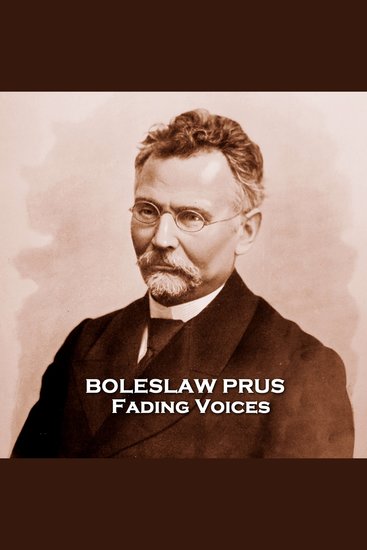
    Aleksander Głowacki who wrote under the nom de plume Boleslaw Prus was born on 20th August 1847 at Hrubieszów in the Kingdom of Poland, at that time, controlled by the Russian Empire. 
    At three his mother died and then at nine his father.  Female relatives helped raise him but at 15 he joined the Polish uprising against the might of Imperial Russia.  Wounded on the battlefield, arrested and imprisoned, he was later released into the care of a relative and resumed secondary school and then Warsaw University but poverty forced him to leave after two years.  At some point he developed agoraphobia which often caused problems. 
    In 1869, he enrolled in the Forestry Department at Puławy but was soon sacked and so he began a system of self-education that led to work as a newspaper columnist on a wide-ranging series of topics that eventually became the ‘Weekly Chronicles’ and spanned 40 years. 
    With his finances now stabilized he married and then adopted his late brother-in-law’s son.  
    It seems he had doubts as to the scale of his talents and early on adopted the name ‘Boleslaw Prus’ for both his journalistic and literary offerings. 
    His work as a short-story writer met with much acclaim. He wrote several dozen of them, originally published in newspapers and ranging in length from micro-story to novella. His keen observation of everyday life and sense of humor are evident in them.  
    During his career he also wrote novels. After ‘Pharoah’, in 1895, he embarked on a four-month journey taking in Berlin, Dresden, Nuremberg, Rapperswil in Switzerland, where he stayed for two months, and his final destination, Paris.  Here his agoraphobia was so bad he couldn’t cross the Seine.  
    However, his writing continued and in 1911 his novel ‘Changes’, though uncompleted, began to be serialised.  It was never finished. 
    Boleslaw Prus died on 19th May 1912, at his Warsaw apartment.  He was 64.  A National Hero, thousands attended both his funeral service and interment.
    Mostra libro