
Join us on a literary world trip!
Add this book to bookshelf
Grey
Write a new comment Default profile 50px
Grey
Subscribe to read the full book or read the first pages for free!
All characters reduced
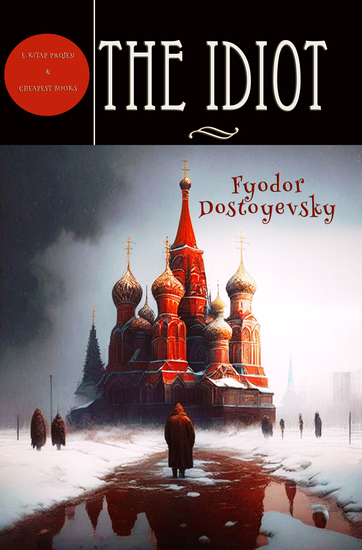
The Idiot - cover

The Idiot

Fyodor Dostoyevsky

Publisher: E-Kitap Projesi & Cheapest Books

  • 0
  • 0
  • 0

Summary

Towards the end of November, during a thaw, at nine o'clock one morning, a train on the Warsaw and Petersburg railway was approaching the latter city at full speed. The morning was so damp and misty that it was only with great difficulty that the day succeeded in breaking; and it was impossible to distinguish anything more than a few yards away from the carriage windows.
Some of the passengers by this particular train were returning from abroad; but the third-class carriages were the best filled, chiefly with insignificant persons of various occupations and degrees, picked up at the different stations nearer town. All of them seemed weary, and most of them had sleepy eyes and a shivering expression, while their complexions generally appeared to have taken on the colour of the fog outside.

When day dawned, two passengers in one of the third-class carriages found themselves opposite each other. Both were young fellows, both were rather poorly dressed, both had remarkable faces, and both were evidently anxious to start a conversation. If they had but known why, at this particular moment, they were both remarkable persons, they would undoubtedly have wondered at the strange chance which had set them down opposite to one another in a third-class carriage of the Warsaw Railway Company.

One of them was a young fellow of about twenty-seven, not tall, with black curling hair, and small, grey, fiery eyes. His nose was broad and flat, and he had high cheek bones; his thin lips were constantly compressed into an impudent, ironical—it might almost be called a malicious—smile; but his forehead was high and well formed, and atoned for a good deal of the ugliness of the lower part of his face. A special feature of this physiognomy was its death-like pallor, which gave to the whole man an indescribably emaciated appearance in spite of his hard look, and at the same time a sort of passionate and suffering expression which did not harmonize with his impudent, sarcastic smile and keen, self-satisfied bearing. He wore a large fur—or rather astrachan—overcoat, which had kept him warm all night, while his neighbour had been obliged to bear the full severity of a Russian November night entirely unprepared. His wide sleeveless mantle with a large cape to it—the sort of cloak one sees upon travellers during the winter months in Switzerland or North Italy—was by no means adapted to the long cold journey through Russia, from Eydkuhnen to St. Petersburg.

Copyright, Illustrated version of "the Idiot" by e-Kitap Projesi, 2024
Available since: 01/30/2024.
Print length: 800 pages.

Other books that might interest you

  • Around the World in Eighty Days - cover

    Around the World in Eighty Days

    Jules Verne

    • 0
    • 0
    • 0
    Embark on an exhilarating global adventure with Around the World in Eighty Days, Jules Verne’s beloved tale of determination, ingenuity, and the thrill of discovery. Follow the unflappable Phileas Fogg and his loyal servant, Passepartout, as they race against time to circumnavigate the world in just eighty days. Facing unexpected obstacles, from storms at sea to encounters with outlaws, Fogg’s remarkable journey tests their courage and resourcefulness at every turn. 
    Verne’s iconic story captures the spirit of the 19th-century age of exploration, blending suspense, humor, and a sense of wonder. Around the World in Eighty Days is an enduring classic that continues to inspire and entertain readers of all ages. 
    Narrated with energy and charm, this audiobook brings each locale and colorful character to life, making it the perfect listen for adventurers and dreamers alike. 
    Start listening to Around the World in Eighty Days today and join a whirlwind journey that spans the globe!
    Show book
  • Martin Eden - cover

    Martin Eden

    Jack London

    • 0
    • 0
    • 0
    Martin Eden by Jack London is the story of a self-taught sailor turned writer who rises from poverty to literary fame. Martin Eden, a working-class dreamer, falls in love with Ruth Morse, an upper-class woman whose family initially rejects him. Driven by ambition and passion, he educates himself voraciously, transforming into a skilled writer. As his works gain recognition, Martin grapples with alienation, disillusionment, and the emptiness of success. While Ruth embraces his achievements, their class differences and evolving values drive them apart. Ultimately, Martin’s existential despair leads to a tragic conclusion, reflecting London’s exploration of ambition, individualism, and the cost of pursuing one's dreams.
    Show book
  • A Farewell to Arms - cover

    A Farewell to Arms

    Ernest Hemingway

    • 0
    • 0
    • 0
    Step into the gripping world of A Farewell to Arms, Ernest Hemingway's poignant tale of love and war. Set against the backdrop of World War I, this classic novel follows Lieutenant Frederic Henry, an American ambulance driver in the Italian army, as he navigates the horrors of battle and the solace of love with Catherine Barkley, a British nurse. 
    Hemingway's spare, evocative prose captures the intensity of human emotion in a time of profound chaos, creating a narrative both heart-wrenching and timeless. 
    This audiobook brings Hemingway's masterpiece to life, immersing listeners in a story of courage, sacrifice, and the enduring power of love. Perfect for fans of classic literature and compelling storytelling, this is a journey you won’t want to miss.
    Show book
  • Sea Stories (Unabridged) - cover

    Sea Stories (Unabridged)

    Cyrus Townsend Brady, Frank...

    • 0
    • 0
    • 0
    SEA STORIES, tells the entire tale. You will find excerpts of some of the most famous nautical stories of all time. Most of us have passed through a period of life during which we have ardently longed to be, if not actually a rover, a buccaneer, or a pirate, at least and really a sailor! To run away to sea has been the misdirected ambition of many a youngster, and some lads there are who have realized their desire to their sorrow. The boy who has not cherished in his heart and exhibited in his actions at sometime or other during his youthful days, a love of ships and salt water, is fit for-well, he is fit for the shore, and that is the worst thing a sailor could say about him! The virile nations, the strong peoples, are those whose countries border on the sea. They who go down to the great deep in ships are they who master the world. On the ocean as well as on the mountain top dwells the spirit of freedom. When men have struggled with each other in the shock of war, or the emulation of peace, when they have matched skill against skill, strength to strength, courage with courage, the higher quality of manhood in each instance has been required upon the sea; for there the sharp contention has been not only between man and man but between nature and man as well. A double portion of heroic spirit is needed to meet the double demand. That is the reason we love the sea. It is this Homeric spirit of the Ocean Masters that fills the dreams of youth and stirs the memories of old age. In these dreams and memories the veriest boy catches glimpses of the perpetual Titanic struggle of, and on, the deep; dimly discerning in his youthful way, a thousand generations of heroic achievement before, and through which, he begins to be; and he realizes that the ocean affords such a field for the exhibition of every high quality that goes to make a man as may be found nowhere else.
    Show book
  • The Montezuma Emerald - cover

    The Montezuma Emerald

    Rodrigues Ottolengui

    • 0
    • 0
    • 0
    Rodrigues Ottolengui was an American writer and pioneering dentist born in Charleston, SC, who lived most of his life in New York City. Ottolengui was one of the first dentists to use X-rays and was a specialist in orthodontics and root canal therapy. In the 1890s, Ottolengui published four novels and a collection of detective short stories, including The Montezuma Emerald. 
    A seasoned stage actor, Raymond Stottlemyre was born and raised in Pelican Rapids, MN. He has worked in local radio, narrated audio programs, and has performed in hundreds of plays over the decades.
    Show book
  • Anathema - From their pens to your ears genius in every story - cover

    Anathema - From their pens to...

    Alexander Kuprin

    • 0
    • 0
    • 0
    Alexander Kuprin was born in Narovchat, Penza in Russia on 7th September 1870. 
    At 3 his Father died and he and mother moved to Moscow. By 10 he was enrolled at the Second Moscow Military High School and there his interest in literature began. The Alexander Military Academy followed and two years later he was a sub-lieutenant and posted to an Infantry Regiment for a further four years. 
    Despite his duties he was a now a keen writer and published his first short story at this time. His military duties also garnered him experiences for his breakthrough work ‘The Duel’.  Leaving the military he left for Kiev to work for local newspapers.  He continued to publish both stories and novels and by 1901 he was in St Petersburg becoming part of a group that included Chekhov, Ivan Bunin, Maxim Gorky and Leonid Andreyev.  
    In the years that followed further controversial works and acclaim followed.  His comments on the regime meant he was also put under secret police surveillance.   
    As World War I erupted, Kuprin opened a military hospital but was then given command of an infantry company in Finland. He was soon discharged on grounds of ill health.  
    The October Revolution saw him praise Lenin, but he warned that the Bolsheviks threatened Russian culture and might cause further widespread suffering to the peasants.  As Civil War raged he took his family to Helsinki and then on to Paris. 
    Exile saw his talents decline further and his succumbing to alcoholism. He became lonely and withdrawn. The family's poverty increased his malaise.   
    In May 1937, the Kuprin’s returned to Moscow.  He now saw his work published but wrote almost nothing new.  In 1938 his health rapidly deteriorated.  Already suffering from a kidney problems and sclerosis, he had now developed cancer of the oesophagus.  
    Alexander Kuprin died on 25th August 1938.
    Show book