Join us on a literary world trip!
Add this book to bookshelf
Grey
Write a new comment Default profile 50px
Grey
Subscribe to read the full book or read the first pages for free!
All characters reduced
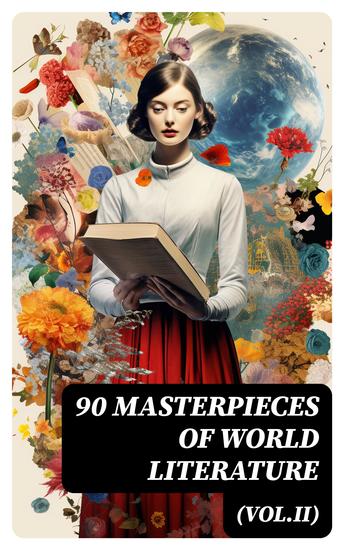
90 Masterpieces of World Literature (VolII) - Novels Poetry Plays Short Stories Essays Psychology & Philosophy - cover

90 Masterpieces of World Literature (VolII) - Novels Poetry Plays Short Stories Essays Psychology & Philosophy

Edgar Allan Poe, Pedro Calderon de la Barca, Charles Dickens, Jane Austen, Alexandre Dumas, Bram Stoker, Jonathan Swift, Joseph Conrad, Daniel Defoe, Washington Irving, Nathaniel Hawthorne, Henry James, Henrik Ibsen, Wilkie Collins, D. H. Lawrence, Friedrich Nietzsche, Harriet Beecher-Stowe, Anthony Trollope, Laozi Laozi, Kate Chopin, James Fenimore Cooper, Ann Ward Radcliffe, Laurence Sterne, George MacDonald, Lewis Wallace, Robert Louis Stevenson, William Dean Howells, Honoré de Balzac, Émile Zola, Henry Fielding, George Bernard Shaw, Benjamin Franklin, Walter Scott, Theodor Storm, Willa Cather, Edith Wharton, Edgar Wallace, F. Scott Fitzgerald, Nikolai Leskov, Sinclair Lewis, Ivan Turgenev, G.K. Chesterton, J.M. Barrie, Virginia Woolf, John Buchan, Charlotte Perkins Gilman, Rabindranath Tagore, Jerome K. Jerome, W. B. Yeats, Kenneth Grahame, Kakuzo Okakura, Kurt Vonnegut, E. M. Forster, H. G. Wells, Nikolai Gogol, William Walker Atkinson, Elizabeth von Arnim, Victor Hugo, Fyodor Dostoyevsky, Cao Xueqin, Emile Coué, Johann Wolfgang von Goethe, Dante, Thomas Hardy, Valmiki, Kalidasa, Jules Verne, Bankim Chandra Chatterjee, Leo Tolstoy, Gaston Leroux, P. B. Shelley, John Milton, George Weedon Grossmith, Machiavelli, Stendhal, Confucius, W. Somerset Maugham, Gustave Flaubert, Ford Madox Ford, Homer Homer

Publisher: DigiCat

  • 0
  • 0
  • 0

Summary

In the collection '90 Masterpieces of World Literature (Vol. II)', readers are invited to embark on a literary odyssey through time and space, encountering an eclectic array of styles and genres that showcase the universal human experience. The anthology offers a sweeping panorama of world literature, featuring timeless narratives, profound philosophical inquiries, and groundbreaking artistic innovations. From the penetrating social critiques of Flaubert and Zola to the transformative mythologies of Homer and Kalidasa, this volume captures the breadth and depth of literary achievements across cultures and epochs. Though diverse in form, each piece contributes to the rich tapestry of themes exploring love, identity, existential dilemmas, and the enduring quest for meaning. The distinguished collective of authors in this volume represents a cross-section of the literary canon, bringing together the visionary ideas of avant-garde thinkers, Romantic poets, and Enlightenment philosophers, among others. It juxtaposes Confucian ethics with the satirical genius of Swift and Nietzsche's provocations with the introspective narratives of Austen and Wharton. Together, they encapsulate the spirit of movements such as Romanticism, Realism, and Modernism, marrying the geographical and cultural diversity of the world's great storytellers. This global mosaic invites readers to transcend boundaries and engage with the philosophies that have shaped literary thought. This anthology is a treasure trove for any reader with a keen interest in literature, offering an unparalleled opportunity to explore myriad perspectives within a single tome. By traversing the vast spectrum of literary traditions and thought, '90 Masterpieces of World Literature (Vol. II)' not only enriches the reader's understanding of individual authorship but also fosters a dialogue that reverberates across different epochs and societies. Dive into this exceptional volume to appreciate the wealth of insights and knowledge it bestows, ensuring an enlightening experience that is both challenging and deeply rewarding.
Available since: 11/16/2023.
Print length: 27947 pages.
Other books that might interest you

  • Wuthering Heights - cover

    Wuthering Heights

    Emily Brontë

    • 0
    • 0
    • 0
    Wuthering Heights is Emily Brontë's only novel. It was first published in 1847 under the pseudonym Ellis Bell, and a posthumous second edition was edited by her sister Charlotte. The name of the novel comes from the Yorkshire manor on the moors on which the story centres (as an adjective, wuthering is a Yorkshire word referring to turbulent weather). The narrative tells the tale of the all-encompassing and passionate, yet thwarted, love between Heathcliff and Catherine Earnshaw, and how this unresolved passion eventually destroys them and many around them.
    Show book
  • Little Men - cover

    Little Men

    Louisa May Alcott

    • 0
    • 0
    • 0
    "Little Men" is a classic novel that continues the story of the March family from "Little Women." The focus shifts to Jo March, who is now married to Professor Bhaer and runs a school for boys called Plumfield. The novel explores the lives, adventures, and moral lessons of the boys at Plumfield, providing a heartwarming and insightful look into childhood and adolescence.
    Show book
  • Five Children and It - cover

    Five Children and It

    E. Nesbit

    • 0
    • 0
    • 0
    The story of three wishes being granted is an old one and often takes the form of a precautionary tale with the resultant moral being “be careful what you wish for!” Such is the fallibility of human nature that we can’t easily be trusted to use those wishes wisely. 
    The great children’s author Edith Nesbit (1858 – 1924) took this popular concept for her 1903 book “Five Children and It” and extended the wishes from three to eleven, now granted to five young siblings in Edwardian England. 
    They have no Geni of the Lamp or Fairy Godmother, but instead, an irascible Sand Fairy dug accidently out of the sand of an abandon quarry. This strange “Psammead”, with his snail’s eyes on stalks, furry squat body and aversion to water reluctantly grants the four children their, often ill thought out, wishes. 
    Nesbit writes with her usual warmth and humour, placing her protagonists into funny and sometimes frightening adventures which gradually make the children “wise beyond their years.” 
    Head Stories Audio presents "Five Children and It" by E. Nesbit. Narrated by Simon Hester. With original music.
    Show book
  • Before the Supreme Court - From their pens to your ears genius in every story - cover

    Before the Supreme Court - From...

    Lafcadio Hearn

    • 0
    • 0
    • 0
    Lafcadio Hearn was born on the 27th June 1850 on the Ionian isle of Levkás in Greece to a British Army officer and a Greek Mother. 
    His father, fearing for his career prospects at being married to a Greek Orthodox wife, sent them to Dublin whilst he continued to advance his career with further postings.  Life there was difficult for mother and son.  His father returned, wounded and traumatised, when Lafcadio was three.  He annulled the marriage and she remarried but had to give up care of Lafcadio to her sister-in law.   
    After brief periods for Catholic education in England and France he emigrated to Ohio in the United States when he was 19, taking on a series of casual jobs before embarking on a career as a journalist, publishing poems and essays in Cincinnati.  It was whilst here that he began a side-line in translating, starting with Gautier and Flaubert.  He married in 1874 to a 20 year old African-American woman in violation of Ohio's anti-miscegenation law.  The marriage soon failed. 
    In 1877 he relocated to New Orleans to write on a variety of themes before picking up a two year assignment from Harper’s to write in the West Indies, where he also wrote his first novel. 
    In 1890 Harper’s sent him to Japan.  Here he left journalism and took the remarkable decision to become a schoolteacher in the north of Japan.   Enraptured by the culture he was driven to explain it in various Western publications to those who had little, if any, knowledge of its culture.  Within the year he had fallen in love with, and married, a high-born Japanese lady, together they would have four children.   
    In 1895 he became a Japanese national and took the name Koizumi Yakumo, Koizumi being his wife’s family name. 
    The following few years, whilst a professor of Literature at the Imperial University of Japan, were his most creative and admired period.   
    Lafcadio Hearn died of heart failure on the 26th of September 1904, in Tokyo, Japan shortly before leaving to deliver a series of lectures at Cornell University in New York State.  He was 54.
    Show book
  • Diary of a Lunatic - From their pens to your ears genius in every story - cover

    Diary of a Lunatic - From their...

    Leo Tolstoy

    • 0
    • 0
    • 0
    Leo Tolstoy was born in 1828 in the Russian province of Tula to a wealthy noble family. As a child, he had private tutors but he showed little interest in any formal education. When he went to the University of Kazan in 1843 to study oriental languages and law, he left without completing his courses.  Life now was relaxed and idle but with some writing also taking place.  Gambling debts forced an abrupt change of path and he joined the army to fight in the Crimean War.  He was commended for his bravery and promoted but was appalled at the brutality and loss of life.  He recorded these and other earlier experiences in his diaries which formed the basis of several of his works. 
    In 1852 ‘Childhood’ was published to immediate success and was followed by ‘Boyhood’ and ‘Youth’. 
    His experience in the army and the horrors he witnessed resulted in ‘The Cossacks’ in 1862 and the trilogy ‘Sevastopol Tales’. After the war he travelled around Europe, visiting London and Paris and meeting such luminaries as Victor Hugo and Charles Darwin.  
    It was now that Tolstoy began his masterpiece, ‘War and Peace’. Published in 1869 it was an epic work that changed literature. He quickly followed this with ‘Anna Karenina’.  
    These successes made Tolstoy rich and helped him accomplish many of his dreams but also brought problems as he grappled with his faith and the lot of the oppressed poor. These revolutionary views became so popular that the authorities now kept him under surveillance.  
    He led a life of asceticism and vegetarianism and put his socialist ideals into practice by establishing numerous schools for the poor and food programmes. He also believed in giving away his wealth, which caused much discord with his wife.  
    His writing continued to bring forth classics such as ‘The Death of Ivan Ilyich’ and many brilliant and incisive short stories such as ‘How Much Land Does A Man Need’.  
    In 1901 Tolstoy was excommunicated from the Church and controversially deselected for the Nobel Prize for Literature. 
    Whilst undertaking a pilgrimage by train in October 1910 with his daughter Aleksandra he caught pneumonia in the nearby town of Astapovo.  Leo Tolstoy died on November 9th, 1910, he was 82.
    Show book
  • H G Wells 3 Complete Works - The Island Of Doctor Moreau Tales Of Space & Time The History Of Mr Polly - cover

    H G Wells 3 Complete Works - The...

    H. G. Wells

    • 0
    • 0
    • 0
    H.G. Wells, one of the most influential writers of science fiction and speculative fiction, has left an indelible mark on literature with his vast body of work. Wells's books, spanning across various genres, captivate readers with their imaginative narratives, thought-provoking concepts, and insightful social commentary. His novels, such as "The Time Machine," "The War of the Worlds," and "The Invisible Man," have become iconic and have helped shape the science fiction genre as we know it today. 
     
    Wells's books often explore scientific and technological advancements and their potential impact on society. In "The Time Machine," Wells takes readers on a journey to the future, addressing themes of class struggle, evolution, and the consequences of uncontrolled progress. In "The War of the Worlds," he weaves a thrilling tale of a Martian invasion, reflecting anxieties of the time and exploring the vulnerability of humanity in the face of an alien threat. With "The Invisible Man," Wells delves into the ethical implications of scientific discovery, examining the effects of invisibility on human behavior and morality. Throughout his works, Wells's keen observations of human nature and society add depth to his narratives, making his books not only exciting adventures but also profound explorations of the human condition. 
     
    H.G. Wells's books continue to resonate with readers across generations due to their timeless themes and their ability to provoke thought and inspire imagination. Wells's literary legacy extends beyond his contributions to science fiction, as his works remain relevant and impactful in today's world. His ability to combine thrilling narratives with profound social commentary solidifies his place as a master storyteller and a visionary author whose books continue to captivate and provoke contemplation in readers worldwide.
    Show book