
Join us on a literary world trip!
Add this book to bookshelf
Grey
Write a new comment Default profile 50px
Grey
Subscribe to read the full book or read the first pages for free!
All characters reduced
The Complaint of Peace - cover

The Complaint of Peace

Desiderius Erasmus of Rotterdam

Publisher: Edizioni Aurora Boreale

  • 0
  • 0
  • 0

Summary

Desiderius Erasmus of Rotterdam (1466-1536) was a Dutch humanist, Catholic theologian, educationalist, satirist and philosopher. Through his vast number of translations, books and essays, he is considered one of the most influential thinkers of the Northern Renaissance and one of the major figures of Dutch and Western culture.
He was an important figure in classical scholarship who wrote in a spontaneous, copious and natural Latin style. As a Catholic priest developing humanist techniques for working on texts, he prepared important new Latin and Greek editions of the New Testament, and also wrote fundamental works as On Free Will, The Praise of Folly, Handbook of a Christian Knight, On Civility in Children, and many other essays.
Erasmus' work Querela Pacis (The Complaint of Peace), which we propose to our readers today, is one of the classics of the literature of peace, which has enjoyed a widespread and continuous hearing. In the text it is Peace, in her own person, who addresses the reader. It was composed in 1516 and first published in 1517.
To us posterity, Erasmus leaves a lesson that goes beyond the specific content of the text: Peace always needs those who give it voice.
Available since: 01/31/2025.

Other books that might interest you

  • The Final Fight for Freedom - How to Save Our Country from Chaos and War - cover

    The Final Fight for Freedom -...

    Dane Stewart, Congressman Chris...

    • 0
    • 0
    • 0
    From New York Times bestselling author Chris Stewart and Dr. Dane Stewart 


    Truth is being destroyed, free speech criminalized, the dollar fast becoming worthless. Ideologues at the helm of Big Tech, Big Media, and Big Business are set on the destruction of capitalism and democracy. Powerful federal agencies are no longer protectors of the people, but their primary adversary. 


    Not since the Civil War has our nation been so divided, bringing us to the edge of national suicide. And our enemies—China being chief among them—see our weakness. If we falter, they will act. 


    Not since World War II have we faced an adversary so determined to achieve global dominance. At this moment, they are perfecting an arsenal of weapons to use against us: Quantum computing. Artificial intelligence. Hypersonic missiles. Bio-warfare. These are threats we must defeat. But before we are able to do that, we must protect ourselves from the enemy within. 


    Many of our forefathers had to fight a Great War to save their freedom. It falls upon this generation to fight two. But we must not lose hope. There is a way to save our nation.
    Show book
  • America: Standing Strong - cover

    America: Standing Strong

    Robert J. Emery

    • 0
    • 0
    • 0
    America: Standing Strong, from award-winning author Robert J. Emery (www.robertjemeryauthor.com) 
    In 1920, while campaigning for the office of president, Warren G. Harding said in a campaign speech, “America’s present need is not heroics, but healing; not nostrums, but normalcy.” 
    That is where America finds itself today. 
    “America: Standing Strong” brings together investigative reporters, scholars, scientists, philosophers, medical professionals, elected officials across the political spectrum and an endless string of quotes from respected voices, past and present, to examine the events of recent years, not what we already know, but what we may not, or have yet to acknowledge, in our quest for reformation. Every voice counts. 
     
    Show book
  • The Smallest Room in the House - 50 political oddities to read in more than one sitting - cover

    The Smallest Room in the House -...

    Philip Cowley

    • 0
    • 0
    • 0
    Based on Philip Cowley's entertaining columns in The House magazine, this collection of political oddities and fascinating research, discussing the politics of fights, cockroaches, riots, potholes, beards and much more, is perfect for reading in multiple sittings. Discover the electoral relevance of chip shops and football grounds, what your lawn tells you about your voting, why politicians need to pay extra care in Scunthorpe, what MPs think of voters, why they all claim to be local and why they are all now so inexperienced.
    Equal parts witty and thought-provoking, and with additional grumpy complaints about bats, overly long constituency names and giving the vote to sixteen-year-olds, it's a book that will appeal to the sort of person who likes to tell you that, actually, it's all a bit more complicated than that…
    Show book
  • The Scheme - How the Right Wing Used Dark Money to Capture the Supreme Court - cover

    The Scheme - How the Right Wing...

    Senator Sheldon Whitehouse,...

    • 0
    • 0
    • 0
    Following his book Captured on corporate capture of regulatory and government agencies, and his years of experience as a prosecutor, Senator Sheldon Whitehouse here turns his attention to the right-wing scheme to capture the courts, and how it influenced the Trump administration's appointment of over 230 "business-friendly" judges, including the last three justices of the United States Supreme Court. 


    Whitehouse traces the motive to control the court system back to Lewis Powell's notorious memo, which gave a road map for corporate influence to target the judiciary, and chronicles a hidden-money campaign using an armada of front groups and helped by the infamous Citizens United Supreme Court decision. The scheme utilized the Federalist Society as an appointments turnstile, spent secret millions to support the nominees, orchestrated an "amicus brief" signaling apparatus, and propped up front-group litigants to "fast-lane" strategic test cases to the friendly justices. 


    Whitehouse finds the same small handful of right-wing billionaires and corporations running operations that he likens to "covert ops," ultimately enticing the Senate to break rules, norms, and precedents to confirm wildly inappropriate nominees who would advance the anti-government agenda of a small number of corporate oligarchs.
    Show book
  • The Jesuits in the United States - A Concise History - cover

    The Jesuits in the United States...

    S.J. David J. Collins

    • 0
    • 0
    • 0
    The history of America cannot be told without the history of religion, the history of American religion cannot be told without the history of Catholicism, and the history of Catholicism in America cannot be told without the history of Jesuits in America. 


    Jesuits in the United States offers a panoramic overview of the Jesuit order in the United States from the colonial era to the present. David J. Collins, SJ, describes the development of the Jesuit order in the US against the background of American religious, cultural, and social history. He covers the papacy's suppression of the order and its restoration period. The author also compares Jesuit activities in the US to those in Europe and, by the twentieth century, to those around the world, as the political and religious connections between the US and the world, especially Latin America, grow. Collins also reflects on the future of the order in light of its past. 


    Listeners familiar with the Jesuit tradition and those who are new to it will learn from this book's distinctive and modern perspective—using twenty-first century scholarship on Jesuit slaveholding, the sexual abuse crisis, and other contemporary issues—on 500 years of Jesuit history in the United States.
    Show book
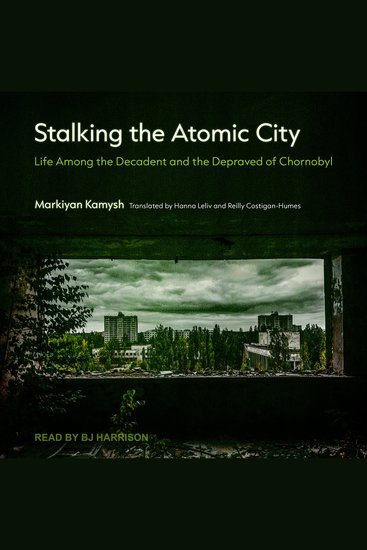
  • Stalking the Atomic City - Life Among the Decadent and the Depraved of Chornobyl - cover

    Stalking the Atomic City - Life...

    Markiyan Kamysh

    • 0
    • 0
    • 0
    Since the Chornobyl nuclear disaster in April 1986, the area remains a toxic, forbidden wasteland. The zone has become a place for meditation at the edge of geography where you can lose yourself. As with all dangerous places, this terra incognita attracts a wild assortment of adventurers who climb over the barbed wire illegally to witness the aftermath of catastrophe in the flesh. Breaking the law here is a pilgrimage: a metamodern sacred experience that coexists with thrash. 


    Markiyan Kamysh, whose father worked as an on-site disaster liquidator of Chornobyl, works as a "stalker," guiding people who dare to venture into the disaster area for thrills. Kamysh tells us about thieves who hide in the abandoned buildings, the policemen who chase them, and the romantic utopists who have built families here, even as deadly toxic waste lingers in the buildings, playgrounds, and streams. 


    More than extraordinary guide to this alien world, Kamysh writes with a singular style that is both brash and bold, conferring an understated elegance to this dystopian reality. Stalking the Atomic City is a haunting account of what total autonomy could mean in our growingly fractured world.
    Show book