

Join us on a literary world trip!
Add this book to bookshelf
Grey
Write a new comment Default profile 50px
Grey
Subscribe to read the full book or read the first pages for free!
All characters reduced
Medieval Medicine - cover

Medieval Medicine

Cassian Pereira

Translator A AI

Publisher: Publifye

  • 0
  • 0
  • 0

Summary

Medieval Medicine explores the evolution of medical practices in Europe from 500 to 1500 AD, revealing a world where herbal remedies, surgical techniques, and complex theories intertwined. The book highlights how medieval approaches to health were shaped by empirical observation, religious beliefs, and classical learning. Intriguingly, surgery, despite limitations in anesthesia and anatomical understanding, achieved surprising sophistication in areas like wound care and cataract removal. The book argues that medieval medicine, while seemingly primitive today, laid crucial groundwork for later medical advancements. It delves into the dominance of humoral theory, the role of religion in healing, and the diverse roles of lay healers, monastic physicians, and university doctors. Progressing through chapters, Medieval Medicine first introduces key concepts, then explores herbal remedies and surgical procedures in detail, culminating in an analysis of the shift toward more scientific approaches during the late medieval period. A distinctive aspect of this work is its integration of social context with medical practices, explaining why treatments were used and how they reflected contemporary beliefs. By examining primary sources like medical treatises and herbals, the book offers a balanced perspective on the ingenuity and resourcefulness of medieval practitioners, making it valuable for anyone interested in medical or medieval history.
Available since: 03/29/2025.
Print length: 61 pages.

Other books that might interest you

  • Machine Learning Mastery: Shaping the Future with Algorithms - Unlocking Insights Through Predictive Machine Learning - cover

    Machine Learning Mastery:...

    Daniel Foster

    • 0
    • 0
    • 0
    Machine Learning Mastery: Shaping the Future with Algorithms: Unlocking Insights Through Predictive Machine Learning is a must-read for anyone who wants to learn more about the fast-paced field of machine learning. The ideas, techniques, and applications of machine learning are covered in detail in this book, which is suitable for both new and experienced users. 
    In its parts, the book breaks down difficult ideas like supervised and unsupervised learning, deep learning, and reinforcement learning in a way that is easy to understand. Readers will learn how to use strong algorithms to get useful information from very large datasets. This will help them make smart choices in many fields, such as technology, healthcare, and finance. 
    One thing that makes this book stand out is that it combines theoretical background with real-life examples and hands-on tasks. This gives readers the skills to use well-known computer languages and frameworks to implement machine learning techniques, which helps them fully grasp how these algorithms work in real life. 
    Also, the book stresses how important prediction modeling is and shows how data-driven insights can lead to new ideas and better operations. By the end of this journey, readers will have the information and skills they need to confidently move through the changing world of machine learning.
    Show book
  • Decoding Animal Minds - Bridging the Communication Gap between Species - cover

    Decoding Animal Minds - Bridging...

    John Harpoon

    • 0
    • 0
    • 0
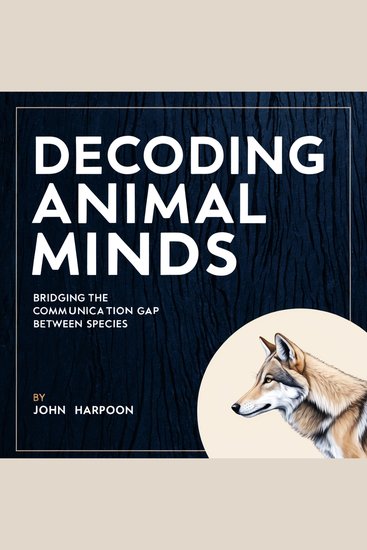
    The question of whether animals possess consciousness has intrigued philosophers, scientists, and animal lovers for centuries. Consciousness, often described as the awareness of one's thoughts, feelings, and surroundings, is a concept that has been challenging to define, even in humans. When applied to animals, the puzzle becomes even more complex, as humans must contend with species whose mental processes are vastly different, yet still intriguing. 
    For much of history, animals were thought to be little more than instinctual beings, driven by basic needs and lacking the higher cognitive functions attributed to humans. Early philosophers, such as René Descartes, even went so far as to declare that animals were mere automata, incapable of experiencing consciousness or complex thoughts. This perspective began to shift, however, with the growing body of research into animal behavior and cognition, which showed that many animals exhibit problem-solving skills, emotional responses, and even a sense of self. 
    Theories of animal intelligence have evolved over time, with a growing recognition that animal minds are not simply mechanical, but can possess depth and complexity. Cognitive ethology, the study of animal minds in their natural environments, emphasizes that animals may experience the world in ways similar to humans, but with distinct differences shaped by their evolutionary paths. From elephants who demonstrate clear evidence of grief, to dolphins that engage in sophisticated social interactions, the evidence suggests that animals may possess emotional and cognitive layers far more intricate than previously imagined.
    Show book
  • Accelerating hydrogen deployment in the G7: Recommendations for the Hydrogen Action Pact - cover

    Accelerating hydrogen deployment...

    Irena International Renewable...

    • 0
    • 0
    • 0
    This report briefly summarises the status and outlook for hydrogen in each G7 member, including analyses of technology, costs, strategy and stated policy support for each country, and presents recommendations for accelerating global hydrogen trade.
    Show book
  • Quantum Mechanics Technology Consciousness and the Multiverse - cover

    Quantum Mechanics Technology...

    Martin K. Ettington

    • 0
    • 0
    • 0
    Quantum Mechanics is a strange but fundamental part of modern physics and we see the results of this theory with technology used in our daily lives. Quantum effects may also help to explain our consciousness and spiritual (paranormal) abilities. Quantum effects also lead to some very strange phenomena which seem impossible at first glance.Some of the main subjects discussed here include:•,Quantum Teleportation•,Quantum Computing•,Quantum Gravity•,Quantum Consciousness•,Our Consciousness wave function•,The MultiverseI also use the experiential knowledge from my prophecies and the research I’ve done on the paranormal to show potential links to quantum effects. The human ability to teleport psychically is one possible connection.There seems to be a coordination between quantum effects and spiritual abilities as described in the Yoga Sutras on Patanjali. Near the end of the book I make an effort to link quantum phenomena and consciousness together.
    Show book
  • From Swamp to Wetland - The Creation of Everglades National Park - cover

    From Swamp to Wetland - The...

    Chris Wilhelm

    • 0
    • 0
    • 0
    This book chronicles the creation of Everglades National Park, the largest subtropical wilderness in the United States. Prior to the park's creation, the Everglades was seen as a reviled and useless swamp, unfit for typical recreational or development projects. 


    Park advocates drew on new ideas concerning the value of biota and ecology, the importance of wilderness, and the need to protect habitats, marine ecosystems, and plant life to redefine the Everglades. Using these ideas, the Everglades began to be recognized as an ecologically valuable and fragile wetland—and thus a region in need of protective status. 


    While these new ideas foreshadowed the later emergence of modern environmentalism, tourism and the economic desires of Florida's business and political elites also impacted the park's future. These groups saw the Everglades' unique biology and ecology as a foundation on which to build a tourism empire. 


    Yet, even after the park's creation, conservative landowners successfully fought to limit the park and saw it as a threat to their own economic freedoms. The battle to save the swamp's biodiversity continues, and Everglades Park stands at the center of ongoing restoration efforts.
    Show book
  • Wild American Ginseng - Lessons for Conservation in the Age of Humans - cover

    Wild American Ginseng - Lessons...

    James McGraw

    • 0
    • 0
    • 0
    Wild American ginseng, America's most famous medicinal plant, is in trouble. In plain prose, James McGraw explains why as he translates the latest in ecological and conservation science findings on this unassuming understory herb. As the world's foremost authority on wild ginseng, McGraw is uniquely poised to present this story based on more than twenty years of uninterrupted field research. 


    McGraw traces the dramatic ecological history of ginseng in North America, documenting the ginseng-centric view of a world increasingly dominated by both direct and indirect actions of humans. Far more than a story of a single plant species, ginseng becomes a parable, a canary in a coal mine, for what is happening to our dwindling wild species across the globe. Documenting lingchi (death by a thousand cuts) in human interactions with wild species, McGraw shows us the evidence of our slowly eroding biodiversity and our diminishing global biotreasury. 


    Beyond merely documenting our destruction of nature, McGraw also offers a pathway to an optimistic future for ginseng and the wild species with whom we share the planet. He illuminates how a dramatic expansion of our commitment to sharing the planet with our fellow planetary companions is the key to preservation; and now is the time to do so.
    Show book