Begleiten Sie uns auf eine literarische Weltreise!
Buch zum Bücherregal hinzufügen
Grey
Einen neuen Kommentar schreiben Default profile 50px
Grey
Jetzt das ganze Buch im Abo oder die ersten Seiten gratis lesen!
All characters reduced
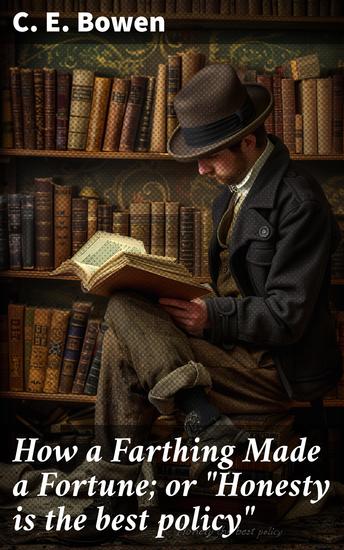
How a Farthing Made a Fortune; or "Honesty is the best policy" - A Tale of Integrity and Prosperity in Victorian England - cover

How a Farthing Made a Fortune; or "Honesty is the best policy" - A Tale of Integrity and Prosperity in Victorian England

C. E. Bowen

Verlag: Good Press

  • 0
  • 0
  • 0

Beschreibung

In "How a Farthing Made a Fortune; or 'Honesty is the Best Policy,'" C. E. Bowen crafts a captivating narrative that intertwines themes of morality, economic wisdom, and social responsibility. Set against the backdrop of the late 19th century, Bowen employs a vivid and engaging literary style characterized by rich characterization and ironic humor. The story explores the journey of its protagonist as he navigates the challenges of integrity in a rapidly industrializing society, reflecting contemporary concerns of both the Victorian era and its critiques of capitalism, ultimately reinforcing the timeless adage that honesty is indeed the best policy. C. E. Bowen was an astute observer of society, likely influenced by the economic transformations that marked his time. His works often reveal a deep-seated awareness of the moral dilemmas faced by individuals in an increasingly materialistic world. Bowen'Äôs own experiences, possibly drawn from his interactions with various social classes and his understanding of the consequences of ethical considerations, significantly shaped his narrative approach, enabling him to encapsulate the struggles of ordinary people with relatable depth. This book is an essential read for anyone interested in moral philosophy, economic ethics, or the societal shifts of the Victorian era. Bowen'Äôs masterful storytelling is both entertaining and thought-provoking, inviting readers to reflect on the importance of virtue in achieving lasting success. Delve into this work to uncover insights that resonate in today's world, making it a timeless classic.
Verfügbar seit: 01.11.2023.
Drucklänge: 58 Seiten.

Weitere Bücher, die Sie mögen werden

  • African American history - Narrative of the Life of Frederick Douglass Incidents In The Life Of A Slave Girl by Harriet Jacobs Up From Slavery by Booker T Washington - cover

    African American history -...

    Frederick Douglass, Harriet Ann...

    • 0
    • 0
    • 0
    African American history is the part of American history that looks at the history of African Americans or Black Americans.
    Of the 10.7 million Africans who were brought to the Americas until the 1860s, 450 thousand were shipped to what is now the United States.
    Most African Americans are descended from Africans who were brought directly from Africa to America and became slaves. The future slaves were originally captured in African wars or raids and transported in the Atlantic slave trade.
    Our collection includes the following of works: 
    Narrative Of The Life by Frederick Douglass. The impassioned abolitionist and eloquent orator provides graphic descriptions of his childhood and horrifying experiences as a slave as well as a harrowing record of his dramatic escape to the North and eventual freedom. 
    Incidents In The Life Of A Slave Girl by Harriet Jacobs. Powerful by portrayal of the brutality of slave life through the inspiring tale of one woman's dauntless spirit and faith. 
    Up From Slavery by Booker T. Washington. Washington rose to become the most influential spokesman for African Americans of his day. He describes events in a remarkable life that began in slavery and culminated in worldwide recognition.
    Zum Buch
  • A Horse Brought Us Here - A Novel - cover

    A Horse Brought Us Here - A Novel

    Dershie McDevitt

    • 0
    • 0
    • 0
    Perfect for fans of Margot Livesey and William Maxwell’s So Long, See You Tomorrow 
    Excitement grows all day Friday in the quiet Wyoming cattle town of Juniper. As cheerleaders and football players ready themselves for the biggest game of 1959, the Homecoming Parade winds its way down Main Street. Everyone claps with delight when they spot Homecoming Queen BJ Bonniface in her pink strapless formal sitting high on the back of a big Buick convertible. She’s the popular girlfriend of star quarterback Rob Hitchcock and the daughter of a wealthy and influential local rancher. The longtime sweethearts continue to be the talk of the town as the home team wins the big game on Saturday. But by Monday morning, Juniper is shaken to its core when everyone learns their beloved Homecoming Queen is dead. 
    “Act as if nothing has changed,” the high school’s Dean of Women advises the devastated student body. Some doubt BJ died from a bee sting, as reported. Things don’t add up. Rob and BJ’s best friend Nella Fortune have private and deeply personal reasons to question the official story, but the community’s silence is deafening. Both will sleepwalk their way through the rest of senior year, consumed by what they know and cannot tell. How long can such a crushing secret be kept? 
    Though A Horse Brought Us Here, is a work of fiction—and the characters, places, and events depicted are products of the author’s imagination—the core event in this novel is based on a real-life occurrence. Author Dershie McDevitt invites readers to travel back in time to a seemingly idyllic American small town where life looks simple at the surface but is often much more disturbing behind closed doors. Masterfully evoking a nostalgic tapestry of a bygone era, McDevitt reminds us that though some of life’s mysteries are kept buried, they should never be forgotten.
    Zum Buch
  • The Great Western Railway Girls 4 - cover

    The Great Western Railway Girls 4

    Jane Lark

    • 0
    • 0
    • 0
    Not Yet Available
    Zum Buch
  • Top 10 Short Stories The - The 19th Century - The Men - The top ten Short Stories of the 19th century written by male authors - cover

    Top 10 Short Stories The - The...

    Charles Dickens, Herman...

    • 0
    • 0
    • 0
    Short stories have always been a sort of instant access into an author’s brain, their soul and heart.  A few pages can lift our lives into locations, people and experiences with a sweep of landscape, narration, feelings and emotions that is difficult to achieve elsewhere. 
     
    In this series we try to offer up tried and trusted ‘Top Tens’ across many different themes and authors. But any anthology will immediately throw up the questions – Why that story? Why that author?  
     
    The theme itself will form the boundaries for our stories which range from well-known classics, newly told, to stories that modern times have overlooked but perfectly exemplify the theme.  Throughout the volume our authors whether of instant recognition or new to you are all leviathans of literature. 
     
    Some you may disagree with but they will get you thinking; about our choices and about those you would have made.  If this volume takes you on a path to discover more of these miniature masterpieces then we have all gained something. 
     
    Kipling in these more modern times is increasingly seen as an apologist for the bad ways of evil empires.  It’s a simplistic analysis and avoids much of his literary talent that is entertaining, scary and down right brilliant story telling whatever the background it is based on or comes from.   
     
    01 - The Top Ten - The 19th Century - The Men - An Introduction 
    02 - The Signalman by Charles Dickens 
    03 - Bartleby the Scrivener - Part 1 by Herman Melville 
    04 - Bartleby the Scrivener - Part 2 by Herman Melville 
    05 - The Cloak by Nikolai Gogol also known as 'The Overcoat' 
    06 - The Necklace by Guy de Maupassant 
    07 - About Love by Anton Chekhov 
    08 - The Tell Tale Heart by Edgar Allan Poe 
    09 - The District Doctor by Ivan Turgenev 
    10 - Young Goodman Brown by Nathaniel Hawthorne 
    11 - A Passion in the Desert by Honoré de Balzac 
    12 -Lost Hearts by M R James
    Zum Buch
  • Austerlitz or Death - cover

    Austerlitz or Death

    Auguste Vallois

    • 0
    • 0
    • 0
    "Austerlitz or Death" is an epic historical novel by Auguste Vallois, a captain of the Imperial Guard who recounts his memories from the battlefields of Europe to the solitude of inner exile. 
    From his revolutionary youth in Lyon to the Egyptian campaign, the victories in Italy, the glory at Austerlitz, the frozen hell of Russia, and the final tragedy at Waterloo, Auguste tells the story of the Napoleonic Empire in first person and with painful clarity—not from the pages of history books, but from the blood, mud, and soul of those who built it… and watched it fall. 
    Through these pages, the reader will march alongside a man who lost everything but his honor. You will witness how a soldier is forged, how faith fades, how a sword is held even on broken knees. Each chapter is filled with emotion, introspection, fire, and silence. Every victory bears the taste of sacrifice, and every defeat, the dignity of those who never surrendered. 
    Vallois's prose is both elegant and raw, intimate and epic, heir to the great traditions of war and memory literature such as All Quiet on the Western Front or The Disasters of War. This is not the official history of Napoleon, nor the tale of grand strategists. It is the story of the anonymous men who believed in something greater than themselves… and paid the price. 
    A novel that masterfully blends epic military drama, psychological depth, and historical tragedy. Ideal for readers of war literature, historical fiction, soldier memoirs, or explorations of the human condition in times of crisis. 
    "I served the Emperor. And I do not regret it." 
    — Auguste Vallois
    Zum Buch
  • Wilkie Collins - A Short Story Collection - Array of tales from the famed author of The Moonstone and The Woman In White - cover

    Wilkie Collins - A Short Story...

    Wilkie Collins

    • 0
    • 0
    • 0
    Wilkie Collins was born on 8th January 1824 in Marylebone, London.  
     
    The family moved several times in his early years before, at 12, they travelled to France and Italy for 2 years where the sights and atmosphere made a deep and lasting impression on him. 
     
    He resumed his education at Mr Cole’s private boarding school in Highbury, Islington.  Here, he began his literary career under unusual circumstances: the school bully would give him no peace until he had been told a bedtime story.  This ‘little brute’ helped create one of England’s greatest writers.  
     
    On leaving school, in 1841, he became a clerk at a tea merchant before, 2 years later, publishing his first short story.  However, his first novel was rejected and remained so during his lifetime.  
     
    A brief stint at Lincoln’s Inn to please his father and to acquire a steady income was halted by his father’s death.  Collins then wrote and published his fathers’ memoirs.  He then completed his legal education though he would never practice.  
     
    In March 1851, he was introduced to Charles Dickens and there now started a period of sustained literary output and a remarkable lifelong friendship.  His stories were published in Dicken’s magazines, and he toured with Dicken’s theatrical before the two of them travelled to the Continent. 
     
    By the early 1860’s worrying signs of ill-health appeared with rheumatic gout.  As it worsened, he sought respite and cures in German spa towns and gave up writing to help his recuperation. 
     
    His personal life had become very complicated.  He was living with the widowed Caroline Graves and conducting an affair with a much younger Martha Rudd.  With the serialised release of ‘The Moonstone’ and vicious attacks of gout Caroline left him and married another.  Collins was now prescribed opium and was soon its lifelong dependent.  Martha bore him two children and with the return of a now divorced Caroline Graves he now divided his time between the two women. 
     
    In 1874 he set aside writing to tour North America on a reading tour. 
     
    Throughout his later years he continued to write and publish.  In all 30 novels, 14 plays, 60 short stories and over a 100 non-fiction essays as well as many more collaborations with Dickens. 
     
    In 1884 the Society of Authors elected him as it’s Vice-President. 
     
    Wilkie Collins died from a paralytic stroke on September 23rd, 1889, in London. He was 65.
    Zum Buch