Join us on a literary world trip!
Add this book to bookshelf
Grey
Write a new comment Default profile 50px
Grey
Subscribe to read the full book or read the first pages for free!
All characters reduced
Minds of the Scientific Universe - Exploring the Giants of Knowledge - cover

Minds of the Scientific Universe - Exploring the Giants of Knowledge

Asif Ahmed Srabon

Publisher: BookRix

  • 0
  • 0
  • 0

Summary

"Minds of the Scientific Universe: Exploring the Giants of Knowledge" is a captivating exploration of the brilliant minds that have shaped our understanding of the world. Author Asif Ahmed Srabon takes readers on a journey through the lives and achievements of renowned scientists such as Galileo Galilei, Albert Einstein, Marie Curie, and Isaac Newton. This book goes beyond biographies to delve into the personal lives and influences that shaped these scientific geniuses. Whether you're a science enthusiast or simply curious about the minds behind groundbreaking discoveries, "Minds of the Scientific Universe" offers a comprehensive and engaging exploration of the giants of knowledge.
Available since: 09/13/2023.
Print length: 43 pages.
Other books that might interest you

  • Pseudoscience - A Very Short Introduction - cover

    Pseudoscience - A Very Short...

    Michael D. Gordin

    • 0
    • 0
    • 0
    Everyone has heard of the term "pseudoscience," typically used to describe something that looks like science, but is somehow false, misleading, or unproven. Given the virulence of contemporary disputes over the denial of climate change and anti-vaccination movements—both of which display allegations of "pseudoscience" on all sides—there is a clear need to better understand issues of scientific demarcation. 


    Pseudoscience: A Very Short Introduction explores the philosophical and historical attempts to address this problem of demarcation. This book argues that by understanding doctrines that are often seen as antithetical to science, we can learn a great deal about how science operated in the past and does today. This exploration raises several questions: How is the status of science shaped by political or cultural contexts? How does pseudoscience differ from scientific fraud? 


    Michael D. Gordin both answers these questions and guides listeners along a bewildering array of marginalized doctrines, looking at parapsychology (ESP), Lysenkoism, scientific racism, and alchemy, among others, to better understand the struggle to define what science is and is not. Pseudoscience: A Very Short Introduction provides a historical tour through many of these fringe fields in order to provide tools to think deeply about scientific controversies.
    Show book
  • Healing Sleep Sounds 2-in-1 - Binaural Beats & Healing Frequencies for Deep Sleep and Relaxation - cover

    Healing Sleep Sounds 2-in-1 -...

    Sleeptime Publications

    • 0
    • 0
    • 0
    The Ultimate Sleep Experience—Binaural Beats & Healing Frequencies in One Audiobook. 
    Struggling to fall asleep? Does stress or anxiety keep your mind racing? This 2-in-1 audiobook combines binaural beats and healing frequencies to help you relax, unwind, and drift into deep, restorative sleep—naturally.Two Proven Sound Therapies—One Powerful Solution.Binaural Beats – Uses two slightly different frequencies to sync your brainwaves into a deep state of relaxation. Studies in Frontiers in Human Neuroscience show they improve sleep quality and reduce anxiety.Healing Frequencies (432 Hz & 528 Hz) – Known for their calming and restorative effects, these frequencies help reduce stress, balance emotions, and promote healing. Research in Explore: The Journal of Science and Healing found 432 Hz lowers stress, while 528 Hz enhances relaxation and recovery.Simply Press Play and Let the Healing Begin. 
    With this audiobook, you’ll experience:✅ Binaural beats and healing frequencies for deep relaxation and sleep✅ Scientifically backed sound therapy to reduce stress and improve well-being✅ A natural, drug-free way to enhance sleep quality and mental clarity✅ An immersive sound experience to help you wake up refreshedThe Ultimate Soundtrack for Restorative Sleep. 
    Why choose one when you can have both? Press play now and let binaural beats and healing frequencies guide you into peaceful, rejuvenating sleep.
    Show book
  • Dividing Lines - How Transportation Infrastructure Reinforces Racial Inequality - cover

    Dividing Lines - How...

    Deborah N. Archer

    • 0
    • 0
    • 0
    Our nation's transportation system is crumbling. But as acclaimed scholar and ACLU president Deborah Archer warns in Dividing Lines, before we can think about rebuilding and repairing, we must consider the role race has played in transportation infrastructure, from the early twentieth century and into the present day. 


    As Archer demonstrates, the success of the Civil Rights movement and the fall of Jim Crow in the 1960s did not mean the end of segregation. With state-sanctioned racism no longer legal, officials across the country turned to transportation infrastructure to keep Americans divided. A wealthy white neighborhood could no longer be "protected" by racial covenants and segregated shops, but a multilane road, with no pedestrian crossings, could be built along its border to make it difficult for people from a lower-income community to visit. Highways could not be routed through Black neighborhoods based on the race of their residents, but those neighborhoods' lower property values—a legacy of racial exclusion—could justify their destruction. 


    Drawing on a wealth of sources, including interviews with people who now live in the shadow of highways and other major infrastructure projects, Archer presents a sweeping, national account—from Atlanta and Houston to Indianapolis and New York City—of our persistent divisions.
    Show book
  • Cosmic Bullsh*t - A Guide to the Galaxy's Worst Life Hacks - cover

    Cosmic Bullsh*t - A Guide to the...

    Chris Ferrie

    • 0
    • 0
    • 0
    A hilarious guide to what's real (and what's not) in our vast, beautiful (and terrifying) universe 


    Embark on a journey through Cosmic Bullsh*t: A Guide to the Galaxy's Worst Life Hacks and uncover the real science behind some of the greatest lies society loves to tell! Apologies to everyone who makes major life decisions based on their newspaper horoscope, but astrology isn't real and stars and planets don't give a sh*t about us. Planning a vacation to Roswell to finally discover the truth about aliens that the government has been hiding? Bad news—aliens were never here, and they aren't coming, either. Put on your myth-busting goggles and dig into Cosmic Bullsh*t for a nice, healthy dose of fascinating facts to cure the misinformation sickness so many of us are suffering from. Quantum physicist and bestselling science author Chris Ferrie explains: 


    ● Why creation myths are bullsh*t and why humans have loved them for millennia anyway 


    ● The misconceptions surrounding extraterrestrial life and why little green men aren't knocking on our door 


    ● The paradoxes and pitfalls of time travel 


    ● How to brace yourself for the ultimate cosmic finale as we contemplate the fate of the universe 


    ● And much more!
    Show book
  • Navigating Tomorrow - A Journey into the World of Autonomous Vehicles - cover

    Navigating Tomorrow - A Journey...

    Chuck Sherman

    • 0
    • 0
    • 0
    In the not-so-distant future, the world of transportation is on the cusp of a radical transformation. "Navigating Tomorrow: A Journey into the World of Autonomous Vehicles" takes you on an exhilarating expedition through the groundbreaking realm of self-driving cars and beyond. 
    Imagine a world where vehicles pilot themselves with precision, navigating bustling city streets and open highways without a human hand on the wheel. This book unveils the captivating technology that propels us into this new era, providing a comprehensive exploration of the past, present, and potential future of autonomous vehicles. 
    From the earliest days of experimental robotics to the most recent advancements in artificial intelligence, this book traces the evolution of self-driving technology. Delve into the mechanics that power these incredible machines, uncovering the intricate dance of sensors, cameras, lidar, and algorithms that fuse together to create an autonomous intelligence capable of interpreting the world like never before. 
    "Navigating Tomorrow" unravels the mysteries of perception, as vehicles learn to see and understand the environment around them with astonishing clarity. It takes you behind the scenes of decision-making processes that blend real-time data analysis, rule-based programming, and ethical considerations, all while exploring the ongoing quest for absolute safety in an unpredictable world. 
    Beyond technology, this book ventures into uncharted territories of law and society. Discover the legal landscape that navigates the complexities of liability and regulation in an autonomous world. Explore the profound implications for urban planning, as self-driving cars reshape cities and communities, promising reduced congestion and a greener future.
    Show book
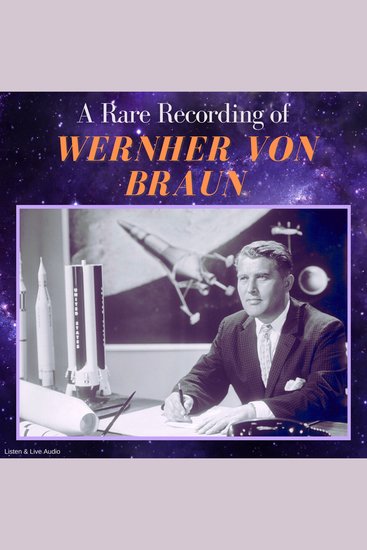
  • A Rare Recording of Wernher von Braun - cover

    A Rare Recording of Wernher von...

    Wernher Von Braun

    • 0
    • 0
    • 0
    Wernher von Braun ( March 23, 1912 – June 16, 1977) was a German aerospace engineer and space architect. He was the leading figure in the development of rocket technology in Nazi Germany and a pioneer of space technology and science in the United States. 
    After World War II, von Braun was secretly moved to the US, along with roughly 1,600 other German scientists, engineers, and technicians, as part of Operation Paperclip. He worked for the United States Army on an intermediate-range ballistic missile (IRBM) program, and he developed the rockets that launched the United States' first space satellite Explorer 1. 
    He served as director of the Marshall Space Flight Center and as the chief architect of the Saturn V super heavy-lift launch vehicle that propelled the Apollo spacecraft to the Moon. In 1955, von Braun became a naturalized citizen of the United States. In 1975, von Braun received the National Medal of Science. This recording is from Dr. Von Braun's speech at the 1st Annual SOLE Symposium, September 13, 1966, in Huntsville Alabama.
    Show book