
Join us on a literary world trip!
Add this book to bookshelf
Grey
Write a new comment Default profile 50px
Grey
Subscribe to read the full book or read the first pages for free!
All characters reduced
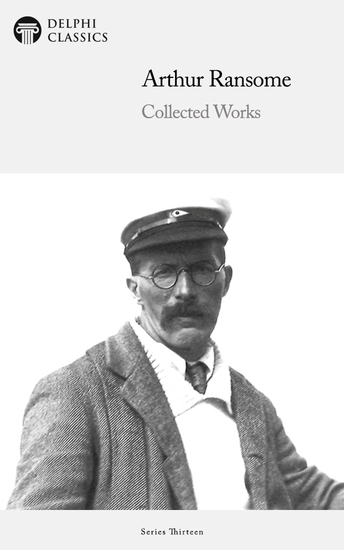
Delphi Collected Works of Arthur Ransome Illustrated - cover

Delphi Collected Works of Arthur Ransome Illustrated

Arthur Ransome

Publisher: Delphi Publishing Ltd

  • 0
  • 0
  • 0

Summary

The beloved children’s author Arthur Ransome is noted for popularising the pattern for “holiday adventure” stories. A writer of various genres, his first success, ‘Bohemia in London’, is a partly autobiographical account of his early days. He also published a noted general ‘History of Story-Telling’, as well as landmark critical works on Edgar Allan Poe and Oscar Wilde. During the Great War, Ransome worked as a war correspondent in Russia, where he studied native folktales, which he retold for children. He also wrote extensively about his passion of angling, producing the seminal work in its field, ‘Rod and Line’. This eBook presents Ransome’s collected works, with numerous illustrations, rare texts, informative introductions and the usual Delphi bonus material. (Version 1)
 
* Beautifully illustrated with images relating to Ransome’s life and works* Concise introductions to the major works* Rare children’s books, with the original artwork* Many rare texts appearing for the first time in digital publishing * Images of how the books were first published, giving your eReader a taste of the original texts* Excellent formatting of the texts* Rare short stories available in no other collection* Includes Ransome’s rare non-fiction works* Features the celebrated autobiography – discover Ransome’s intriguing life* Ordering of texts into chronological order and genres
 
CONTENTS:
 
Other Children’s BooksThe Child’s Book of the Seasons (1906)Pond and Stream (1906)The Things in our Garden (1906)The Hoofmarks of the Faun (1911)Old Peter’s Russian Tales (1916)Aladdin and his Wonderful Lamp in Rhyme (1920)The Soldier and Death (1922)
 
The Horror NovelThe Elixir of Life (1915)
 
The Short StoriesMiscellaneous Stories
 
The Non-FictionThe Souls of the Streets and Other Little Papers (1904)Bohemia in London (1907)A History of Story-telling (1909)Edgar Allan Poe (1910)Oscar Wilde (1912)Portraits and Speculations (1913)Six Weeks in Russia (1919)The Crisis in Russia (1921)Racundra’s First Cruise (1923)Rod and Line (1929)Racundra’s Third Cruise (1972)
 
The AutobiographyThe Autobiography of Arthur Ransome (1976)
Available since: 06/15/2023.
Print length: 1020 pages.


Other books that might interest you

  • Edward Page Mitchell - A Short Story Collection - A pioneer of the Sci Fi genre the first man to write about invisibility time travel and teleportation - cover

    Edward Page Mitchell - A Short...

    Edward Page Mitchell

    • 0
    • 0
    • 0
    Edward Page Mitchell – An Introduction 
     
    Edward Page Mitchell was born in Bath, Maine on 24th March 1852 into a wealthy family.  When he was eight the family moved to a house on New York’s Fifth Avenue. 
     
    In 1863 he witnessed the Draft Riots and in the aftermath Mitchell's father moved the family to Tar River, North Carolina. It was there, at the age of fourteen, that his letters were first published in the local newspaper The Bath Times. 
     
    In 1872, at age twenty, whilst on a train journey to Bath, Maine, a hot cinder from the engine's smokestack flew in through the window blinding his left eye.  After several weeks, while doctors attempted to restore his sight his uninjured right eye underwent sympathetic blindness.  He was now completely blind. His burnt left eye eventually regained its sight, but his uninjured right eye remained blind and was later removed surgically and replaced with a prosthetic glass eye. While recovering from this surgery, Mitchell wrote his famed story ‘The Tachypomp’. 
     
    He became a journalist for the Daily Advertiser in Boston, where his mentor was Edward Everett Hale, now also recognized as an early pioneer of science fiction. 
     
    Mitchell’s influence on science fiction writing is incredible, pre-dating many major themes. He wrote about a man made invisible (‘The Crystal Man’, 1881), a time-travel machine (‘The Clock that Went Backward’), about faster-than-light travel (‘The Tachypomp’, 1874), a thinking computer and a cyborg (‘The Ablest Man in the World’, 1879), matter transmission or teleportation (‘The Man without a Body’, 1877), superior mutants (‘Old Squids and Little Speller’) and mind transfer (‘Exchanging Their Souls’, 1877). Add to this other stories which predicted travel by pneumatic tube, electrical heating, newspapers printed at home, food-pellet concentrates, international broadcasts, and suspended animation through cryogenics amount to talents that are not as publicly lauded as they should be. 
     
    He had a lifelong interest in the supernatural and paranormal—several early newspaper pieces are factual investigations of alleged hauntings and usually he determined they had rational explanations. 
     
    In 1874, Mitchell married Annie Sewall Welch and they had four children.  
     
    In 1903, Mitchell became editor-in-chief of the New York Sun, then the Nation’s leading newspaper. 
     
    In 1912, following Annie’s death, he married Ada M. Burroughs and produced a fifth son. Mitchell remained a popular and respected figure in American journalism and writing up to his death. 
     
    Edward Page Mitchell died of a cerebral hemorrhage in New London, Connecticut on 22nd January 1927.  He was 76. 
     
    1 - Edward Page Mitchell - A Short Story Collection - An Introduction 
    2 - The Clock That Went Backward by Edward Page Mitchell 
    3 - The Tachypomp by Edward Page Mitchell 
    4 - The Man Without a Body by Edward Page Mitchell 
    5 - The Devilish Rat by Edward Page Mitchell 
    6 - The Crystal Man by Edward Page Mitchell
    Show book
  • Silas Marner - cover

    Silas Marner

    George Eliot

    • 0
    • 0
    • 0
    In the town of Reveloe, there lives a man called Silas Marner. A strange little man, a weaver by trade, and seen with suspicion by the other villagers. He's been beset by bad luck all his life. Cast out of his simple religious life in Lantern Yard, and then returns home to find his money stolen. But then, on new years day, his luck changes when he finds a small child sitting before his hearth...  
    Published in 1861, this was the third novel by George Elliot, and delves into the topics of religion, industrialisation and community, and was praised at the time for its realism.  
    Narrated by Michael Ward.
    Show book
  • Filmer (Unabridged) - cover

    Filmer (Unabridged)

    H. G. Wells

    • 0
    • 0
    • 0
    Herbert George Wells (21 September 1866 - 13 August 1946) was an English writer. Prolific in many genres, he wrote dozens of novels, short stories, and works of social commentary, history, satire, biography and autobiography. His work also included two books on recreational war games. Wells is now best remembered for his science fiction novels and is often called the "father of science fiction", along with Jules Verne and the publisher Hugo Gernsback.
    FILMER: In truth the mastery of flying was the work of thousands of men-this man a suggestion and that an experiment, until at last only one vigorous intellectual effort was needed to finish the work.
    Show book
  • Four Winds (Unabridged) - cover

    Four Winds (Unabridged)

    L. M. Montgomery

    • 0
    • 0
    • 0
    Lucy Maud Montgomery (November 30, 1874 - April 24, 1942), published as L. M. Montgomery, was a Canadian author best known for a series of novels beginning in 1908 with Anne of Green Gables. The book was an immediate success. The title character, orphan Anne Shirley, made Montgomery famous in her lifetime and gave her an international following.
    Four Winds: Alan Douglas threw down his pen with an impatient exclamation. It was high time his next Sunday's sermon was written, but he could not concentrate his thoughts on his chosen text. For one thing he did not like it and had selected it only because Elder Trewin, in his call of the evening before, had hinted that it was time for a good stiff doctrinal discourse, such as his predecessor in Rexton, the Rev. Jabez Strong, had delighted in.
    Show book
  • The Aspern Papers - cover

    The Aspern Papers

    Henry James

    • 0
    • 0
    • 0
    "The Aspern Papers" by Henry James is a gripping novella centered around the literary intrigue of an ambitious American editor, who seeks to obtain the private papers of the esteemed poet Jeffrey Aspern. Traveling to Venice, the editor meets Aspern's elderly former lover, Juliana Bordereau, and her niece, Miss Tina. Obsessed with acquiring the papers, the editor navigates a web of secrecy and manipulation, as Juliana guards the precious documents jealously. He develops a peculiar relationship with Miss Tina, using her affection to gain access to the coveted papers.
    Show book
  • Polaris - cover

    Polaris

    H. P. Lovecraft

    • 0
    • 0
    • 0
    Title: Polaris 
    Author: H. P. Lovecraft 
    Narrator: Jonathan Dunne 
    Original Publication: 1920 
    Public Domain: Yes 
    Series Placement: Number 43 in the Timeless Terrors series 
    Description: 
    Polaris by H. P. Lovecraft is a dreamlike descent into obsession, identity, and cosmic futility. Set beneath the eerie shimmer of the North Star, it unfolds as both a tale of ancient war and a fevered vision of a soul caught between two worlds — the waking and the eternal. 
    The narrator, haunted by dreams of a lost city beneath the Arctic light, becomes convinced he is the reincarnation of a watchman doomed to fail in his sacred duty. As memory, madness, and destiny blur, Polaris becomes a meditation on guilt and the insignificance of man beneath the indifferent stars. 
    Narrated by Amazon bestselling horror author Jonathan Dunne, this performance captures Lovecraft’s hypnotic rhythm and the slow unravelling of sanity that defines his early cosmic vision — the sense that truth may be glimpsed only in dreams, and that awakening brings no escape. While the text is in the public domain, this narration is an original performance and copyright © 2025 Jonathan Dunne. 
    Part of Timeless Terrors, a series devoted to resurrecting the masters of the macabre and uncanny, Polaris endures as an early glimpse of Lovecraft’s cosmic dread — a haunting reminder that even the stars above may whisper our doom.
    Show book