Join us on a literary world trip!
Add this book to bookshelf
Grey
Write a new comment Default profile 50px
Grey
Subscribe to read the full book or read the first pages for free!
All characters reduced
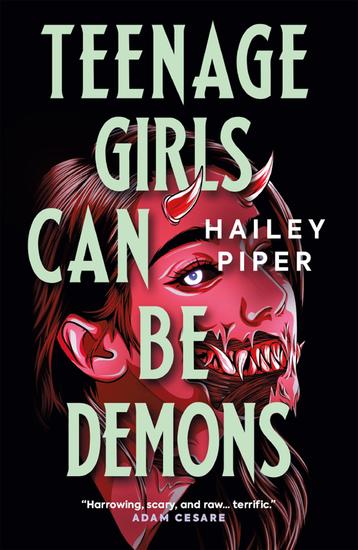
Teenage Girls Can Be Demons - cover

Sorry, the publisher does not allow users to read this book from the country from which you are connecting.

Teenage Girls Can Be Demons

Hailey Piper

Publisher: Titan Books

  • 1
  • 2
  • 1

Summary

13 terrifying coming-of-rage stories from the Bram Stoker Award-winning author of Queen of Teeth, perfect for fans of Clive Barker, Mariana Enriquez and Eric LaRocca
13 coming-of-rage stories the way only Bram Stoker Award-winning author Hailey Piper can tell them—wildly inventive, brilliantly imaginative, and completely and utterly enthralling.
A vicious group of college upperclassmen prey on the freshman girls in "Why We Keep Exploding;" an impossible world of sinister desire opens beneath a family basement in "A Living Piece of Time;" a girl on a night out realizes a bizarre cop is hunting her in "The Long Flesh of the Law;" and in the acclaimed novella "Benny Rose, the Cannibal King," a Halloween prank goes horribly wrong when a murderous ghost steps out of an urban legend and into the real world.
These stories take our most difficult years of transformation and twist them into new and terrifying shapes, where the monsters are real and you'll do whatever it takes to get away, or get even.
Available since: 09/16/2025.
Print length: 400 pages.

Other books that might interest you

  • Witch Wood - cover

    Witch Wood

    John Buchan

    • 0
    • 0
    • 0
    …for Witch Wood specially I am always grateful; all that devilment sprouting up out of a beginning like Galt's Annals of the Parish. That's the way to do it. — C. S. Lewis Published in 1927, Scottish writer John Buchan's Witch Wood is set in a rural parish located in the Scottish Borders during the Wars of the Three Kingdoms. The story centers around newly-ordained minister David Sempill's arrival in Woodilee in the wake of the Church of Scotland's acceptance of the Solemn League and Covenant and explores themes and issues surrounding religious tolerance and seventeenth-century Calvinism. With pagan rituals, an outbreak of the plague, and rumors about fairies and the devil, Witch Wood also delves into the supernatural and occult. Written while doing research for his biography of Scottish nobleman James Graham, the 1st Marquess of Montrose, Witch Wood is considered Buchan's masterpiece by scholars and critics. Read by Scottish narrator Angus King, this audio edition maintains sections of dialogue originally written and published in Scots.
    Show book
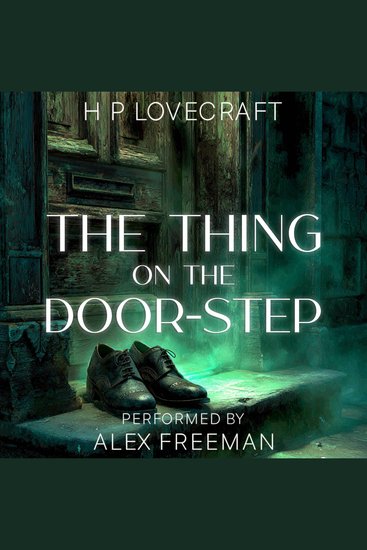
  • The Thing on the Door-Step - cover

    The Thing on the Door-Step

    H. P. Lovecraft

    • 0
    • 0
    • 0
    In Arkham, a promising marriage curdles into a body-stealing nightmare. H. P. Lovecraft’s “The Thing on the Door-Step” fuses occult ritual, identity horror, and cosmic dread into a relentless descent toward doom. When shy prodigy Edward Derby weds the enigmatic Asenath Waite, whispers of Innsmouth blood and forbidden rites swell into a chilling struggle for the self—where the mind may be only a husk to be worn. Perfect for readers of weird fiction and dark fantasy, this tale probes possession, madness, and the price of power, culminating in a finale that lingers like a curse.
    Show book
  • Existential Stories - Tales of characters questioning their existence and place in the world - cover

    Existential Stories - Tales of...

    Franz Kafka

    • 0
    • 0
    • 0
    Everything we know must end.  In the fundamentals of our lives its usually our own deaths which bring that to an end.  But what if we widen that premise.  What if we are caught in its quixotic jaws. Held fast with escape merely a fleeting thought. 
    In this volume authors of real note bring their narratives of existential crisis and threat directly to our senses.  That conflict can yield terrible results. 
    And for that place the blame on Franz Kafka, Boleslaw Prus, Herman Melville, Oscar Wilde and many others. 
     
    1 - Existential Stories - An Introduction 
    2 - The Dream of a Ridiculous Man by Fyodor Dostoyevsky 
    3 - Bartleby the Scrivener - Part 1 by Herman Melville 
    4 - Bartleby the Scrivener - Part 2 by Herman Melville 
    5 - A Legend of Old Egypt by Boleslaw Prus 
    6 - An Egyptian Cigarette by Kate Chopin 
    7 - A Hunger Artist by Franz Kafka 
    8 - Mold of the Earth by Boleslaw Prus 
    9 - Solid Objects by Virginia Woolf 
    10 - An Honest Thief by Fyodor Dostoyveskey 
    11 - The Bet by Anton Chekhov 
    12 - Shades by Boleslaw Prus 
    13 - An Occurrence At Owl Creek Bridge by Ambrose Bierce 
    14 - In the Penal Colony by Franz Kafka 
    15 - The Happy Prince by Oscar Wilde 
    16 - Youth - Part 1 by Joseph Conrad 
    17 - Youth - Part 2 by Joseph Conrad
    Show book
  • The Apocalypse Rebellion - cover

    The Apocalypse Rebellion

    Nick Vossen

    • 0
    • 0
    • 0
    For fans of Simone St. James
    
    A devious doomsday cult is leading civilization to the brink of extinction.
    
    
    Now when they are needed most, Lilly and Quincy Swansong are worlds apart—both physically and mentally. However, they must set aside their personal struggles for one last time to deal with an ancient evil corrupting the hearts of mankind. Or they'll die trying.
    
    
    Luckily, the twins are not alone. Across the entire globe, those too strong for Haven's brainwashing and too fond of the Earth are stoking the flames of rebellion. Unlikely alliances are made, and help arrives from distant places: from beneath the sea, from inside the earth, from the afterlife, and from the spaces between worlds. 
    
    
    As Lilly, Quincy, and their friends dive into Europe's darkest corners in search of answers, four individuals rise to lead the Apocalypse Rebellion. But who are these mysterious four, and can they be trusted?
    
    
    Yet even greater mysteries are afoot. Why is the resurrected corpse of Witchfynder General Matthew Hopkins possessed? And what supernatural event did the late Emily and Tobias Swansong really experience years ago?
    
    
    Lilly and Quincy must piece the puzzle together before it's too late.
    Show book
  • Weird Tales: Best of the Early Years 1923-25 - Best of the Early Years 1923-25 - cover

    Weird Tales: Best of the Early...

    Harry Houdini

    • 0
    • 0
    • 0
    Thirteen tales of terror—from the macabre and morbid to unexplainable stories of the occult—from such authors as Harry Houdini, H. P. Lovecraft, and others.    First hitting newsstands in 1923, Weird Tales magazine quickly became a literary monster in discovering and publishing the best horror, sci-fi and fantasy writers of its day.   The pulp magazine was one of the earliest publications, if not the first, to feature strange tales of occultism and alien invasions that simply didn’t fit into any other magazine at that time.   The stories struck a chord with those early audiences, and as a result, Weird Tales created a subgenre as “weird” could be attached itself to various genres.   Marquee names like master magician Harry Houdini and cosmic horror creator H. P. Lovecraft graced the magazine’s pages during those early years with several debut stories, alongside authors who were already giants in their own right—Otis Adelbert Kline, Seabury Quinn, and Greye La Spina. Maybe lesser known, but no less influential, writers like Frank Belknap Long Jr., Mary S. Brown, Lyllian Huntley Harris, Hasan Vokine, Arthur J. Burks, and H. Warner Munn turned out disturbing yarns that have stood the test of time only to be resurrected nearly a century later.   This collection features those early authors across thirteen spooky stories from the impactful years of 1923 to 1925 that are best enjoyed at the witching hour.   Reading ritual aside, you’ve been warned.
    Show book
  • Horror at Red Hook The (The Work of H P Lovecraft Episode 38) - cover

    Horror at Red Hook The (The Work...

    H. P. Lovecraft

    • 0
    • 0
    • 0
    The story begins with Detective Malone describing an on-duty incident in Red Hook, Brooklyn, that gave him a phobia of large buildings. Back-tracking to where it all began, the Brooklyn waterfront slum Red Hook is described in detail, with its gangs and crime, and hinting at an occult underbelly. The "case of Robert Suydam" is then told to be the driving force behind Malone's federally ordered involvement at Red Hook. Suydam's demeanor changes suddenly. Known as a shabby recluse, he is seen around town looking younger and more radiant. News arrives of his engagement to a well-to-do woman, while, at the same time, there is an increase in local kidnappings. A police raid, involving Malone, uncovers nothing useful from Suydam's Red Hook flat save a few strange inscriptions. After Suydam's wedding, he and his bride leave on a ship. Aboard, a scream is heard and, when the crew enter Suydam's stateroom, they find him and his wife dead, with claw-marks on his wife's body. Later, some strange men from another ship come on board and lay claim to Suydam's body. Malone enters Suydam's flat to see what he can find. In the basement, he comes across a door that breaks open and sucks him inside, revealing a hellish landscape. He witnesses human sacrifices and a ritual that reanimates Suydam's corpse. Malone is found in the basement of Suydam's flat, which has caved in inexplicably above him, killing everyone else inside. The tunnels and chambers uncovered in the raids are filled in and cemented, though, as Malone recounts, the threat in Red Hook subtly re-emerges.
    Show book